
Arden Vul - Conclusions
It's Over!

We’re done! On July 25th, 2026, after playing 60+ sessions of Arden Vul, after three TPKs, the fourth iteration of the Dawn Pawns quelled the heqeti threat and saved Irthuin from Kauket’s manifestation on the material plane.
After defeating the heqeti’s gate guards and discovering their vulnerability to fire, the Dawn Pawns went on a shopping spree (Gosterwick → Newmarket → Narsileon) and spent ~120k gold on a dozen fireball scrolls, a wand of fire, several necklaces of fireballs, a handful of potions, and, amusingly, Pipes of the Sewers. The pipes let them command ~100 rats to hold the beads from the necklaces of fireballs, and they had the rats kamikaze into the huge cult statue next to the ziggurat. Once in place, a fireball ignited the rest of the beads and blew up for ~200d6. This, in combination with casting ~4 fireballs per round (from the wand and a dozen scrolls), and a giga-buffed and insanely-well-equipped fighter was enough to chew through the waves of heqeti defenders guarding the ziggurat.
The heqeti broke, the ziggurat was raided (and dismantled), and we wrapped up the campaign.
Now that it’s over, here are my thoughts on the module as a whole. I’ll number the thoughts so folks can more easily refer to them.
The Bad
1 | Info Design
I’ve harped on it a bunch, but the presentation of the information is hard to use.
Room keys are long, and constantly intermingle player-facing details, GM-facing details, and irrelevant historical notes.
Monster stat blocks reference abilities by name (like a Giant Wolverine will just say “Special attacks: musk” instead of defining what musk does).
Casters have huge lists of spells that look like this: “Cleric spells: bless, command, create water, cure light wounds, detect magic, protection from good; chant, hold person (x2), resist fire, silence 15’ radius, snake charm; animate dead, curse, dispel magic, feign death; cure serious wounds, protection from good 10’ radius, tongues; flame strike. Magic user spells: enlarge, magic missile (x2), shield; darkness 15’ radius, mirror image, ray of enfeeblement, web; dispel magic, fireball, haste; confusion, polymorph other; cloudkill, cone of cold.”
Higher level NPCs have a laundry list of high-impact magic items from both the 1e DMG and the appendix that need to all be read to understand how the NPC is able to fight and act. “Possessions: choker of the Great Tongue (see new magic items); a heqeti ring (see new magic items); staff of the serpent (adder); cleric scroll with dispel magic (x2); cleric scroll with gate spell; cleric scroll with symbol of pain”.
It’s an 1100+ page PDF without internal hyperlinks.
HP values are sorted for some god forsaken reason: “6 medium chasm cephalopods (see new monsters): SZ M; AL N; AC 5; MV 60’ flying (Class A); HD 4; HP 28, 27, 26, 25, 24, 24; #AT 5 (4 tentacles and a beak)”
Range notation is so, so, so awful. “4-8 giant fire beetles” - how is that supposed to be rolled? 4d2? It also interferes with automated attempts to hyperlink references to other rooms.
2 | Maps
The mapping situation is wild.
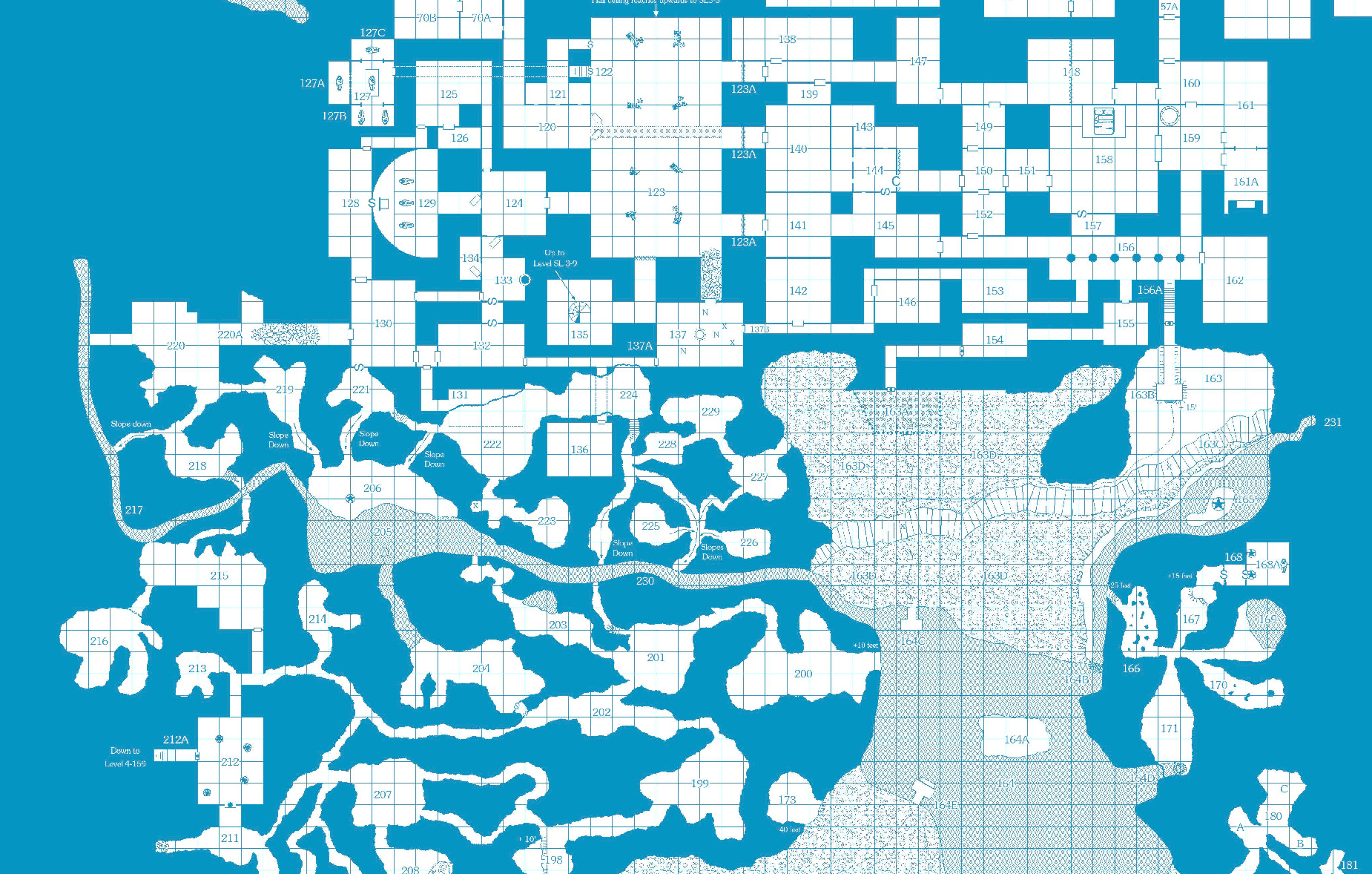
Volume 5 of the printed books is a book of maps, and thinking that was remotely a viable product is deranged.
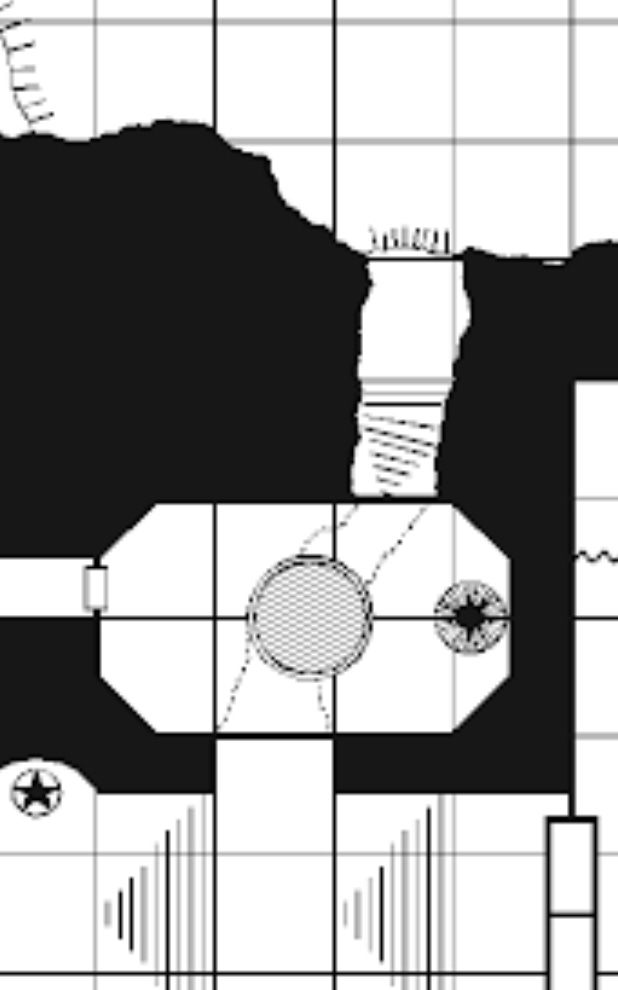
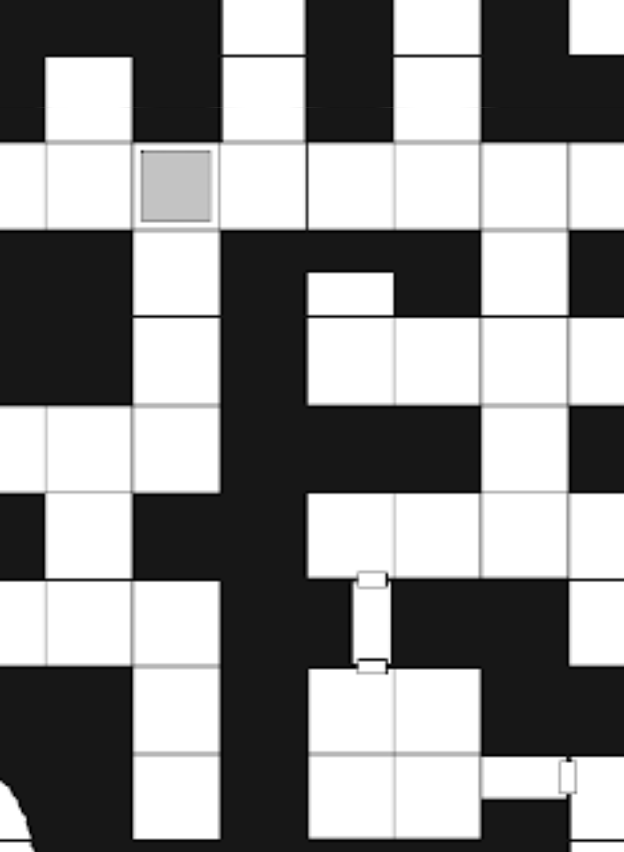
Trying to convey these maps as a GM to a player, even with a convention, is a nightmare. Lines + nodes style maps work better, but remove the ability for players to infer where the million secret doors are. We ended up using a vtt that I built with a monitor inset into my gaming table.
Unfortunately, the vtt files are also messy:
The grid squares aren’t perfectly square
The file dimensions aren’t a multiple of the grid size
The gm-side dimensions are different from the player dimensions
Level 3 gm-side is 4096x4968, player-side is 6557x8000.
Level 4 gm-side is 5360x9744, player-side is 4321x8000.
The gm-side aspect ratio is different from the player-side aspect ratio
Level 3 gm-side is 512:621, player-side is 512:624.68
Level 4 gm-side is 335:609, player-side is 335:620.23
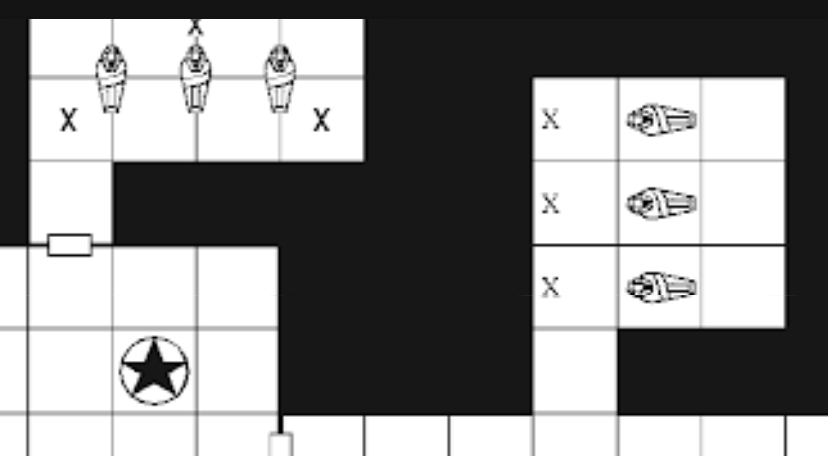
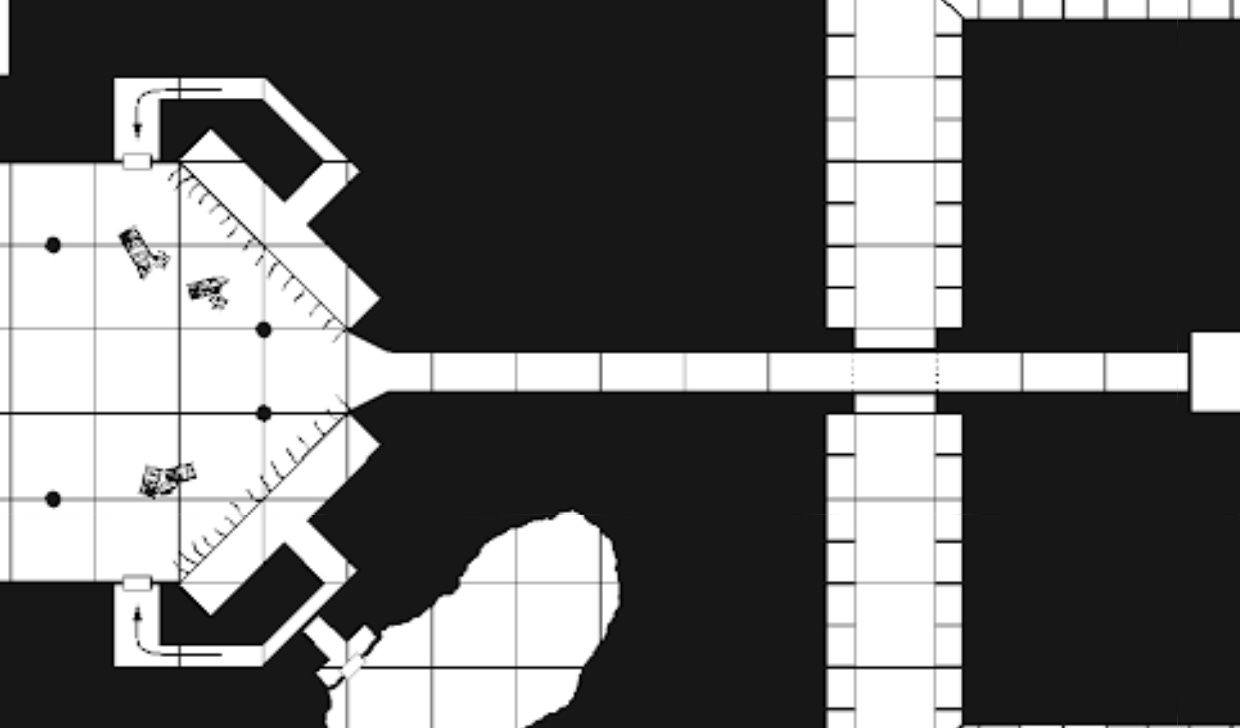
The player-side maps have secret GM-only info
3 | Treasure
The amount of lightly-defended treasure is nuts.
The main entry point to Arden Vul proper is through the pyramid down to 3-2. From there, there’s a locked door (or a one-way door), a 4 HD dust monster, and a manipulate-the-arms-puzzle down the hallway to 3-46. This area has three artifact-level magic items (cloak that gives +25% reactions, +2 AC, and invis 3/day; a +3 dagger that gives +1 DEX and applies slow on hit; a 500lb bag of holding that can also produce an infinite number of items that are worth <15g and weigh <15lbs, including living creatures like chickens).
1 room west of the entrance is a hidden tomb guarded only by 4 ghouls that have 2 rings of protection +1 that also let one wearer blind themselves to give the other wearer invisibility unlimited times per day.
Up the short stair and ~3 rooms to the northeast (past no defenders) is imperial field plate +2 (AC 20) in a game where the best armor available for purchase is banded (AC 16).
Each random-encounter patrol of 4 Set Guards and a Set Acolyte has a Set Was Stick (can cast hold person 2x per day; worth 10000g). Other fixed encounters (like in 3-111) have the same Was Stick. I can echo Sandra’s sentiment:
Arden Vul is a world where copper pieces preciously do matter because getting them is what so many interactions are designed around, and simultaneously tediously don’t matter because each was stick is like five hundred gems anyway. “You manage to solve six puzzles and spend three days(three days diegetically. That’d be maybe thirty, forty minutes of table time) slogging through a dozen encounters of the exact same 3d2 skeletons type and you manage to find a secrer [sic] compartment containing a… copper torque. Worth 1d10 × 10 fels. 0.00002% of a was stick. And you have thirty was sticks. So… 🥳🤔❓”
This was also one of the things my players brought up in our post-mortem:
thorns: What has been a pain point? Why do you think it was painful? Do you have any ideas for future mitigation?
Power scaling. That was horrendous for the DM side. So many game breaking powerful items just laying around. I mean you could outfit a starting party with powerful items just laying on the surface of this picked clean dungeon. +2 plate just two rooms deep from the side entrance to the sett area. So I want to give Beau his flowers for this one. He let us go wild with these magic items. But what was the author thinking on that one.
Moreover, lots of the custom treasure isn’t well-defined. There’s a beaker of plentiful potions at AV-40 that my players looted:
[…] a suit of cursed armor of arrow attraction (banded mail); a beaker of plentiful potions; an Alexia’s useful pole; […]
But when I go look up what that is…
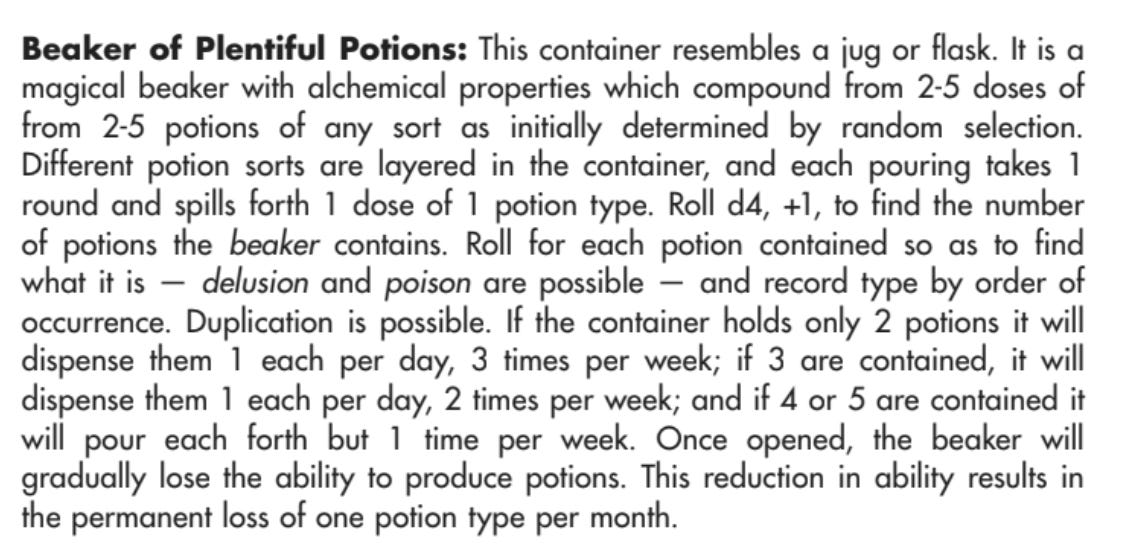
Okay so we need to roll 2-5 potions, and then for each potion roll 2-5 doses.
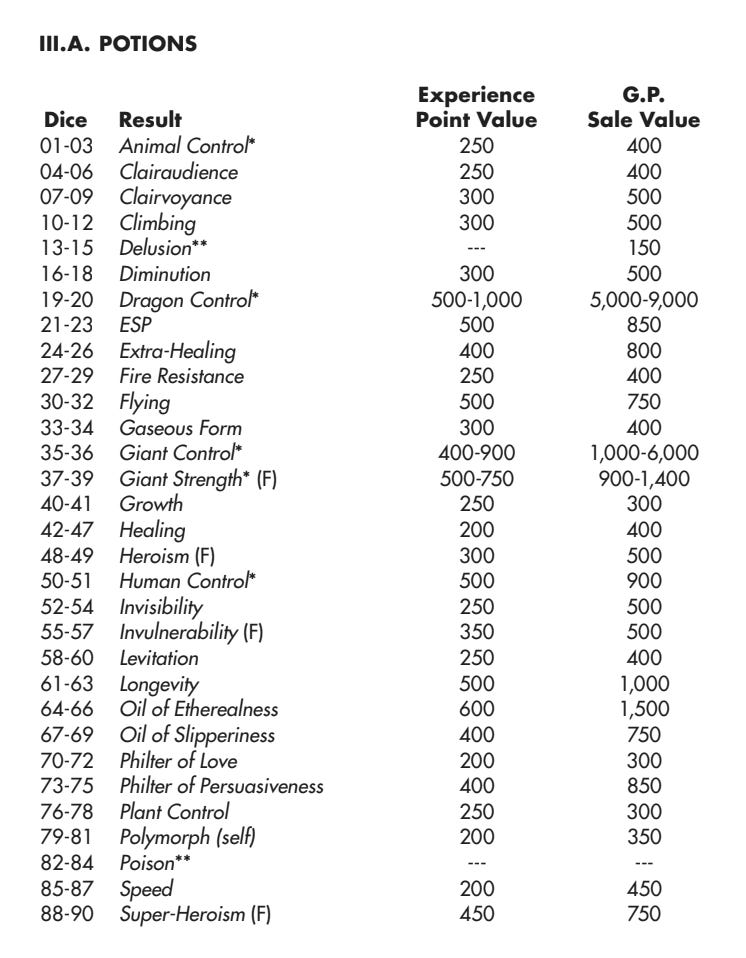
All of the potions marked with an asterisk (__ control) have additional rolls you need to make to figure out what sort of potion they are. Each potion has a unique XP value and gold-value, so we really do need to know this by the time they finish their delve. The treasure hoards are riddled with problems like this, where it felt clear that Barton just rolled on the tables in the DMG (or picked the ones that sounded cool).
Or, the aforementioned imperial field plate +2. Armor in 1e has a few properties: encumbrance, max speed, and AC at least. Imperial field plate is a new type of armor, but Barton only specifies the AC!
Or, the aforementioned ring that lets you become invisible:
The wearer of one ring of a pair can command, at any time, one of the following effects to be instantly imposed on the wearer of the other ring. Each effect inflicts some cost on the wearer who instigates the effect, and rings of different metals are known to carry a different array of effects. In most cases the duration of a cost is exactly the same as the duration of the beneficial effect (exception: Life). In most cases there is no limit to the number of uses per day (save for the instigator’s ability to bear the cost of each effect).
Rings of friendly defense each possess a unique command word, which must be determined using magic or intensive (and costly) research.
For the rings with multiple powers (like the above pair can activate Shield and Stealth), are they supposed to have two command words? Is there a limit on how far apart the rings can be? Does the blindness end when the invisibility ends? How do items like this interact with 1e’s bonkers initiative system — can one character “ready an action” to re-blind themselves the moment the invisible character attacks?
4 | Homework
There’s so much homework!
rampaging-poet has been compiling the implied homework from the book front-to-back.
In terms of missing game design:
The lab in 2-23 implies the existence of an alchemy system
The library in 2-70 implies the existence of a library reference system
The fire elemental in 3-49 can teleport the party to the legendary City of Brass on the elemental plane of fire
The gate in 4-152 leads to the “497th Layer of the Abyss”
There are dozens of treasure maps, both buried in existing hoards, found as random loot in burial niches, or clutched in the hands of adventurers. Those should probably be real handouts, but someone has to make them!
Sometimes we get a key to a “mundane lock of the GM’s choosing”.
The surface has this blurb:
Lost Cellar or Room:
If this result is rolled, the PCs have found a relatively intact chamber in the rubble. The value and role of this chamber is up to the GM to decide. It is recommended that an additional 2-3 entry points to the dungeon levels be discoverable in this manner; if the GM decides that a lost cellar does lead to the dungeons, it should be trapped in some manner and should lead to a small sub-level (of the GM’s devising) which can be made to connect to one of the main levels.
Which directly asks us to create a whole sub-level and then connect it to the main levels somehow.
There’s a bunch of smaller implied game systems that aren’t actually defined. For example:
“a small gold head depicting a barbarian (actually fool’s gold – worth 35 cp)” implies that there’s some sort of appraisal system and the characters don’t immediately know it’s fool’s gold.
Treasure hoards frequently have 20+ entries. How do we manage and track that? How do we describe it to the players?
Are players supposed to be given a hint that a particular item is magical?
How does identifying the properties of magic items work? 1e’s identify spell is totally unusable.
The existence of the statue brokers with their various deals makes me think that art (like statues) isn’t supposed to just be sellable for face-value. If it isn’t, how does selling art/gems/magic items work?
There’s also bizarre omissions:
There’s no restocking table or mechanics!
There are no sage NPCs described in Gosterwick, Newmarket, or Narsileon
The whole intrigue with the oddly-behaving Knights of the Azure Shield was never developed
The whole intrigue with the political rivalry between Lady Alexia and her brother was never developed
The whole Warden of Vetucaster concept was never developed
NPCs broadly don’t have physical or personality descriptions, making them hard to bring to life at the table
How gameplay in somewhere like Gosterwick is supposed to work is undefined
Surrounding areas have quarter-baked distracting quest hooks
The whole thing with the Thorcin Recovery League isn’t developed. The book is even cagey, GM-side, about who leads it.
There’s 13 full pages of in-game books, with full stat blocks like
Laelius’s Linguistic Primer, or How to Speak the Old Ones’ Tongue: This three-volume work is a one-stop resource for those wishing to learn the Rudishva language. The first volume is a grammar, one that makes surprisingly good sense of Rudishva. The second volume is a word-list organized by Archontean words; each Archontean word is followed by its transliterated Rudishva equivalent, plus a phonetical pronunciation guide. The last volume reverses the organization of the second: an alphabetically-organized list of transliterated Rudishva words with their Archontean equivalents. Only two copies of this text is known to exist. (A Laelius the Praetor; L Mithric and Rudishva; T 3-volume codex; D 10x17x5 (each); W 8 lb (each); M red-leather bindings, vellum; R unique; FoS humankind, humanoids and giantkind; SKC languages) Experience Point Value: 500 G. P. Value: 10,000 Location: SL12-25, SL14-4.
but no guidance on how to actually use this chapter. If a player finds this book, what am I supposed to tell them? Do I copy+paste this description into their notes? Are we defining the Special Knowledge Category and Field of Study for a reason? I recognize those terms from the DMG’s section on sages, but there’s no library-book sage mechanic in the DMG.
5 | Monotony
This one is a mixture of self-inflicted and incentive-following. My campaign wrapped up at ~level 9. My players looted…
All of the ruined city, including the Tower of Scrutiny and the Tower of the Wyrm
Level 1
Bits and pieces of Level 3
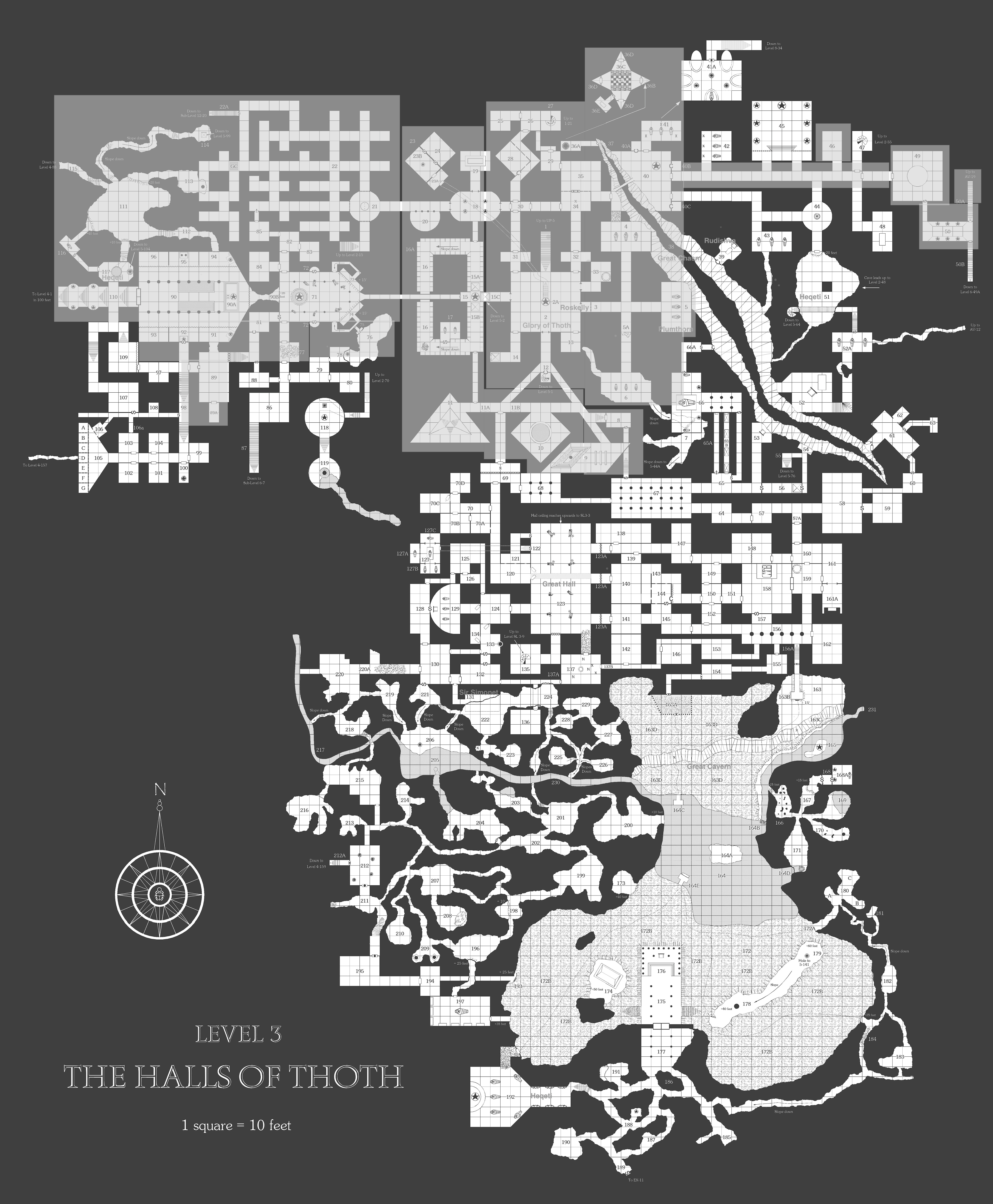
The Set areas and the necropolis of level 4
The Rudishva areas (by getting in from level 3: 3-111 → 3-116 → 3-117 → 5-104 → 5-113 → 5-105 → 5-94) and then immediately looting the yellow keycard in 5-98 and teleporting around from 5-92 and the shaft in 5-84.
Level 10 in the last ~2 sessions.
We spent a year and a half doing this! The amount of “new rooms” per session was really low and the amount of time we spent re-treading ground was pretty miserable. A big part of the pacing problem comes down to a mixture of Arden Vul and 1e:
Inventory: We’re supposed to care deeply about inventory, so a bunch of every session was spent on moving things between characters, shopping, parsing through the absurd amount of new items we got after every delve. Eventually I wrote an inventory manager to help with this (including a json importer so I could bulk-upload treasure hoards).
I would have loved to have the players manage their inventory between sessions, but we never built the discipline.
Spell Prep: We had 3 clerics and 3 elven magic-user/fighter-thieves and 3 magic-user henchmen (don’t get me started). They all (totally reasonably) want to coordinate their spell prep. Here’s one of their spell books:
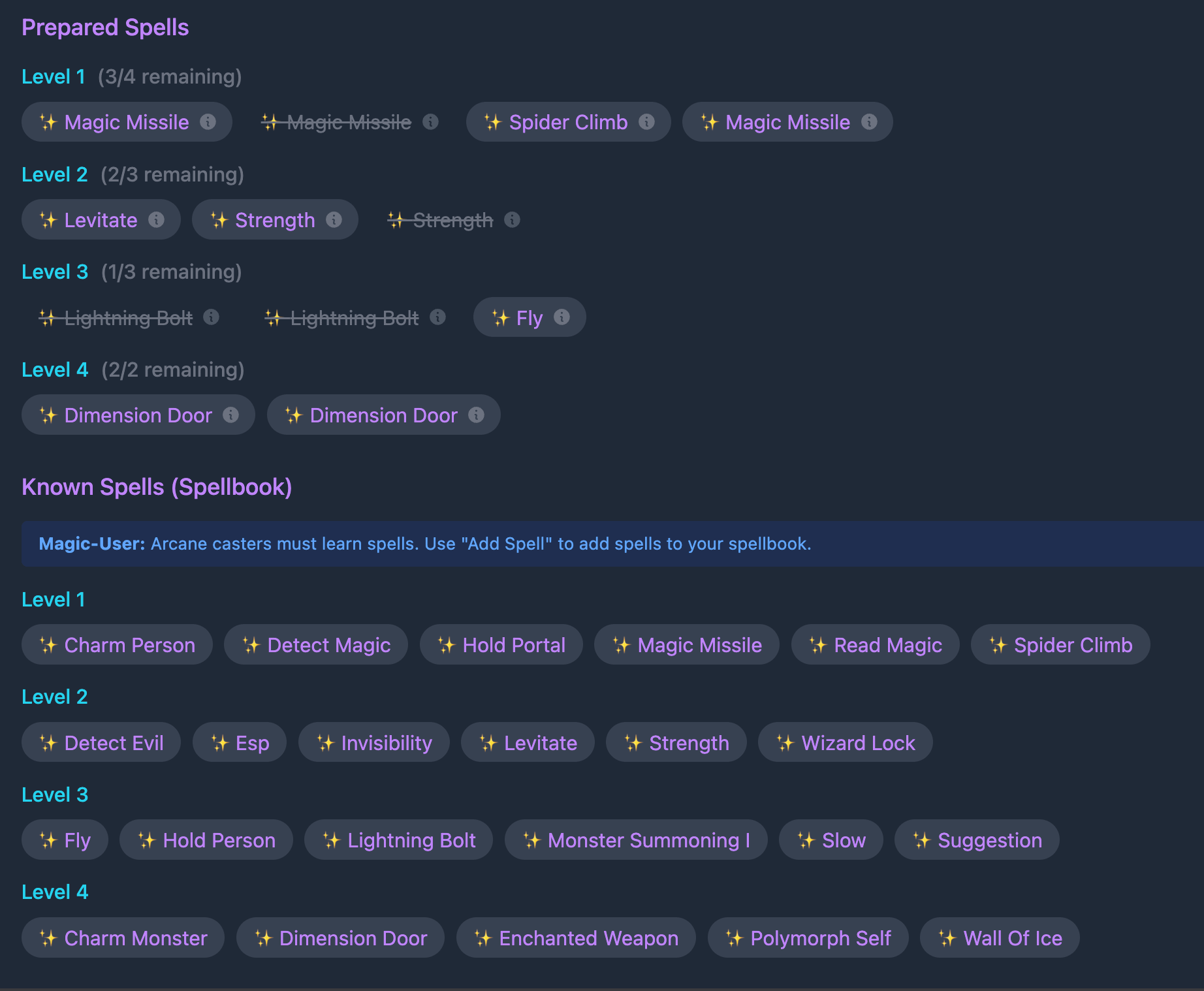
This was also a painful enough problem that I ended up writing a manager so they could look at each other’s stuff.
Rolled Info Barriers: Elves have a passive chance to detect secret stuff that they walk past (3 elven magic-user/fighter/thieves and one elven thief makes 4 rolls per secret thing). Doors tend to be stuck and need to be kicked open. Thieves want to move silently as they explore ahead. Traps have a chance to not be triggered. There’s a half-dozen different random encounter frequencies per dungeon floor. If I’m reading room 3-75 on p192, I need to flip back to p157 to see the random encounter frequency, which is 1-in-6 every 3 turns. If I remember how many turns it’s been since the last time I rolled correctly, and I roll a 1, then I roll on the table. I’ll then get the “Dragonfly of Kerbog Khan”, which is a RP encounter. Now I’m flipping to the Kerbog Khan faction writeup on p38 for the “Attitudes Towards Adventurers” section. The faction writeup doesn’t give information where Kerbog is located, so I keep searching and find he’s described in SL12-25, on p850 to get additional context.
All of those (except kicking open doors) are GM-side secret rolls, so before I can actually describe a room and what PCs can see (and whether enemies see the sneaking thief) I need to make a mind-numbing amount of repetitive rolls (roll for sneak, roll for encounter, roll for surprise, roll four times for the elves to notice stuff).
One of the lines of feedback I got in our post-mortem was
exploration got boring and very methodical
Different games handle exploration in a lot of different ways. Here’s an example
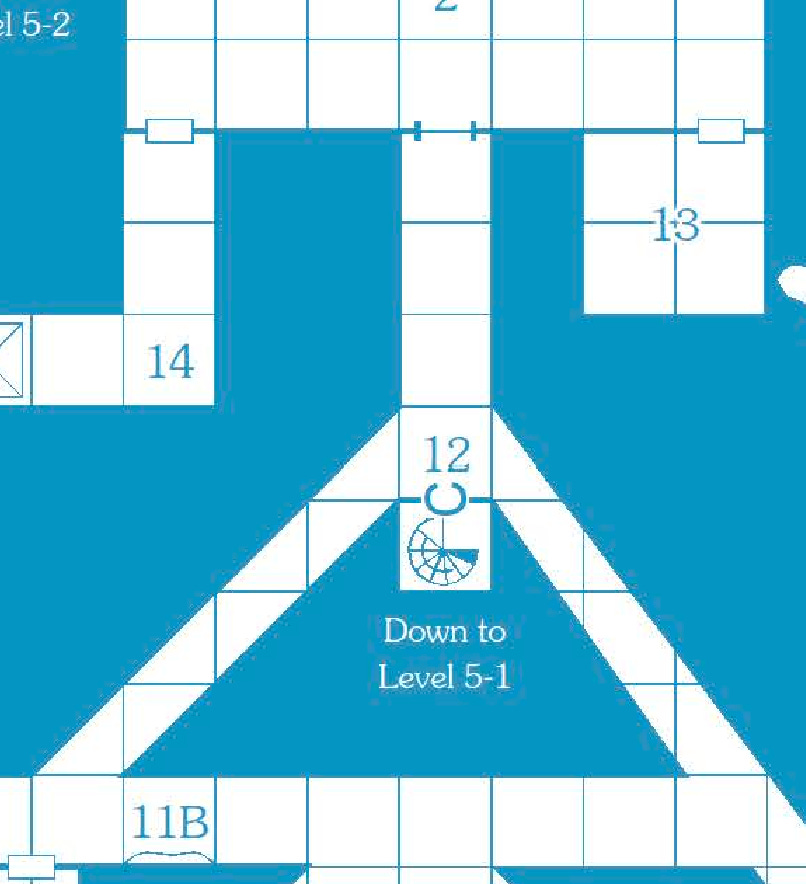
3-12: Concealed Door, with Access to Level 5-1
The wall contains an enormous fresco of a baboon, squatting on the ground and staring forward with bared teeth. The image is a good 6’ tall and 4’ wide. Although there is much wear on the walls, the image is still recognizable. Pressing both of the baboon’s eyes will cause the wall to grind inwards, revealing a staircase leading down 250’ to Level 5 (area 5-1).
What is the GM supposed to say when the players get to this area? Here’s one option:
As you continue south, the tunnel splits south-west and south-east. On the wall between the splitting halls is an enormous fresco of a baboon, squatting on the ground and staring forward with bared teeth. The fresco is worn, but the image is still recognizable. Looking closely, both of the baboon eyes are press-able buttons.
This is super free with the information, and is basically the Knave 2e approach. The party is moving at crawl speed (~100ft every 10 minutes), so they just get the hidden information. It drastically speeds up the game and gets straight to the players making choices.
Here’s another option:
As you continue south, the tunnel splits south-west and south-east. On the wall between the splitting halls is an enormous fresco of a baboon, squatting on the ground and staring forward with bared teeth. The fresco is worn, but the image is still recognizable.
Then, only if the players explicitly say that they look at the baboon eyes (or run their hands over the whole fresco or some other pixel-bitchy thing) do you tell them that the baboon eyes can be pressed. You could make it even lower-chance by still calling for a roll even if they say the “right” thing.
Other games will have some sort of search check. Old school games give a low% chance to find stuff in a 10ft area. Pathfinder/5e/delta green/etc have concepts around passive perception. 1e elves get a passive chance (rolled by the GM) to find this kind of stuff by just walking by.
The more rolling, exceptions, and complexity you have around these procedures the more cumbersome this gets. If everyone has a flat 2-in-6 chance to notice something secret when they walk by, that’s manageable. If the chance varies by class, race, level, and optional feats then that’s a huge headache.
Arden Vul exacerbates this by the sheer volume of these kinds of secrets. There are secret doors everywhere! The party is extremely incentivized to search for these secret doors because they frequently contain absurd amounts of treasure, so now we’re spending sessions just checking the walls, or re-walking through areas we’ve already been in but with true-sight and so on.
Moreover, I get the impression (though some sort of designer commentary in the appendix would have been helpful) that Barton leans more towards being cagey, and that the secret doors are supposed to be legitimately difficult to find (hence the great reward). By making them easier to spot (or playing the module in systems like WWN or ACKS that have much more favorable notice-secret-stuff math), we break some of the internal “balance” (if that was ever a concern of Barton’s).
6 | Unattainable Triangle
Are you familiar with the phrase “good, cheap, fast; pick 2”? I think there’s a similar thing happening with mega-dungeons. “Interconnected, Dynamic, Huge; pick 2” feels right to me, but Arden Vul tries to do all 3. We have 2000+ pre-written rooms. The various levels are deeply connected to each other; jaquayed to heck. The factions are a powderkeg of conflict, ready for the players to make a spark.
If we pick interconnected and dynamic, then that should affect our thousands of room keys:
My party kills the halflings. The goblins expand into the halfling area. This involves the goblins spreading out, both in terms of where they normally sleep and patrol, but also they’d redistribute their possessions, furniture, and treasure. This means all of the room keys in the goblin warrens are out-of-date and need to be rewritten. I should also update the level 3 random encounters to include goblins, and then probably also adjust the frequency for encounters in the goblin warrens (since it’s now less populated).
The beastmen also want the new territory, or now that the goblins are spread thin, the lizardmen (who hate the gobbos) take that as an opportunity to attack, incurring losses on each side. That should adjust both of their forces, and at the very least it should probably deplete their armory as the soldiers start equipping themselves. This broadly means the beastmen room keys on level 3 are out of date and need to be rewritten.
But now that the lizardmen are distracted, that’s the perfect opportunity for the fishmen in the drowned canyon to move in, which causes...
If we pick dynamic and huge or interconnected and huge, then it stretches disbelief that these activities wouldn’t cause changes elsewhere in the dungeon. The players just killed the Set Cult; why aren’t the Sun-Scarred Knights getting involved? Why don’t the trolls try to take the territory? (because we need to not have to update our 2000 rooms over and over).
Arden Vul is already huge and already interconnected, so I think the only sane way to run it is by dropping the dynamics. If that sounds horrifying, I recommend either running a hexcrawl (which drops interconnectivity since you have isolated hexes), running smaller modules (which drops size), or creating your own megadungeon as you go instead of all up-front (which also drops size).
For more reading here, a lot of the reddit discourse on my Level 3 review was on this topic.
The Good
There’s a ton of really neat adventuring grist. 12 huge factions. 2000+ rooms to pull from. Custom traps, magic items, spells, and monsters to steal with abandon.
The setting is cool. I loved the deep sense of historical cohesion, and how the thousands of years of conflict and development felt represented in the current state. It was intrinsically rewarding to just find out (as a player) what the heck is going on.
The faction writeups are great. Explicit listings of forces, resources, faction conflicts, and how-they-behave-toward-adventurers.
A whole appendix of NPC-adventuring parties (where Barton did the legwork of leveling them up for you). Creating rival adventurers is extremely time-consuming, so I love that Barton did this work so we don’t have to.
While I bitch about the technical details of the maps, I think the space itself is well-defined, interesting, well-themed, and well-jaquayed.
The front-matter for each chapter is genuinely useful. The overview, overview of the regions, callout for important NPCs, etc are all really nice to get oriented. I compiled much of this info here.
Finding new paths and shortcuts felt rewarding.
Tons of really cool secret areas or set-piece interactions like the elevator-hand of the colossal statue of Arden on the cliff face. Understanding the space was well rewarded.
The rumor tables are fantastic. Same with a lot of the information that you can get early (from Kronos, Plumthorn, and the graffiti).
Verdict
Buy (on sale probably) but don’t run. Probably just buy the PDF, definitely don’t buy volume 5 of the print line.
If you’re going to run it anyway…
Have some way to layer revisions on top of the text. I used marker-pdf to convert the whole thing to markdown, and then edited the markdown directly.
Have some way to make it easier on yourself to initially describe a room. I edited my markdown copy of the game through my room reformatter, but attacking the PDF with a highlighter is a proven method. If anyone wants to bear the torch here and spin up a community project where we share highlighter metadata (so this only has to be done once, rather than by each GM), I think that would be valuable.
Annotate the maps. It’s not easy to reason about where the organized forces of the various factions are stationed. It’s not easy to figure out which rooms are already bright and which are pitch black. As above, a community project where we share map annotations would be valuable.
Convert the random encounter frequencies to be rolled every turn. 1-in-6 every 2 turns can be converted into 1-in-12 every turn. This is one less thing to keep track of! Annotate each room key with this number.
Do your homework. This is another area where I think GMs sharing the load would be helpful.
The module calls for a pile of treasure maps; we don’t all have to make all of them ourselves, have a shared google drive or whatever.
Heaps of areas have lengthy rolling procedures. Pre-roll these where possible (including the locations of quantum NPCs like Lankios or the goblin king).
There’s a ton of handouts that would be useful — the initial rumors being handouts will drastically decrease how long it takes to give out 20 rumors. Have a Gosterwick services handout. Shopping handouts for what is available for purchase, and who will buy what. Visual aids for puzzles.
There are a bunch of sages implied by the book that don’t exist. Sages have a bunch of properties and probably ought to be pre-generated.
Have some way to fix the pre-rolled monster HP problem. I don’t know what Barton did, but he definitely didn’t roll 4d8 to generate the HP values of monsters with 4 HD. Moreover, he sorted the HP values, so if you ever try to number your monsters, the players will learn very fast that monster #1 will always have the most HP.
Have some way to get Treasure Hoards in front of your players efficiently.
Decide how magic item identification works. There’s tons of magic items that don’t necessarily look magic, have undefined command words, and unguessable properties. Similarly, figure out a system for the GM-side tracking of unidentified magic items, how you’ll identify them 6 sessions from now, and how you’ll trigger their effects when the players do things that trigger them (but that they don’t know will do so).
I would normally say to reduce the treasure, except I genuinely don’t know how to fix the problem here, it’s such a pervasive, large-scale problem. At the very least, I recommend dividing all of the treasure values by 3 and removing the rule that lets players get XP from sold, unused magic items.
Have some sort of easy-to-search index of XP values for monsters (ideally pre-calculated based on average HP), and magic items.
Decide how selling stuff works. If a player wants to use a 2000g sapphire to buy a week’s worth of training for 1650g, does the trainer make change? Would they accept an 1800g statue or do you need to find a statue-broker? How much treasure can you actually offload in Gosterwick/Newmarket/Narsileon? Do you care to model undefined thieves trying to steal the party’s treasures? Do players automatically know the value of gems, jewels, and art? What about magic items?
Decide how restocking works. If the players clear out the northern section of Level 3, does it ever repopulate? If so, after how long? With what?
Decide how the whole in-game-book thing works. Does it take time to read the books? How much? When they read a book, what do you tell them?
Heavily consider nerfing the items that provide continual true-sight to be, at most, x times per day for short periods. They’re a nightmare.
What fascinates me as someone running this in parallel is how converting the material to the 3e clone Fantasy Craft (which is extra homework) avoids most of the gameplay problems you encountered. It doesn't solve a lot of design issues or anything that is purely Barton's own creation, but the stuff where Barton's ideas run up against the game systems are problems I largely did not encounter, largely because Fantasy Craft redesigned those systems to solve adjacent problems that cropped up in 3e play. A few of those design changes even enable Barton's ideas rather than conflict with them.
- There are systems that restrict how much loot the characters can retain. Players can only save a percentage of their monetary wealth dictate and can only safely retain a certain number of special rewards (magic items, contacts, real estate, etc., collectively called "Prizes"). Money beyond their saving percentage is spent off-screen between delves as mercenaries have done since the dawn of time, and Prizes over the limit are lost at dramatically inopportune moments. Both the savings limit and Prize limit can be increased by spending character resources gained while leveling up. The fact that real estate is part of this system, real estate provides defined mechanical benefits, and it ties in with the Reputation system means the whole Wardens thing is actually playable as a mechanic, and some character options make interacting with it quite valuable.
- Magic items are designed entirely differently. The critical one here is spell-like effects are limited to a certain number of used per scene (even if that duration is nebulous), so while magic items do not "wear out", you also don't get permanent superpowers. The conversion isn't perfect, and there are some effects that are not covered by FC's table of magic item effects, so some of the bigger ticket items the GM is just required to figure it out.
- Items in general are different, so an easily accessible suit of enchanted plate mail is powerful, but it does not render the equipped PC practically invulnerable.
- There are skill usages for appraisal, haggling, identification, research, etc. There are classes that can be good at or even specialize in these if the players so choose. Books and such become bonuses on relevant checks. The Library of Thoth applies the bonus of a library on such checks, and when Birdie the alchemist/hobbyist archaeologist hauled all the tomes from the Secret Library back to town to read them, I allowed her to take Study: Lost Secrets of the Cult of Thoth as her new Interest when leveled up. Studies provide small bonuses on relevant skills checks, your overall bonus on Knowledge checks, and award extra information on Knowledge checks in the relevant field.
- There is a system for crafting, which includes alchemy. It is relatively straightforward (if badly worded) but is a downtime activity for PCs requiring a minimum of 1 day and as much as several months for complex or large-volume projects. Characters can specialize in it if they so choose, and in fact there is one class dedicated to being a skill specialist that has a lot of options for being a crafting specialist and there is an alchemist advanced class a PC can unlock at 5th level. This also explicitly allows for things like repairing all the statues and broken mechanisms and whatnot for characters inclined in those directions.
- NPCs have to be totally redesigned and lack rolled health, so Barton's terrible habits there are completely obviated. Standard enemies make death saves every time they take damage and unique enemies use the same two-tier health system as PCs. A strict conversion of the statblocks to FC has left the enemies feeling a little undertuned, only one PC has come close to taking serious damage, but my players are also very careful about conflict. Mage NPCs still have the "list of spells" problem, but the list is generally shorter because spellcasting as a system works differently so I'm picking spells a lot more judiciously and some NPCs end up with other abilities instead of spells.
- Secret GM-side checks to notice things are done with the Notice skill. Player-initiated checks to look for things are done with the Search skill. In both cases, a single roll is made either using the triggering player's skill bonus (if alone) or by the player with the highest/lowest bonus (if as a group, highest if success will benefit everyone, lowest if failure would impede everyone). This makes it relatively streamlined to search whole rooms or hallways with a single roll, although it does require pre-calculated square footage to determine how many turns it takes to resolve. Further for player-initiated checks, players can retry, but doing so cumulatively increases their critical failure range with each retry on top of the additional time investment, so there are mounting risks with metaphorically pulling the lever on the slot machine over and over.
Obviously this isn't everything, some problems like random encounters and potions require manual intervention and lots of homework (it took me all my free time for a week to prepare level 2 when the players blithely teleported themselves there, after spending the previous week prepping the transition area of level 3 between the precincts of Thoth and the beastman stronghold), but Fantasy Craft handles a lot of the regular procedural stuff surprisingly well and in ways that provide players meaningful mechanical choices.
Would I recommend it? I don't know. I recommend Fantasy Craft in general as a better alternative for 3e/Pathfinder style play, but converting a 1e/OSRIC/homebrew megadungeon that's already a hot mess is a lot of homework. However, if you're already doing the homework and rewriting stuff to make it work anyway, converting it to a one-book system that's surprisingly accommodating hasn't made it any harder to run. Just wish Barton had put in that legwork instead.
My group is still enjoying it, but I do look forward to taking a break to move on to other plans like MechWarrior Destiny, the Dark Heresy Haarlock's Legacy campaign, and some turbo nerd Robotech/Stargate crack crossover running on the Edge of the Empire rules. Wouldn't you know it, all of these are even more homework than Arden Vul! There is probably something very wrong with me.
I'm impressed. Not just that you ran this thing for so long, but that you also provided such valuable feedback for the community. If we don't have people providing that detailed critique, we don't get to see the where to the "fresh" or "rotten" (to borrow the Rotten Tomatoes aggregator system) ratings came from.
Also, I wanted to say that your blog is one of the more unique spaces in the wider OSR community. We have lots of people writing theory posts. Few people seem to want to talk about something equally valuable, which is technical writing and presentation. I'd argue that the technical writing piece is actually harder for 99% of would-be adventure writers than creating the adventure ideas and the dungeon rooms. Communicating such things in a clear and effective manner might be just as, if not more, important than the adventure concept itself.
It's easy to write something in a way you know how to run it at your table. It's a lot harder to write something in a way that anyone at any table know what the hell you're trying to say. We're luck to have you sharing your views with us. Thanks Beau.