
Table Talk: Treasure Hoards

I’m adding a new blog title prefix - “Table Talk”. The idea with this collection of posts is to get into the practical side of game mastering, with the specific real-life methods that game masters can use to bring concepts to the table.
For examples of other posts by other authors, check out GFC’s So You Want to Run OSR Part 0, Part 1, Part 2 (note the practical advice on how to structure session notes), or Glossary of Key Phrases - Idiom Drottning.
Last night, my players defeated Craastinistorex and her two Wyvern henchmen guarding the Tower of the Wyrm in Arden Vul. This has been a long time coming!
Dragons tend to have hoards of wealth, and ol’ Crassy is no exception. Here’s what the text says:
The head from the huge statue of Vul (AV-42); 101 ancient octagonal platinum coins (see Arden Vul items), 457 ancient silver pennies (see Arden Vul items), 330 ancient gold solidi (see Arden Vul items), 7,679 cp, 6,492 sp, 5,647 gp, 453 pp; 40 pieces of jewelry worth 100-600 gp each; a gold key to the Obsidian Gates (5-6D); a copy of the Deeds of Marius Tricotor by Lucius Cornelius scriptor (see Arden Vul books); a copy of Yeng of Narsileon’s Great Villains of Archontos, part V: Priscus the Traitor (see Arden Vul books); eight potions, of sweet water, gaseous form, extra healing, philter of love, growth, treasure finding, molasses, and deafening light (see new magic items for the last two); a ring of spell storing; a javelin +1, +2 versus dragons; a suit of cursed armor of arrow attraction (banded mail; see new magic items); a beaker of plentiful potions; an Alexia’s useful pole (see new magic items); a staff of the frog (see new magic items); and six scrolls (fireball, protection from magic, ice storm, tongues, protection from demons, and feline senses [see new spells]).
The way we play the game in physical reality is broadly through conversation; the GM describes a situation, the players ask clarifying questions, the GM answers, the players describe their actions, the GM adjudicates which creates a new situation and then we loop. What does the actual process of playing finding a treasure hoard look like?
As far as I can tell, we need to…
Describe the hoard.
The players ask clarifying questions. The GM answers them.
The players interact with the hoard (like by identifying items, equipping them, carrying them off, etc).
This creates a new situation (heavier encumbrance, XP, etc).
Each individual item has a physical description, gold value, and weight. Magic items have an unidentified description (landmark), and identified description (hidden). So, let’s go through and fetch the information. I’ll note the page numbers to get a sense of how much page-flipping this requires.
Gather Information
The head from the huge statue of Vul (AV-42)
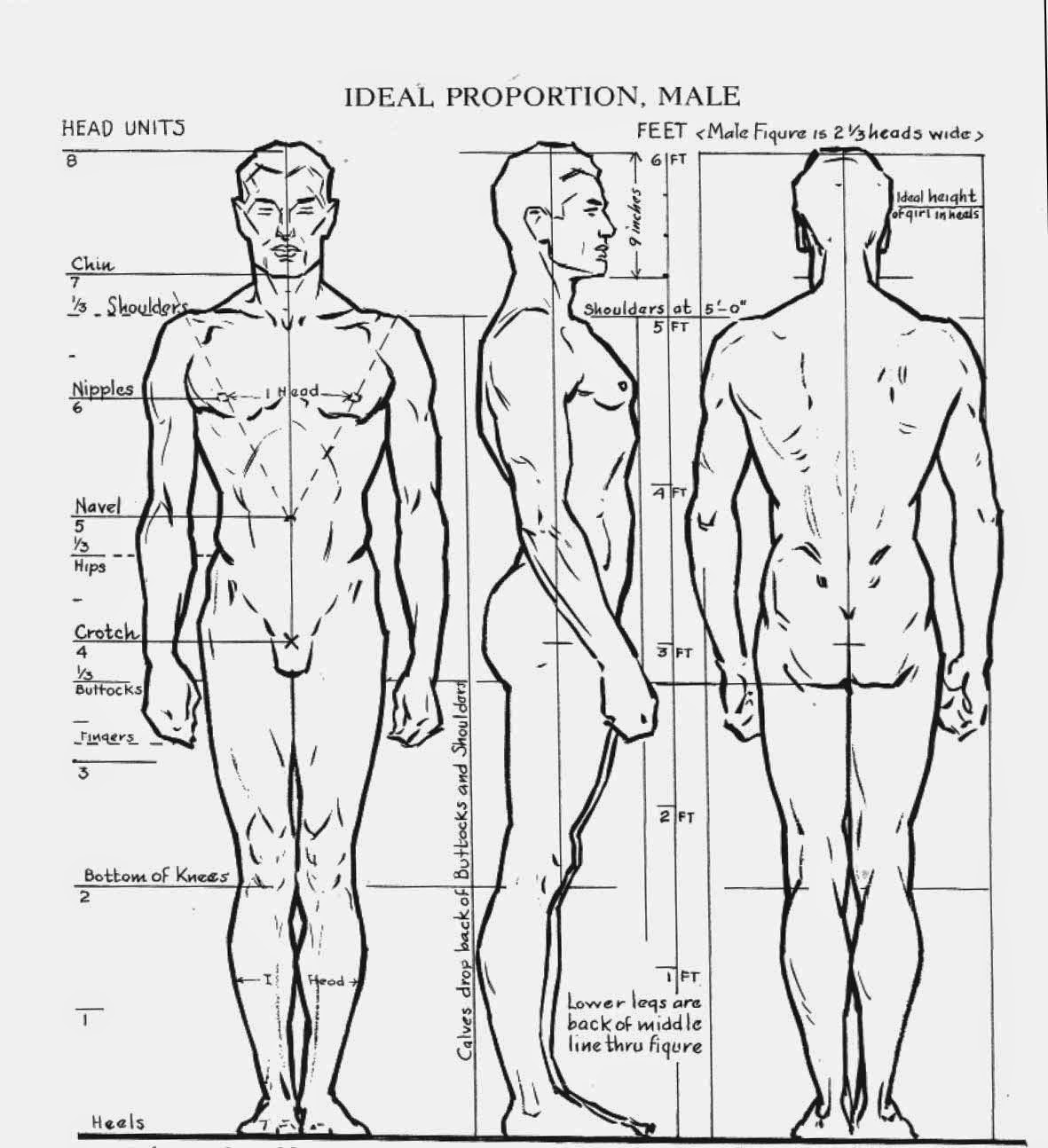
AV-42 refers to p104 of Arden Vul. The text doesn’t give a weight or gold value, but it's a huge hunk of marble so it’s not nothing. AV-42 says “The enormous block of stone is about 20’ square and 30’ tall.” According to this source, heads are about 1/8th of a body’s height, so if the statue of Vul is 30’ tall without the head, then 7/8 • X = 30; X = 30 • 8 / 7; X = 34.3, thus the head is ~4.3ft tall. Heads aren’t perfectly spherical, but close enough, so I’m comfortable estimating that Vul’s head has about 80% of the volume of a sphere. V = 4/3π r^3. r=2.15, so V = 41.6 cubic feet. 80% of that is 33.4 cubic feet. The density of marble is ~2.5g/cm3. 1 cubic foot is 28316.8 cm3, so the volume of the head is ~945,781 cm3, and the weight of the head is 2,364,453g. There are ~454g in a pound, so our head weighs ~5208lb, but we can round it to 5000lb as a nice round number.
This source gives that white marble was worth (as a raw material), 75 denarii / 0.028 m3 , which is 75 denarii per 28,000cm3. That prices our head at 2533 denarii. 1e gives that a mason is paid 3g a month, and the source gives that a mason is paid 50 denarii per day, so 1500 denarii per month, so we can estimate 1g = 500 denarii. That prices our head at ~5g (heh).
101 Ancient octagonal platinum coins
The source for this is page 1013 of the Arden Vul pdf (or vol 4, page 126 with physical media).
Octagonal Platinum Coins: Very large (2” across) and thick (½” thick), these coins are worth 375 modern gp and are 75x as heavy as a modern platinum piece. On the obverse they feature either a dragon’s head or an obelisk with an eye in it; this image is surrounded by the legend “Imp. Archon. Regn. est” [Short for “Imperator Archontii regendum est”, or, “the Archontean Emperor shall rule”]; on the reverse is the legend “Auc. est Potest.” (Short for “Auctoritas est Potestas”, or “Authority is power”). These rare coins were issued on symbolic occasions, e.g. coronation of a new emperor, a major victory, a political marriage, etc.; their relative scarcity is one factor in their value. 1 octagonal platinum coin weighs 1.5 lb.
That gives us a description (2” diameter octagonal platinum coins with a dragon’s head on one side and an obelisk with an eye on the other, inscribed with “The Archonteon Emporer Shall Rule” on one side and “Authority is Power” on the other), the value (375g each) and the weight (1.5lb each). Multiplying out, this is worth 37875g (and thus XP), and weighs 151.5lb.
457 Ancient Silver Pennies
Same source as the octagonal coins, fortunately.
Silver Pennies: These coins are about the size of a dime (1/2” diameter), although they are thicker (1/6”) and heavier. They are equivalent in value to a modern gold piece. On the obverse most feature a bust of the emperor wearing a military helmet, surrounded by the letters of his name; the reverse contains a gladius with the words “Conquerendum est” [It shall be conquered]. A few unusual mintings have been recorded, however, so not all silver pennies are similar. 125 silver pennies weigh 1 lb.
This gives us a description (1/2” diameter silver coins with an emperor in a helmet on one side and a gladius surrounded by the words “It Shall Be Conquered” on the other). They’re worth 457g and weigh 3.7lb.
330 Ancient Gold Solidi
Same source as the other ancient coins, though I’m not sure why we’re listing them in the order of platinum → silver → gold instead of descending.
Gold Solidi: Solidi (aka ‘shillings’) are thick (¼”) and large (1” diameter); they are worth 10 modern gp, but are 10x as heavy as an ordinary gp. The obverse features a bust of the emperor wearing an olive wreath surrounded by the letters of his name; the reverse has an image of the emperor in a chariot pulled by four horses. 5 gold solidi weigh 1 lb.
This gives us a description (1” diameter golden coins with an emperor wearing an olive wreath on one side and an emperor in a chariot pulled by horses on the other). They’re worth 3300g and weigh 66lbs. Of note, we’re told that 5 solidi weighs 1lb, and also told that they’re 10x as heavy as normal gold coins. In 1e, 10 gold coins weighs 1lb, so I assume that this implies that in Barton’s world, 50 gold coins weighs 1lb instead.
7,679 cp, 6,492 sp, 5,647 gp, 453 pp
1e gives that 200cp = 1gp, 20sp = 1g, 5gp = 1pp (PHB35). If 50 coins = 1lb (per the above inference), then this is worth 8,275g and weighs 405.4lb.
40 pieces of jewelry worth 100-600 gp each
My range parser suggests rolling 100-600 as 2d6•50. Plugging this into anydice, and rolling we get [600, 200, 500, 400, 450, 250, 350, 150, 350, 350, 500, 350, 250, 500, 450, 500, 450, 350, 300, 550, 200, 400, 450, 450, 250, 250, 200, 500, 350, 250, 150, 300, 300, 500, 400, 400, 450, 150, 200, 100]. Sorting and compacting gives us [100, 150x3, 200x4, 250x5, 300x3, 350x6, 400x4, 450x6, 500x6, 550, 600] for a total of 14050g.
Side note: It is wild to ask me to roll for the value of 40 pieces of jewelry.
As for weight, in the 1e DMG on page 239, we’re given
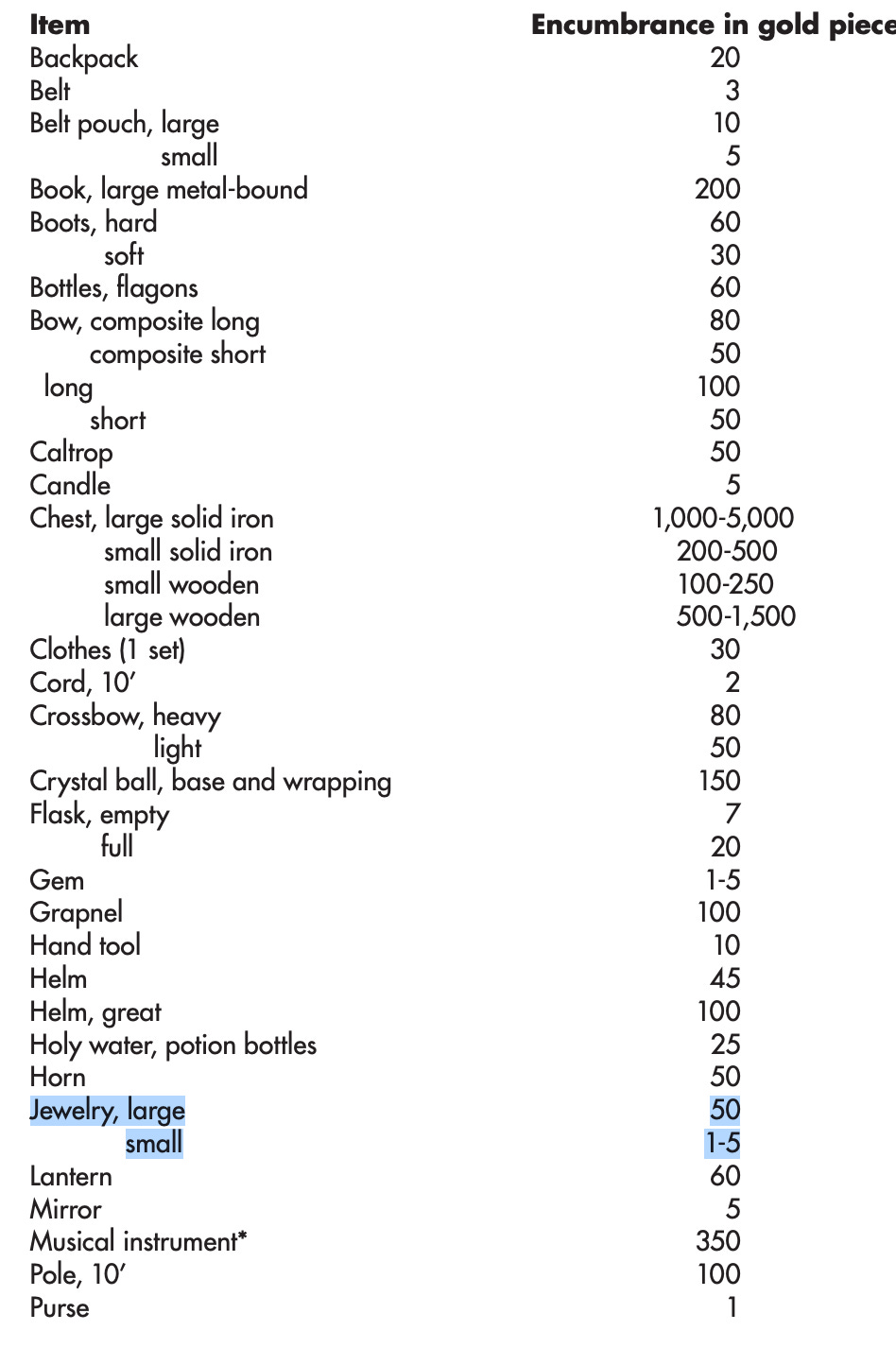
So small jewelry weighs 1d5/10lb and large jewelry weighs 5lb. We’re not told whether the jewelry is large or small and lord knows I dont want to roll 40 more dice to figure out how much this weighs. OSE gives that each piece of jewelry weighs 1lb, which is nice and simple to use, so let’s go with 40lb worth of jewelry.
A gold key to the Obsidian Gates (5-6D)
Here’s what 5-6D has to say on page 324 (vol 2, page 9 in print)
Keyholes some 1.5” in diameter extend halfway through each of the doors.
The next page (360 words later) says
As suggested by the keyholes, the ‘keys’ are in fact rods; each key is 1.5” in diameter and 15” long. […] For the current location of all ten sets of keys, see the Arden Vul items appendix.
Okay so it’s a 15”, 1.5” diameter golden rod. They do have a description on page 1014 (vol 4, page 127) which gives a weight, gp value, and xp value
The gold key weighs 19 lb […] Experience Point Value: 500, G.P. Value: 1000
So it’s a golden rod, 15” long with a 1.5” diameter that weighs 19lbs. It’s worth 1000g and 500xp.
As far as I can tell, there’s no inscription, though it does detect as magic due to durability enchantment.
The Deeds of Marius Tricotor by Lucius Cornelius Scriptor
This is defined on page 1032 of the pdf (or vol 4, page 145 in print)
This famous text provides a full account of the character and public career of the great Archontean military archon, Marius Tricotor. It describes Marius Tricotor’s arrival in Arden Vul as archon and his careful strategic planning; it lauds his common touch, including his decision to live among and in the style of the ordinary legionaries; it praises his rejection of every form of ‘gift’ offered by the great temples; it records the laments of his servants at his unwillingness to wear formal court attire; it notes his possession of the four artifacts of the archons; and, at length, it describes his campaigns through the lower halls against the ‘amphibians’.
Anyone who carefully reads the text gains general information about the functions of the surviving buildings in the ruined city, and some relational directions about Level 3 (areas 3-1 to 3-162), Level 4 (areas 4-1 to 4-122), and Level 6 (areas 6-1 to 6-18, and areas 6-53 to 6-92). Lucius Cornelius’s work appeared in several forms, as a codex and also as a set of scrolls. (A Lucius Cornelius Scriptor; L Mithric; T codex; D 8x10x5; W 7 lb; M purple leather binding embossed with a yellow archon’s seal; R uncommon; FoS humankind; SKC history, legends and folklore, politics and genealogy) Experience Point Value: — G. P. Value: 100
In terms of initial description, it’s a 8•10•5” codex with a purple leather binding that is embossed with a yellow archon’s seal, written in Mithric. It’s worth 100g (but 0 xp), and weighs 7lb.
Note that this also gives the GM homework; when the players read the book the GM needs to figure out how tell the players about the relational direction from 3-1 to 3-162, 4-1 to 4-122, 6-1 to 6-18, and 6-53 to 6-92.
Yeng of Narsileon’s Great Villains of Archontos, part V: Priscus the Traitor
Defined on page 1037 of the pdf (vol 4, page 150 in print)
A colorful work appearing more than a decade after the last installment, this text offers a fairly simplistic ad hominem attack against Priscus Pulcher, here described as a foul sorcerer who betrayed the emperor’s personal trust. The picture painted of Priscus is of a cartoon villain, with hunchback, warts, foetid breath, and a morbid fascination with death; according to the text, Priscus intended the destruction of the empire from the start, and used his evil sorcery to bewitch noble Archonteans before turning them against each other. In Yeng’s telling, Priscus is abetted by a wretched crone named Isadora, who is both his lover and follower.
The text culminates in an epic battle at Arden Vul in which the evil Priscus is slain, Isadora vanishes in a puff of smoke, and much of the city is leveled. Yeng concludes with some hortatory passages warning readers to be on the alert for ‘sons of evil’ who seek to emulate or venerate the evil Priscus.
Despite the fact Yeng’s account is almost entirely fictitious, and laden with the worst sort of stereotypical tropes, this was by far his most successful work, and has shaped most modern Archonteans’ general knowledge of Priscus and the War of Sortians and Theosophs. Sages and literary scholars are confident that this work is by a later continuator of the Yeng series. (A ‘Yeng of Narsileon’; L Archontean; T codex; D 11x16x6; W 7 lb; M blue horsehide bindings; R common; FoS humankind; SKC history) Experience Point Value: — G. P. Value: 50
It’s a 11•16•6” codex, bound in blue horsehide and written in Archontean. It’s worth 50g (but 0 xp) and weighs 7lbs.
Potion of Sweet Water
This is described in the DMG on page 127
This liquid is not actually a potion to be drunk (though if it is drunk it will taste good), but it is to be added to other liquids in order to change them to pure, drinkable water. It will neutralize poison and ruin magic potions (no saving throw). The contents of the container will change up to 100,000 cubic feet of polluted or salt or alkaline water to fresh water. It will turn up to 1,000 cubic feet of acid into pure water. The effects of the potion are permanent, but subject to later contamination or infusion after an initial period of 5-20 rounds.
The DMG (on page 125) writes “As a general rule [potions] should bear no identifying marks, so that the players must sample from each container in order to determine the nature of the liquid.”
The XP value and weight is on a page 121 in a separate table; it’s worth 200xp and sells for 250g. The DMG appendix on page 239 gives that a potion weighs 25g, so 2.5lb.
Potion of Gaseous Form
DMG 126
By imbibing this magical liquid, the individual causes his or her body, as well as what it carries and wears, to become gaseous in form and able to flow accordingly at a base speed of 3”/round. (A gust of wind spell, or even normal strong air currents, will blow the gaseous form backwards at air speed.) The gaseous form is transparent and insubstantial. It wavers and shifts. It cannot be harmed except by magical fires or lightnings, in which case damage is normal. A whirlwind will inflict double damage upon any creature in gaseous form. When in such condition the individual is able to enter any space which is not airtight, i.e., a small crack or hole which allows air to penetrate also allows entry by a creature in gaseous form. The entire potion must be consumed to achieve this result, and the effects last the entire duration.
The table on DMG 121 notes it’s worth 300 xp and 400g. The DMG appendix on page 239 gives that a potion weighs 25g, so 2.5lb.
Potion of Extra Healing
DMG 126
This potion restores 6-27 (3d8 + 3) hit points of damage when wholly consumed, or 1-8 hit points of damage for each one-third potion.
The table on DMG 121 notes it’s worth 400xp and 800g. The DMG appendix on page 239 gives that a potion weighs 25g, so 2.5lb.
Philter of Love
DMG 127
This potion is such as to cause the individual drinking it to become charmed (Cf. charm spells) with the first creature seen after consuming the draught, or actually become enamored and charmed if the creature is of similar race and of the opposite sex. Charming effects wear off in 4 + 1-4 turns, but the enamoring effects last until a dispel magic spell is cast upon the individual.
Following the reference to Charm (maybe Charm Person or Mammal) in PHB55
This spell will affect any single person or mammal it is cast upon. The creature then will regard the druid who cast the spell as a trusted friend and ally to be heeded and protected. The spell does not enable the druid to control the charmed creature as if it were an automaton, but any word or action of the druid will be viewed in its most favorable way. Thus, a charmed creature would not obey a suicide command, but might believe the druid if assured that the only chance to save the druid’s life is if the creature holds back an onrushing red dragon for “just a round or two”. Note also that the spell does not empower the druid with linguistic capabilities beyond those he or she normally possesses. The duration of the spell is a function of the charmed creature’s intelligence, and it is tied to the saving throw. The spell may be broken if a saving throw is made, and this saving throw is checked on a periodic basis according to the creature’s intelligence: [insert table]
If the druid harms, or attempts to harm, the charmed creature by some overt action, or if a dispel magic (q.v.) is successfully cast upon the charmed creature, the charm will be broken automatically. The spell affects all mammalian animals and persons. The term person includes all bipedal human and humanoid creatures of approximately man-size, or less than man-size, including those affected by the hold person spell (q.v.). If the recipient of the charm person or mammal spell makes its saving throw versus the spell, its effect is negated.
The table on DMG 121 notes that it’s worth 200xp and 300g. The DMG appendix on page 239 gives that a potion weighs 2.5lbs.
Potion of Growth
DMG 126
This potion causes the person consuming it to enlarge in both height and weight, his or her garments and other worn and carried gear likewise growing in size. Strength is increased sufficiently to allow bearing normal armor and weapons, but does not add to combat. Movement increases to that of a giant of approximately equal size. Each quarter of the potion consumed causes 6’ height growth, i.e. a full potion increases height by 24’.
The table on DMG 121 notes that it’s worth 250xp and 300g. The DMG appendix on page 239 gives that a potion weighs 2.5lbs.
Potion of Treasure Finding
DMG 127
A potion of treasure finding empowers the drinker with a location sense, so that he or she can point to the direction of the nearest mass of treasure. The treasure must be within 24” or less, and its mass must equal metal of at least 10,000 copper pieces or 100 gems or any combination thereof. Note that only valuable metals (copper, silver, electrum, gold, platinum, etc.) and gems (and jewelry, of course) are located; worthless metals or magic without precious metals/gems are not found. The consumer of the potion can “feel” the direction in which the treasure lies, but not its distance. Intervening substances other than special magical wards or lead-lined walls will not withstand the powers which the liquor bestows upon the individual. The effects of the potion last for from 5-20 rounds. (Clever players will attempt triangulation.)
The table on DMG 121 notes that it’s worth 600xp and 2000g. The DMG appendix on page 239 gives that a potion weighs 2.5lbs.
Potion of Molasses
From the Arden Vul pdf page 985 (or vol 4, page 98 in print).
Plotina the Alchemist devised this potent concoction as a way of slowing down enemies (or any romantic targets who may be running away). Thrown or consumed, the potion halves movement and actions of those it strikes. The effects last for 2-5 rounds on a failed save versus spells, and 1-2 rounds on a successful save.
Experience Point Value: 200 G. P. Value: 800
The DMG appendix on page 239 gives that a potion weighs 2.5lbs.
Potion of Deafening Light
From the Arden Vul pdf page 985 (or vol 4, page 98 in print).
These midnight blue potions are intended to be thrown as missiles. On hitting a solid surface, the material within combusts with a small explosion and a brief flash of light. Any foe within 10’ must save versus petrification or be blinded for 1 round and deafened for 1-4 rounds. In addition, a direct hit on a living being causes 1-6 damage to that creature.
Experience Point Value: 500 G. P. Value: 1,000
The DMG appendix on page 239 gives that a potion weighs 2.5lbs.
Ring of Spell Storing
DMG 131
A ring of spell storing will contain 2-5 (d4 + 1) spells which the wearer can employ just as if he or she were a spell user of the level appropriate to use the spell in question. The class of spells contained within the ring is determined in the same fashion as the spells on scrolls. The level of each spell is determined as follows:
cleric: d6, if 6 is rolled roll d4 instead
druid: as cleric
magic-user: d8, if 8 is rolled roll d6 instead
illusionist: as cleric
Which spell type of any given level is contained by the ring is also randomly determined. The ring has the empathic ability to impart to the wearer the names of its spells. Once class, level, and type are determined, the properties of the ring are fixed and unchangeable. Once a spell is cast from the ring, it can only be restored by a character of appropriate class and level of experience, i.e. a 12th level magic-user is needed to restore a 6th level magic-user spell to the ring. Spells stored require 5 segments each to cast.
Barton doesn’t bother to tell us what class the ring is, or what spells are stored in the ring, so I guess we need to roll those randomly, per the description. It says to determine the class the same way as for scrolls. That info is on DMG 127

We roll 1d100 and get 95 so it’s a it’s either cleric or druid. We roll 1d100 again and get 16, so it’s for druids.
Then, we need to roll 1d4+1 for how many spells are on the ring, and we get 5.
Druid rings are rolled as clerics. Cleric rings are d6 where 6 is rerolled as a d4. So we roll 5d6 and get [1, 6, 4, 6, 4]. Those 6s need to be re-rolled, and we get 3 and 1. Our ring has spell levels [1x2, 3, 4x2]. Those also need to be determined randomly.
PHB 41 has this table
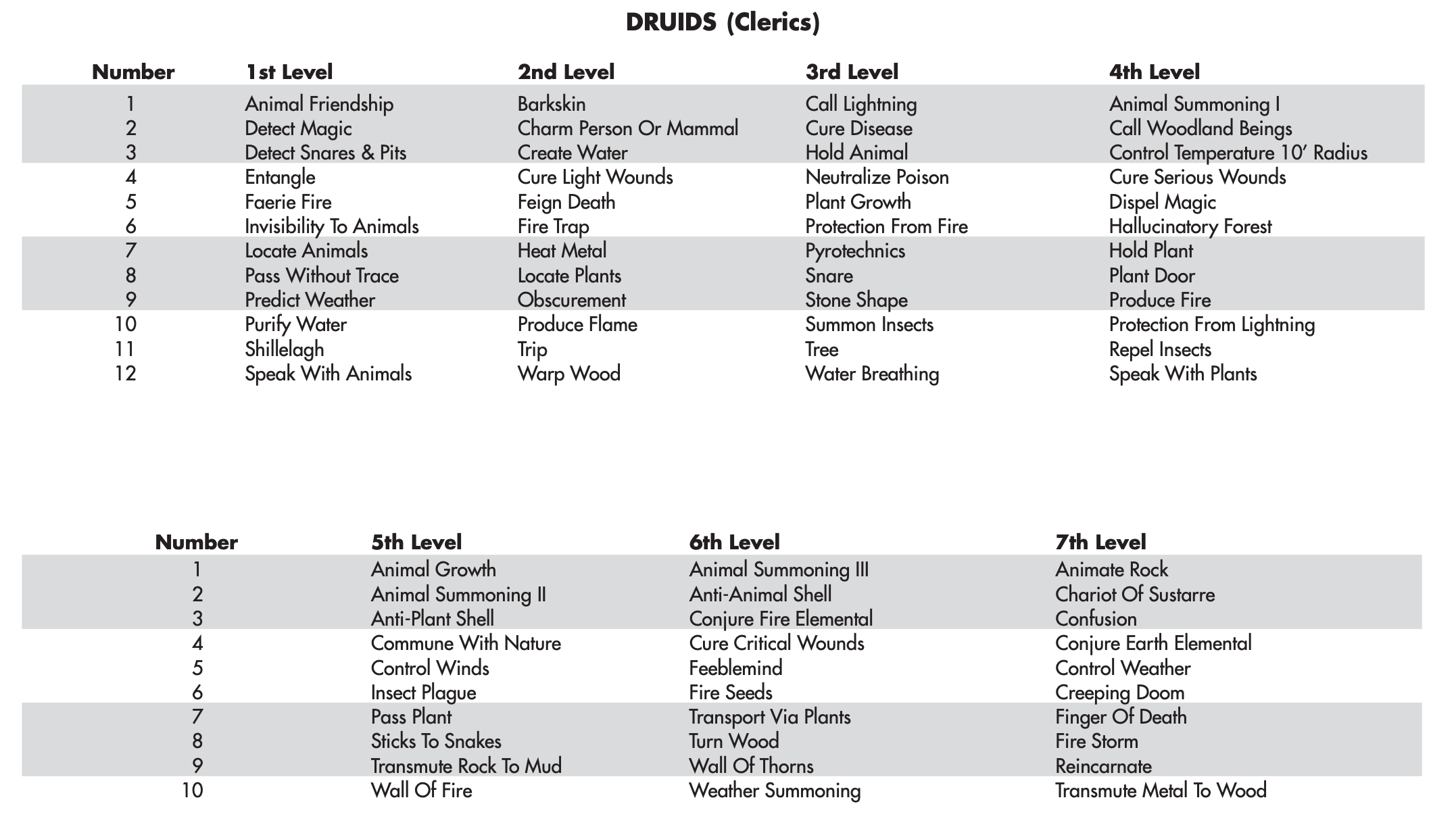
There are 12 first level spells, so we roll 2d12 and get [4, 6]: Entangle (PHB54) and Invisibility to Animals (PHB54). We roll 1d12 for our 3rd level and get 3: Hold Animal (PHB57). We roll 2d12 for our 4th levels and get [5, 11]: Dispel Magic (PHB59) and Repel Insects (PHB60).
DMG 122 notes that the ring is worth 2500xp and 22500g. I treat rings as weightless.
Javelin +1, +2 vs Dragons
This isn’t an item in the book. The closest thing I can see is the table in DMG 124 has “Sword +1, +2 vs. magic-using & enchanted creatures” which is worth 600xp and sells for 3000g.
That also has an entry in on page 165:
Sword +1, +2 vs. magic-using and enchanted creatures, gives its +1 bonus always, +2 when employed against magic-users, monsters which can cast spells, conjured, created, gated, or summoned creatures. Note that the +2 would not operate against a creature magically empowered by some item to cast spells — such as a ring of spell storing.
So I think we can make the (easy) inference that this is a Javelin that has a +1 bonus against everything but dragons, and a +2 bonus instead (not cumulative) against dragons. The paragraph about swords also has this helpful note:
Whenever a sword has some unknown quality — such as the wishes in a Luck Blade or a sword with unusual aspects, you should prepare a special 3 × 5 index card on it and keep the information handy whenever the possessor of the weapon is playing.
Spoiler: we’re going to get to this in the practical advice section.
Then, we head to PHB 37 for the weight of 2lb.
Cursed Armor of Arrow Attraction (banded mail)
From the arden vul pdf page 964 (vol 4 page 77 in print)
This cursed armor can come in any form, although banded mail is most common. It provides a +1 bonus to AC to all attacks except arrows, for which it imposes an AC penalty of -2. Experience Point Value: — G. P. Value: 2,000.
The weight of banded mail isn’t in the PHB, but it is in the DMG on page 27, where it weighs 35lbs and restricts movement to 9”.
That said, the DMG has on page 164
For game purposes all magical armor should be considered as being virtually weightless — equal to normal clothing, let us assume. This gives characters so clad a base movement speed equal to an unarmored man.
It’s not clear to me if it’s supposed to be weightless when picked up, or only when worn.
Beaker of Plentiful Potions
DMG 138
This container resembles a jug or flask. It is a magical beaker with alchemical properties which compound from 2-5 doses of from 2-5 potions of any sort as initially determined by random selection. Different potion sorts are layered in the container, and each pouring takes 1 round and spills forth 1 dose of 1 potion type. Roll d4, +1, to find the number of potions the beaker contains. Roll for each potion contained so as to find what it is — delusion and poison are possible — and record type by order of occurrence. Duplication is possible. If the container holds only 2 potions it will dispense them 1 each per day, 3 times per week; if 3 are contained, it will dispense them 1 each per day, 2 times per week; and if 4 or 5 are contained it will pour each forth but 1 time per week. Once opened, the beaker will gradually lose the ability to produce potions. This reduction in ability results in the permanent loss of one potion type per month.
Barton doesn’t tell us what’s in the Beaker, so we roll it ourselves.
We roll 1d4+1 for the number of potions and get 2. We randomly determine the potion via the potion table in the DMG on page 121 by rolling 2d100 and getting [10, 31], which is Potion of Climbing and Potion of Flying.
We roll 1d4+1 for the number of doses and get 4 and 4, so after the potions have been harvested (which takes 8 days, the description painstakingly says), we wind up with 4 Potions of Climbing and 4 Potions of Flying. I’m going to assume we don’t get additional XP for those, but I don’t understand why they wouldn’t be sellable, so we need to fetch descriptions and gold values.
DMG 122 tells us it’s worth 1500xp and 12500g. No weight is provided, but for my sanity let’s go with 4lbs (since it contains multiple potions).
4x Potion of Climbing
DMG 125
Imbibing this potion enables the individual to climb as a thief, up or down vertical surfaces, with only a base 1% chance of slipping and falling. (Check at the halfway point, d%, 01 equals a fall.) A climbing potion is effective for 1 turn plus 5 to 20 rounds. For every 1,000 g.p. weight equivalent carried by the character, there is an additional 1% added to chance of slipping. If the climber wears armor, there are the following additions to the slipping/falling chance:
studded leather 1%
ring mail 2%
scale mail 4%
chainmail 7%
banded or splinted armor 8%
plate mail 10%
magic armor, any type 1%
The table on DMG 121 notes that it’s worth 500g. The DMG appendix on page 239 gives that a potion weighs 2.5lbs, so 10lbs.
4x Potion of Flying
DMG 126
A flying potion enables the individual drinking it to fly in the same manner as the third level magic-user spell, fly (q.v.).
Heading to the PHB, page 73 for Fly
This spell enables the magic-user to bestow the power of magical flight. The creature affected is able to move vertically and/or horizontally at a rate of 12” per move (half that if ascending, twice that if descending in a dive). The exact duration of the spell is always unknown to the spell caster, as the 1-6 turns variable addition is determined by the Dungeon Master secretly. The material component of the fly spell is a wing feather of any bird.
The table on DMG 121 notes that it’s worth 750g. The DMG appendix on page 239 gives that a potion weighs 2.5lbs, so 10lbs.
Alexia’s Useful Pole
Page 961 of the Arden Vul pdf (vol 4 page 74 in print)
This practical item appears as a 3-inch long, 3/4-inch diameter rod of steel that is remarkably light (only 1 lb regardless length). Most are usually inscribed with runes, and/or with their command words. Useful poles can extend to three or four fixed lengths by speaking an appropriate command word. For example, the most common useful poles have three lengths: the 3’, ‘short’ length, a 4’, ‘medium’ length, and a 6’, ‘long’ length. A few varieties (10%) have a fourth ‘very long’ length (usually 10’ or 15’). The short length functions quite nicely as a jo-stick, doing 1-8/1-6 damage. The medium lengths functions as a bo-stick or quarterstaff, doing 1-10/1-8 damage. The long length functions as a spear 1-10/1-12, and the very long length functions as an awl pike 1-10/3-18. Although the weapon functions are convenient, the magic of these items lies primarily in their portability and light weight.
Experience Point Value: 2,500 G. P. Value: 15,000
Barton does not note whether or not this pole is inscribed with runes or command words or what the command words for this pole are. He also notes that ‘A few varieties (10%) have a very long length’, but does not specify whether this pole is such a specimen. So we roll 1d100, get 18, and note that it lacks the very long length.
Descriptively, it’s a 3” long, 3/4” diameter rod of steel that detects as magic and weighs 1lb. 2500 xp and worth 15000g.
Staff of the Frog
Page 995 of the Arden Vul pdf (vol 4 page 108 in print)
A long (8’) staff made of oak and carved in floral and geometric patterns. It is a staff +1, but is +4 versus amphibians and amphibian-like creatures (frogs, toads, salamanders, heqeti, Kauket). It allows the bearer to breathe water, and allows him/her to jump up to 6/day as per the spell. It also allows the bearer to understand the speech of all amphibians and to communicate with them in their own croaking languages.
Experience Point Value: 6,000 G. P. Value: 30,000
Heading to the Jump spell in the PHB on page 67
When this spell is cast, the individual is empowered to leap up to 30’ forward or 10’ backward or straight upward. Horizontal leaps forward or backward are in only a slight arc — about 2’/10’ of distance traveled. The jump spell does not insure any safety in landing or grasping at the end of the leap. For every 3 additional levels of experience of the magic-user beyond the 1st, he or she is able to empower 1 additional leap, so a 4th level magic-user can cast a jump spell which enables the recipient to make 2 leaps, 3 leaps at 7th level, etc.
All leaps must be completed within 1 turn after the spell is cast, for after that period has elapsed the spell wears off. The material component of this spell is a grasshopper’s hind leg, one for each leap, to be broken when the leap is made.
Descriptively, it’s a 8’ oak staff carved in floral and geometric patterns. The weight of a staff is defined in the PHB on page 37 as 5lb.
Scroll of Fireball
From DMG 121
Experience Points (x.p.) Value:
Awarded only to characters who can use the spell(s); the award should be 100 x.p. per spell level. Protection scrolls are noted as to x.p. value on the table itself.
Gold Piece (g.p.) Sale Value:
Any scroll can be sold in the “open market” for three times its x.p. value. Protection scrolls sell for five times x.p. value.
So a scroll of Fireball is worth 300xp and 900g.
Checking PHB 73 for Fireball
A fireball is an explosive burst of flame, which detonates with a low roar, and delivers damage proportionate to the level of the magic-user who cast it, i.e. 1 six-sided die (d6) for each level of experience of the spell caster. Exception: Magic fireball wands deliver 6 die fireballs (6d6), magic staves with this capability deliver 8 die fireballs, and scroll spells of this type deliver a fireball of from 5 to 10 dice (d6 + 4) of damage. The burst of the fireball does not expend a considerable amount of pressure, and the burst will generally conform to the shape of the area in which it occurs, thus covering an area equal to its normal spherical volume. [The area which is covered by the fireball is a total volume of roughly 33,000 cubic feet (or yards)]. Besides causing damage to creatures, the fireball ignites all combustible materials within its burst radius, and the heat of the fireball will melt soft metals such as gold, copper, silver, etc. Items exposed to the spell’s effects must be rolled for to determine if they are affected. Items with a creature which makes its saving throw are considered as unaffected. The magic-user points his or her finger and speaks the range (distance and height) at which the fireball is to burst. A streak flashes from the pointing digit and, unless it impacts upon a material body prior to attaining the prescribed range, flowers into the fireball. If creatures fail their saving throws, they all take full hit point damage from the blast. Those who make saving throws manage to dodge, fall flat or roll aside, taking ½ the full hit point damage — each and every one within the blast area. The material component of this spell is a tiny ball composed of bat guano and sulphur.
(yes, this is all one paragraph in the book)
Fireball has specific guidance for scrolls: “scroll spells of this type deliver a fireball of from 5 to 10 dice (d6 + 4) of damage”. Barton doesn’t specify this information, so we roll d6+4 and get 10, so this is a scroll of fireball that does 10d6 damage.
Scroll of Protection from Magic
DMG 128
Reading time: 8 segments. This scroll invokes a very powerful and invisible globe of anti-magic in a 5’ radius from the reader. It prevents any form of magic from passing into or out of its confines, but normal things are not restricted by it. As with other protections, the globe of anti-magic moves with its invoker. Any magical item which touches the globe must be saved for with a 50% likelihood of the object being drained of all magic from the power of the globe, i.e. save equals 11 or better with d20. The protection lasts for 5-30 (5d6) rounds.
If multiple magic items encounter the globe simultaneously, the leading item (a magic sword held in advance of its holder, for instance) is the first affected, then the others are checked in order of decreasing power until the first item fails its save, at which time the globe is cancelled and the item is drained of its magic.
DMG 121 notes that a Scroll of Protection from Magic is worth 1500xp. Using the note on the same page, Protection scrolls are worth 5x that in gold, so 7500g. I assume that Scrolls are weightless.
Scroll of Ice Storm
PHB 77
When this spell is cast, the magic-user causes either great hail stones to pound down in an area of 4” diameter and inflict from 3 to 30 (3d10) hit points of damage on any creatures within the area of effect; or the ice storm can be made to cause driving sleet to fall in an area of 8” diameter and both blind creatures within its area of effect for the duration of the spell and cause the ground in the area to be icy, thus slowing movement within by 50% and making it 50% probable that a moving creature will slip and fall when trying to move. The material components for this spell are a pinch of dust and a few drops of water. (Note that this spell will negate a heat metal spell (q.v.), but its first application will also cause damage in the process.)
Ice Storm is a 4th level spell, so it’s worth 400xp and 1200g.
Scroll of Tongues
PHB 49
This spell enables the cleric to speak the language of any creature inside the spell area, whether it is a racial tongue or an alignment language. The reverse of the spell cancels the effect of the tongues spell or confuses verbal communication of any sort within the area of effect.
Tongues is a 4th level spell, so it’s worth 400xp and 1200g.
Scroll of Protection From Demons
DMG 128
This scroll requires 1 full round to read if it is to protect against all sorts of demons, including demon princes, 7 segments to protect against demons of type VI or lower, and only 3 segments to protect against type III or lower. The circle of protection generated springs out-wards from the scroll reader in a 10’ radius. No demon protected against can penetrate the circle physically or magically or in any way, but the person(s) within can launch attacks, if otherwise possible, upon demons. The protection moves with the reader of the scroll. Its effect lasts for 5-20 (5d4) rounds.
Note that the protection radius is not an actual physical globe, and if the user forces a demon into a place from which further retreat is impossible (e.g., a corner), and then continues forward until the demon would be within the radius of the circle, the demon is not harmed, and the protection is considered voluntarily broken and disappears. There is no way in which this can be used as an offensive weapon.
DMG 121 gives the XP value of 2500, and thus a gold value of 12500.
Scroll of Feline Senses
Arden Vul pdf page 1020 (vol 4, page 133 in print)
In casting this spell the cleric acquires enhanced senses, analogous to those of a cat. For the duration the cleric has infravision to 60’, he/she can detect and identify smells at 60’, and his/her listen checks receive a +2 bonus. In addition, he/she has a 50% chance to identify unknown (but non-magical) comestibles (food, liquids). Although most deities can grant this spell if so petitioned, its existence is largely unknown save to the priestesses of Bastet.
This is a 4th level spell, so worth 400xp and 1200g.
Describe the Hoard
Putting this all together…
A ~4ft tall, ~5000lb marble head of Vul.
457 silver coins with a 1/2” diameter. They have an emperor in a helmet on one side and a gladius surrounded by the words “It Shall Be Conquered” on the other. 457g, 3.7lb.
330 1” diameter golden coins with an emperor wearing an olive wreath on one side and an emperor in a chariot pulled by horses on the other. 3300g, 66lb.
101 octagonal platinum coins with a 2” diameter. They have a dragon’s head on one side and an obelisk with an eye on the other, inscribed with “The Archonteon Emporer Shall Rule” on one side and “Authority is Power” on the other. 37875g, 151lbs.
7,679 cp, 6,492 sp, 5,647 gp, 453 pp. Total value of 8,275g and weighs 405.4lb, or 8,237g and 251.8lb without the copper.
40 pieces of jewelry. Gold values: 100, 150x3, 200x4 250x5, 300x3, 350x6, 400x4, 450x6, 500x6, 550, and 600. Total value of 14050g, 40lbs.
A 15” long, 1.5” diameter golden rod. 500xp, 1000g, 19lbs.
A 8•10•5” codex with a purple leather binding that is embossed with a yellow archon’s seal, written in Mithric. 100g, 7lbs.
A 11•16•6” codex, bound in blue horsehide and written in Archontean. 50g, 7lbs.
8 Potions. 2.5lb each, worth 300xp/400g, 400xp/800g, 200xp/300g, 250xp/300g, 600xp/2000g, 200xp/800g, 500xp/1000g respectively.
A magic ring worth 2500xp, 22500g.
A magic javelin worth 600xp, 3000g, 2lb.
Magic armor worth 2000g.
A magic beaker worth 1500xp, 12500g, 4lb.
A magic 3-inch long, 3/4-inch diameter rod of steel worth 2500xp, 15000g, 1lb.
A magic staff made of oak and carved in floral and geometric patterns. 6000xp, 30000g, 5lb.
6 scrolls worth 300xp/900g, 1500xp/7500g, 400xp/1200g, 400xp/1200g, 2500xp/12500g, 400xp/1200g respectively.
In order to cobble this information together, I needed to check
AV pages 104, 324, 325, 961, 985, 995, 1013, 1014, 1020, 1032, 1037
DMG 27, 121, 122, 124, 125, 126, 127, 128, 131, 138, 164, 239
PHB 41, 49, 54, 55, 57, 59, 60, 67, 73, 77
This is too many pages flip through in play. This is too much work to do in prep. Module authors, I beseech you. Please, please, please physically describe your treasure so we can tell the players what they see.
Interact With the Hoard
Some of the interactions are easy. We pick coins up and put them in our bag of holding. Some of the interactions are more complicated or happen days or weeks in-game later (like identifying items).
Our note-taking needs to be able to handle the players looting multiple hoards, bringing them back to town, forgetting about them, and then asking about them later. If you don’t prepare for this eventuality ahead of time, you’ll run into (like I have) something that looks like
Alice: Oh hey I wrote down “Oak Staff” on my paper. Does anyone remember what that does?
Bob: Oak Staff? No…do you remember where you got it? Did we ever get it identified?
Alice: No… maybe it was from the Mummy Lord? Or maybe the Dragon Hoard? Or it could have been from that wizard that we ambushed…
GM: <frantically searching the book>
The simplest way to handle this is to give each item a code. When you give Alice the Oak Staff (staff of the frog), tell her to WRITE DOWN that it’s item#1. In your notes, write 1. Staff of the Frog. AV995.
Eventually your notes look like
1. Staff of the Frog. AV995
2. Scroll of Fireball (10d6). PHB73
3. A stupid hat the players are convinced is magic
4. Alexia's Useful Pole (no extra length). AV961
...
This requires eating into play-time and discipline at the table, but it works and is low-prep.
You can trade prep-time for play-time by writing out index cards in advance. You can grab a stack of index cards and give them codes at the top, in advance. Here’s some sample, unique 3-character codes
4N7 B9X K2W R4M X8P A3P C1V L7N T1K Y3R B8R D6M M4B U9G 7FW C2K E4F N2X V3C 8GL D9T F7G P8D W7H 9HJ E5W G2L R1F X5K 2KJ F1X H8K T6G Y2L 3LM G4Y J3M U4V 4NA 4NP H7B K9N V9P 5PB 5PT J2C L1P W2R 6RC 6RV K6D M5R X7T 7TD 7TX L3F N8T Y4U 8UE 8UY M9G P2V 2AF 9VF 9VB N4H R7W 3BG 2WG 2WC P1J T3X 4CH 3XH 3XD R5K U8Y 5DJ 4YJ 4YF T2L V4A 6EK 5AK 5AG U7M W9B 7FL 6BL 6BH V1N X2C 8GM 7CM 7CJ W6P Y7D 9HN 8DN 8DK
So 4N7 on the first one, B9X on the second, and so on. Then, when you go to prep unidentified items you just put one on each index card. Ahead of time, you’ve got the Staff of the Frog on index card A3P, so when you tell Alice about the staff, tell her to WRITE DOWN that it’s code A3P. Later, when it’s identified she asks you about Oak Staff A3P and you can hand her the index card.
(You can also just number them, but that gives a little information away.)
Next up the automation rung is the digital version of this. It’s hard to copy+paste to an index card. It’s easy to copy+paste into an excel sheet or google doc. You can keep a GM-private google doc with the items you’ve prepped, and a player-public google doc (or wiki or whatever) with the items you’ve identified. This lets you copy+paste from your doc (or from the pdf directly) into the doc the players can see from the phones.
On the module author’s side, we’re pretty constrained by the media (print and pdf). If we’re writing adventures as a webpage, you have the ability to create hyperlinks directly to the content you want to reference. PDFs can sort of do this, but no one does. In lieu of that, it’s super helpful to include the actual page number you’re referencing. “see AV1013” is way better than “see Arden Vul Items”.
If it seems like this juice isn’t worth the squeeze, and you’re not sure how “the players simply interact with the items” is supposed to interact with stuff like the Staff of the Frog, which is implied to have command words but those command words aren’t written down, or how troubling it is that there’s a NPC appraiser (implying that PCs aren’t supposed to be able to appraise the value of gems themselves), then you can do what I do.
I just tell them how much stuff is worth, and identify magic items immediately, just like if we’re playing any of the Souls games or World of Warcraft or reading Dungeon Crawler Carl. If you need a way to do this in your game, consider giving the PCs access to a ritual where they offer 200g worth of treasure to a God of their choice and that god bestows the knowledge unto them, instantly evaporating the treasure. If that’s too on-the-nose, a flavorful magic item that does the same thing (eats treasure, spits out knowledge).
I think a good analogue of this is in Expedition 33, where this expedition is the first one ever (Gustave just invented it) that had access to the Lumina Converter, which is why in-game they’re able to make it so far despite being so few in number relative to the other expeditions.
Bringing It Back To Town
Loot has weight and value, we need to know both! Module authors, for the love of all that is good in the universe please include the weights of every single item you pen down. Don’t assume I memorized how much potions weigh in this particular system. We allegedly do care about encumbrance, right? We’re not just hand-waving it?
Then, value-wise, follow the system and write that down too. Most OSR systems use 1g = 1xp. 1e also includes another complication on DMG121:
The suggested experience point (x.p.) values are for characters who keep the items. Gold piece sale values are the usual sums which characters will be paid for magic items, and if so sold, the x.p. award should be based on the selling price of the items, not the x.p. value.
It’s not clear to me what’s supposed to happen if you use an item and then later sell it, but future texts (OSRIC, ACKs, etc) specify that you get the gold but not the xp. It’s also not clear to me how liquid the markets are supposed to be; does anyone in the Arden Vul universe have the ability and desire to buy this 30000g Staff of the Frog?
So we need some way to tally up the xp-value of this stuff. The low-tech version looks like what GFC has in his session notes:
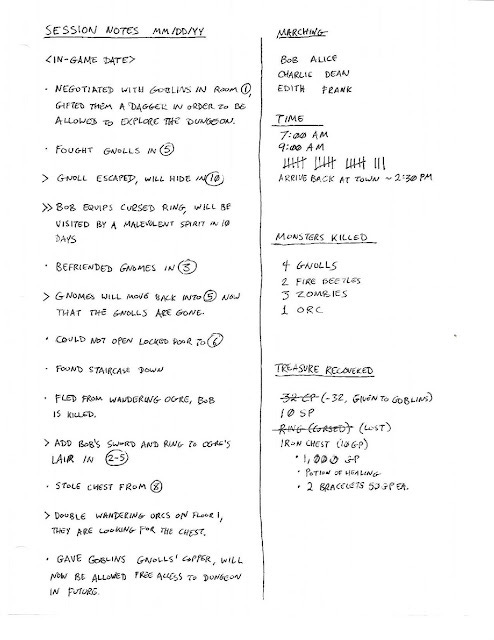
In my experience, delves can last multiple sessions, so I preferred to have a separate scrap sheet with all the treasure from a particular delve, but I think it gets the idea across.
If you’re willing to dip into the digital realm, this is exactly the sort of thing excel is for, since they save you the work of summing it all up yourself at the end. Here’s the very simple google sheet I use (feel free to copy my homework). Gold values go in the A column, notes in the B column the D column does the math.
Here’s what the Craastinistorex Hoard looks like
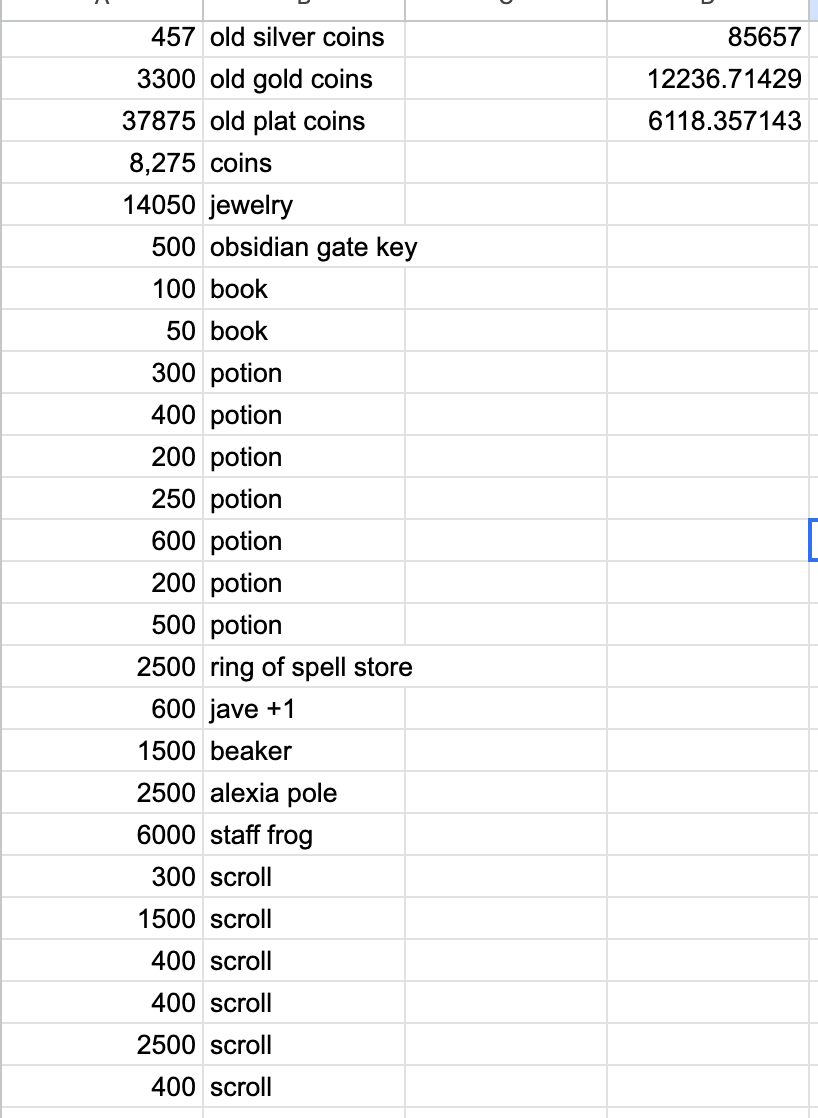
So a ~86k experience haul, split between 7 shares is 12237xp for the PCs and 6118xp for the henchmen.
For module authors, it’s so nice for you to give me these numbers in-line!
Open Letter To Authors
Here’s what I’m currently getting
The head from the huge statue of Vul (AV-42); 101 ancient octagonal platinum coins (see Arden Vul items), 457 ancient silver pennies (see Arden Vul items), 330 ancient gold solidi (see Arden Vul items), 7,679 cp, 6,492 sp, 5,647 gp, 453 pp; 40 pieces of jewelry worth 100-600 gp each; a gold key to the Obsidian Gates (5-6D); a copy of the Deeds of Marius Tricotor by Lucius Cornelius scriptor (see Arden Vul books); a copy of Yeng of Narsileon’s Great Villains of Archontos, part V: Priscus the Traitor (see Arden Vul books); eight potions, of sweet water, gaseous form, extra healing, philter of love, growth, treasure finding, molasses, and deafening light (see new magic items for the last two); a ring of spell storing; a javelin +1, +2 versus dragons; a suit of cursed armor of arrow attraction (banded mail; see new magic items); a beaker of plentiful potions; an Alexia’s useful pole (see new magic items); a staff of the frog (see new magic items); and six scrolls (fireball, protection from magic, ice storm, tongues, protection from demons, and feline senses [see new spells]).
This is horrible to try to use. Here’s what would ease my burden:
A ~4ft tall, ~5000lb marble head of Vul (from AV-42, p104).
457 silver coins with a 1/2” diameter. They have an emperor in a helmet on one side and a gladius surrounded by the words “It Shall Be Conquered” on the other (see Ancient Silver Pennies, p1013). 457g, 3.7lb.
330 1” diameter golden coins with an emperor wearing an olive wreath on one side and an emperor in a chariot pulled by horses on the other (see Ancient Gold Solidi, p1013). 3300g, 66lb.
101 octagonal platinum coins with a 2” diameter. They have a dragon’s head on one side and an obelisk with an eye on the other, inscribed with “The Archonteon Emporer Shall Rule” on one side and “Authority is Power” on the other (see Octagonal Platinum Coins, p1013). 37875g, 151lbs.
7,679 cp, 6,492 sp, 5,647 gp, 453 pp. Total value of 8,275g and weighs 405.4lb, or 8,237g and 251.8lb without the copper.
40 pieces of jewelry. Gold values: 100, 150x3, 200x4 250x5, 300x3, 350x6, 400x4, 450x6, 500x6, 550, and 600. Total value of 14050g, 40lbs.
A 15” long, 1.5” diameter golden rod (see Gold Key to the Obsidian Gates, p1014). 500xp, 1000g, 19lbs.
A 8•10•5” codex with a purple leather binding that is embossed with a yellow archon’s seal, written in Mithric (The Deeds of Marius Tricotor, p1032). 100g, 7lbs.
A 11•16•6” codex, bound in blue horsehide and written in Archontean (Great Villains of Archontos, part V: Priscus the Traitor, p1037). 50g, 7lbs.
7 Potions. 2.5lb each.
Potion of Gaseous Form (DMG126). 300xp, 400g.
Potion of Extra Healing (DMG126). 400xp, 800g.
Philter of Love (DMG127, see also Charm, PHB55). 200xp, 300g.
Potion of Growth (DMG126). 250xp, 300g.
Potion of Treasure Finding (DMG127). 600xp, 2000g.
Potion of Molasses (p985). 200xp, 800g.
Potion of Deafening Light (p985). 500xp, 1000g.
A magic ring (Ring of Spell Storing [druidic; Entangle[1] (PHB54), Invisibility to Animals[1] (PHB54), Hold Animal[3] (PHB57), Dispel Magic[4] (PHB59), and Repel Insects[4] (PHB60), DMG131). 2500xp, 22500g.
A magic javelin (Javelin +1/+2 vs Dragons). 600xp, 3000g, 2lb.
Magic Banded Mail (Cursed Armor of Arrow Attraction, p964). 2000g, weightless.
A magic beaker (Beaker of Plentiful Potions, DMG138, produces 4x Potion of Climbing (DMG125) and 4x Potion of Flying (DMG126, see also Fly, PHB73)). 1500xp, 12500g, 4lb.
A magic 3-inch long, 3/4-inch diameter rod of steel (Alexia’s Useful Pole, p961). 2500xp, 15000g, 1lb.
A magic staff made of oak and carved in floral and geometric patterns (Staff of the Frog, p995). 6000xp, 30000g, 5lb.
6 scrolls
Scroll of Fireball (10d6 damage, PHB73). 300xp, 900g.
Scroll of Protection from Magic (DMG128). 1500xp, 7500g.
Scroll of Ice Storm (PHB77). 400xp, 1200g.
Scroll of Tongues (PHB49). 400xp, 1200g.
Scroll of Protection From Demons (DMG128). 2500xp, 12500g.
Scroll of Feline Senses (p1020). 400xp, 1200g.
Warning: I wrote a lot more in response than I expected to at the start here. My bad!
There's this great tension that seems to exist between adventure writers about exactly how much they should dictate what the GM finds vs what the GM gets to make up on their own. I've seen people (such as Beau) argue that it should be prescribed by the module, but many others seem to favor the "random every time" approach. There are two competing priorities here.
The first is "replayability" which I think is a faulty reason. The gist is that the author wants to make it so that every table's experience is different and unique to them. If you're one of those special groups that runs the origina I6 Ravenloft every Halloween, that might be cool for replayability as well. For almost everyone else, when was the last time you ran the same adventure multiple times or cared if another table got the same magic items as you when they ran it? If you did, do you think your players even remembered that there was a ring of protection in room 23? The answer to these are "almost never", "not at all", and "not a chance".
Adventure writers are almost never best served to tell the reader that there are 2d8 gems in a room. Just roll it as the author and say "you found 5 gems (2 x A, B, C)". Making the GM roll treasure in your module probably means you need to think up more interesting things to give as treasure. People buy the modules so they don't have to roll on the treasure tables. If they don't like a piece of treasure, they can choose to change it anyway.
---
The second reason is more justifiable from an authorship perspective: space. Barton's horde entry is 186 words. Beau's is 457. That's 2.5 times the words. If you're publishing a physical product, you end up being very cognoscente of trying to avoid bloat. Barton doesn't seem to care about keeping Arden Vul's layout tidy, but if you're trying to do control panel layout or keep things constrained due to page count costs, it's a real restriction. I had to make a lot of hard choices in Citadel of the Sun-Kings related to detail vs brevity so that things would fit in the final layout nicely.
If you're writing a limited-scope module (like I just did for Necrotic Gnome with Quick Delve #5 - Golden Lies, coming soon!) you are given a specific word count to stick to pretty closely. There's a real balance of getting the most out of every word. You want to drop a ton of cool ideas and fun treasure. Then you realize you've eaten up 1/8 of your entire word count on a single room. It's a tough balance.
I could go on, but I think I've rambled long enough at the bottom of someone else's blog post!
(Sorry, not trying to name drop my upcoming adventures, just using them as experience to justify my ideas.)