
Arden Vul - Halls of Thoth
Huuuuuge

← Back to overview
reddit thread
Level 3, The Halls of Thoth, is the traditional entry point for Arden Vul: it’s where the rumors point, and where the most obvious entrance (the Pyramid of Thoth) dumps the players.
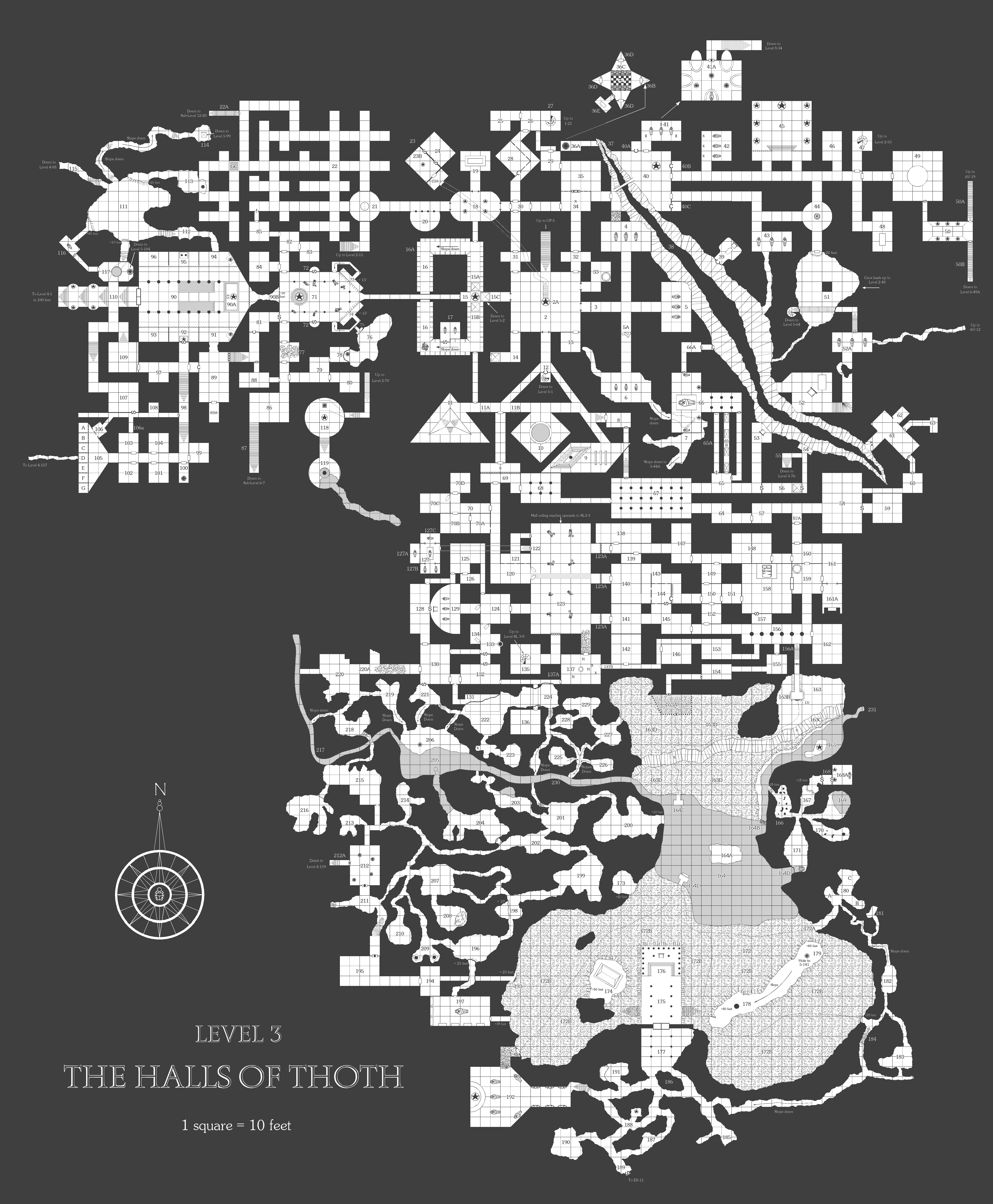
It’s also the biggest level and has 4 distinct regions. I’m only going to be reviewing the northern and western (since that’s all my players have done and will do), but that still covers ~120 rooms.
Overview
I like this section! It’s a natural, conversational explanation from author to GM about the level’s high-level concepts. We find out:
The northern areas were constructed by the thoth priests of antiquity, but are now controlled by various factions.
The halfling extortionists control the entrance.
The halflings have a territory conflict with the goblins.
The western area was constructed by the set cult of antiquity, and has been reclaimed by the modern set cult.
The central regions are controlled by the beastmen.
The natural southern regions are unclaimed (save for a mad mage and his fungal servitors)
Then, we get a “General Construction Notes” header:
General Construction Notes
Heqeti areas: 3-51, 3-117, 3-192.
Rudishva areas: 3-39
Archontean areas: all worked areas (except 3-39, 3-51, 3-117, and 3-192).
I still don’t know what to do with this; is the idea that I should memorize these areas before I play? Should I use these to annotate my map (if so, why didn’t Barton annotate the map?)
If we hop over to the room keys:
3-117: Dripping Chamber, with Well to Level 5 (5-104)
The corridor from 3-116 is narrow, low, and cramped (5’x5’x5’); it is completely undecorated. It ends at a square stone door with a simple wooden latch. The latch lifts easily.
Brightly lit by no visible light source, the chamber is sheathed in white marble squares (5’ square) on all walls, floor and ceiling. The floor is slightly convex, dipping towards a 10’-diameter basin placed in the middle of the floor. Each square of marble has a symbol incised in its center and filled with gold inlay. The symbols are identical: an open, toothless mouth, from which extends a thick tongue. All of the marble tiles are slick with dripping moisture; close examination will determine that the moisture beads up on each incised tongue, only to drip off or down, eventually collecting in the basin. Not surprisingly, the chamber is quite slippery. All movement is halved, and the incautious should roll 3d6 under DEX to keep their footing. Anyone slipping has a chance to end up in the basin, where he or she will be affected by multiple doses of sweat of Rimmaq-Isfet (see new magic items) for 5-20 damage.
At the east end of the room is a 5’-diameter well extending some 200’ down and exiting on Level 5 (5-104). Small handholds have been chiseled into the stone well.
The liquid is clear and slightly more viscous than water. It is in fact an extrusion of Rimmaq-Isfet and is known to sages as the sweat of Rimmaq-Isfet (see new magic items). There is enough sweat in the basin to fill 10 flasks. It will be replenished at a rate of 1 flask-full per day.
Treasure:
Up to 10 flasks of sweat of Rimmaq-Isfet (see new magic items).
From a player-facing perspective, we’re set. And if Barton wanted the GM to know a room was built differently, that belongs in a GM note at the bottom of the room description.
Significant Regions
The various regions (which mostly correspond to the random encounter regions, but not entirely) each get a writeup, which is a little more in-depth than what we got in the overview. Unfortunately, we also get mechanics in these blocks. For instance…
1. Northern Region: Precincts of Thoth (3-1 to 3-70)
The halls in this region were the center of the public rituals held in honor of Thoth. The great statue of Thoth (the Glory of Thoth - 3-2), the three mystery chambers (3-9, 3-10, and 3-11), and the mortuary centers for devotees (3-16 and 3-22) were among the ‘sights’ visited by the faithful. Of course the priests of Thoth also kept some sites carefully hidden, as befit the god of hidden knowledge.
Factions: The band of evil halfling thugs and brigands led by the notorious Phlebotomas Plumthorn (3-5) occupies a key (and highly defensible) section of the region adjacent to the main entry point from the surface (areas 3-3 to 3-6). They claim authority over the entire region and attempt to extort licenses and tribute from all who pass through area 3-2.
Construction: Almost all construction in this region is Archontean, with 10’ ceilings and iron-bound wooden doors. The Thoth priests preferred to sheath the stone walls with plaster, on which they painted elaborate frescoes celebrating Thoth. Many of the frescoes are still visible and might reveal some general or even useful information to those unfamiliar with Thoth. Considering a 10’x10’ section of wall for a turn might reveal some useful and comprehensible information (25% chance). If so indicated, the GM should roll d100 on the table on the next page to determine what the art-lover has learned.
Environment: Cool and dry
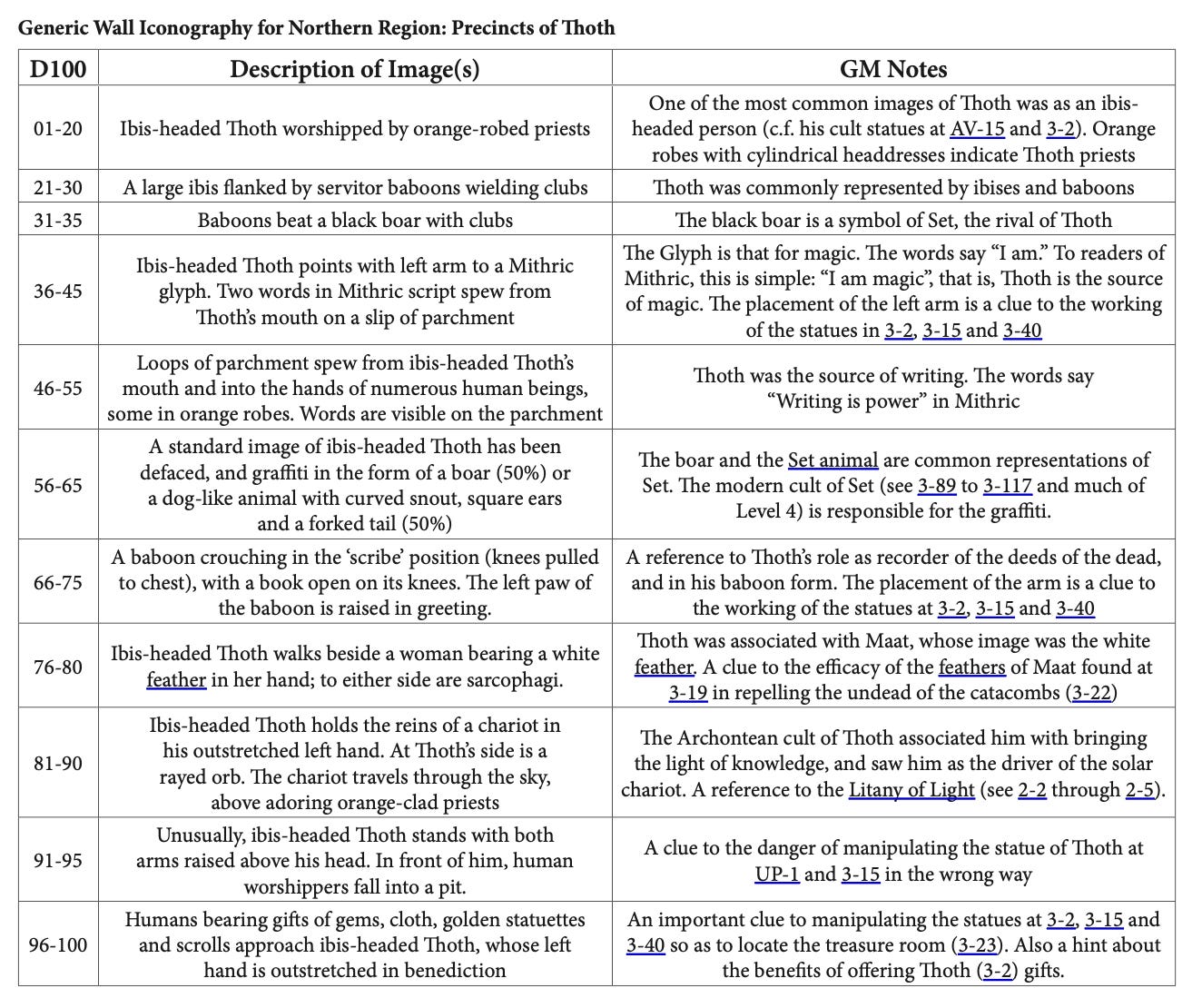
The northern regions are covered in elaborate Thoth frescoes, each in a quantum state of surviving-or-not that collapses only when a character looks at it.
I would have massively preferred that we take these 11 entries and just put them in the rooms. In actual play, I totally forgot about this entire mechanic and only just now as I’m writing the review did I remember it existed.
Here’s the legwork:
3-7: Ibis-headed Thoth holds the reins of a chariot in his outstretched left hand. At Thoth’s side is a rayed orb. The chariot travels through the sky, above adoring orange-clad priests.
3-9: Ibis-headed Thoth points with left arm to a Mithric glyph. Two words in Mithric script spew from Thoth’s mouth on a slip of parchment (“I am.”)
3-10: Unusually, ibis-headed Thoth stands with both arms raised above his head. In front of him, human worshippers fall into a pit.
3-17: Humans bearing gifts of gems, cloth, golden statuettes and scrolls approach ibis-headed Thoth, whose left hand is outstretched in benediction.
3-23: A baboon crouching in the ‘scribe’ position (knees pulled to chest), with a book open on its knees. The left paw of the baboon is raised in greeting.
3-25: A large ibis flanked by servitor baboons wielding clubs.
3-29: A standard image of ibis-headed Thoth has been defaced, and graffiti in the form of a dog-like animal with curved snout, square ears and a forked tail.
3-38: A standard image of ibis-headed Thoth has been defaced, and graffiti in the form of a boar.
3-49: Ibis-headed Thoth worshipped by orange-robed priests.
3-59: Loops of parchment spew from ibis-headed Thoth’s mouth and into the hands of numerous human beings, some in orange robes. Words are visible on the parchment (“Writing is power”).
3-68: Ibis-headed Thoth walks beside a woman bearing a white feather in her hand; to either side are sarcophagi.
Random Encounters
Arden Vul has a wide variety of encounter tables and level 3 is an exemplar of that. We have unique tables for each region (separate from the Significant Regions above), with often different encounter frequencies and probabilities. Here we group by:
Northern Area (areas 3-1 to 3-70). 1/6th chance every 3 turns
Western Areas 3-71 to 3-115 1/6th chance every 3 turns
Areas 3-71 to 3-74, 3-82 to 3-85
Areas 3-81, 3-89 to 3-110
Areas 3-75, 3-76, 3-78 to 3-80, 3-86 to 3-88
Areas 3-111 to 3-115
Central Region: Beastmen (areas 3-120 to 3-162)
Great Hall Area (3-120, 3-121, and 3-123)
Western Halls (3-124 to 3-137)
Beastman Precincts (3-137 to 3-162)
Southern Region: The Great Cavern and Surrounding Caves (areas unspecified). The chance and frequency are unspecified.
Northern Great Cavern (3-163)
River Caves (areas 3-194 to 3-231)
Eastern and Southern Caves (Areas 3-177 and 3-180 to 3-192)
Southern Great Cavern (areas 3-172 to 3-176, 3-178 and 3-179)
Two main things I want to call out here!
First, the random encounters give me light ludonarrative dissonance. The intro tells us:
the Halls of Thoth are the most accessible level to the surface (via the Grand Pyramid of Thoth at AV-15, which leads to 3-1). As a result, it sees a fair amount of traffic, particular in its central areas (3-1 to 3-20 or so).
which is reinforced by the plentiful graffiti on the way down (more about this later).
Yet, there’s an encounter once every ~18 turns. We use a d20 chart, and only a few of the entries (12-13: NPC adventurers, 17-18: beastman patrol, and 20: set patrol) register to me as “traffic”, so 5/20, which means we get an encounter with other people walking around once every ~72 turns. So mechanics say this place is deserted, narrative says it isn’t.
Second, and this is less of a problem specifically on this level, but it’s not clear to me how to run mismatched encounter frequencies. Say that region A has you rolling once every 3 turns, and region B has you rolling once every 2 turns. Say you spend your first and second turn in region A and third turn in region B, do you roll? Say you spend your first turn in region B and second in A, do you roll?
I vastly prefer procedures that don’t require memory/state, so I’d much rather roll with a smaller chance every turn. For instance, rather than rolling 1-in-6 every 3 turns, we can roll 1-in-20 (or 1-in-6+2-in-6 if you want to be precise) every turn. Rather than rolling 1-in-6 every 2 turns, we can roll 1-in-12 every turn. This means I don’t have to track how many turns it’s been since the last time I rolled, and moving between regions is unambiguous.
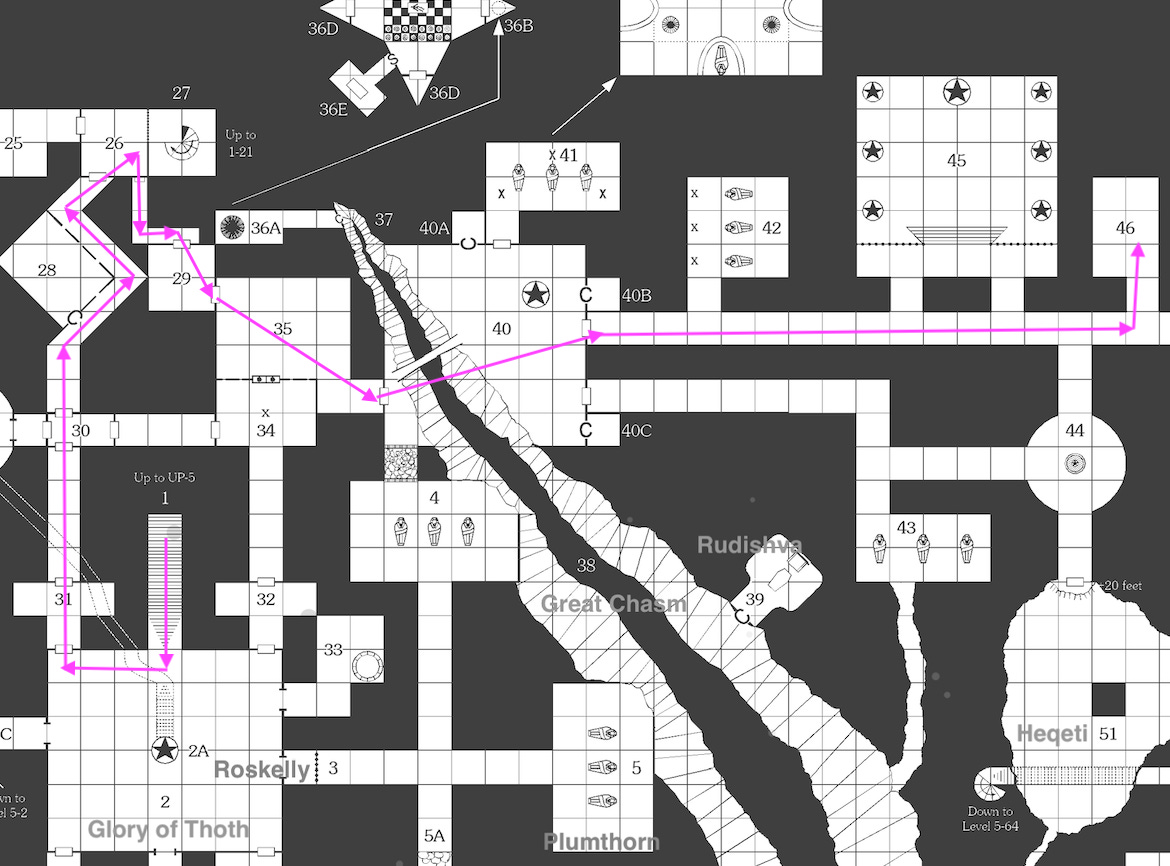
I’d also prefer for this information to be included in the room description. It’s very easy to cross into different regions and different dungeon levels. For instance, here’s a route that my players have been frequently taking: 3-1 ➡️ 3-2 ➡️ 3-31 ➡️ 3-30 ➡️ 3-18 ➡️ 3-20 ➡️ 3-21 ➡️ 3-22 ➡️ 3-113 ➡️ 3-111 ➡️ 3-116 ➡️ 3-118 ➡️ 5-104 ➡️ …
So that takes us from Region 1 ➡️ Region 2.d ➡️ unspecified ➡️ Level 5
Level Key
Skipping around here…
3-1: Entrance Stairs up to UP-5
The stairs leading down from the Great Pyramid (UP-5) are steep and cramped. They descend some 350’ and exit into 3-2. The stairs were once flanked with brightly colored frescoes outlining the glories of Thoth. Today the chute-like stairway is blackened with soot, grime, and desecration. Little meaningful is left to decipher, although the GM may offer some tidbits: a flash of gold paint, a blue beak, some broken runes.
What is legible is a variety of graffiti, some informational and some obscene. PCs may find 1-4 instances of graffiti scratched onto each 10’ section of wall. The GM should roll on the following table to determine the nature of the graffiti.
We have 350ft of stairs, and there are 1d4 instances of graffiti on every 10ft of wall. We could read that as 35 sections of 1d4 graffiti each, or as 70 sections, since there’s a wall on both sides of the stairs. Thus, we’re rolling either 35d4 (~88 instances) or 70d4 (~175 instances). Then, each instance of graffiti is... random? So we roll 88d20 and look up each result in the table. Here’s a sample of 88d20: [6, 9, 3, 3, 3, 8, 18, 9, 11, 2, 17, 13, 10, 14, 1, 12, 5, 16, 10, 2, 13, 8, 18, 6, 15, 3, 3, 9, 14, 17, 20, 12, 3, 8, 10, 6, 5, 20, 15, 13, 5, 14, 4, 8, 15, 1, 5, 6, 16, 11, 4, 12, 9, 20, 3, 3, 13, 9, 7, 11, 13, 6, 20, 15, 20, 15, 14, 2, 1, 17, 9, 16, 16, 11, 2, 18, 3, 13, 14, 1, 11, 9, 5, 8, 13, 11, 1, 12].
Why are we doing this? Eyeballing the list, it has every number except 19. Can we just agree that all of the graffiti is… just… there and skip the weird random procedure for resolving an enormous pile of it?
I have a feeling that the way Barton imagined it, players would read a couple of instances of graffiti per trip. If so, we need to change the mechanics!
3-2: The Glory of Thoth
This will be the first real room in Arden Vul for a lot of tables. The room description is so long.
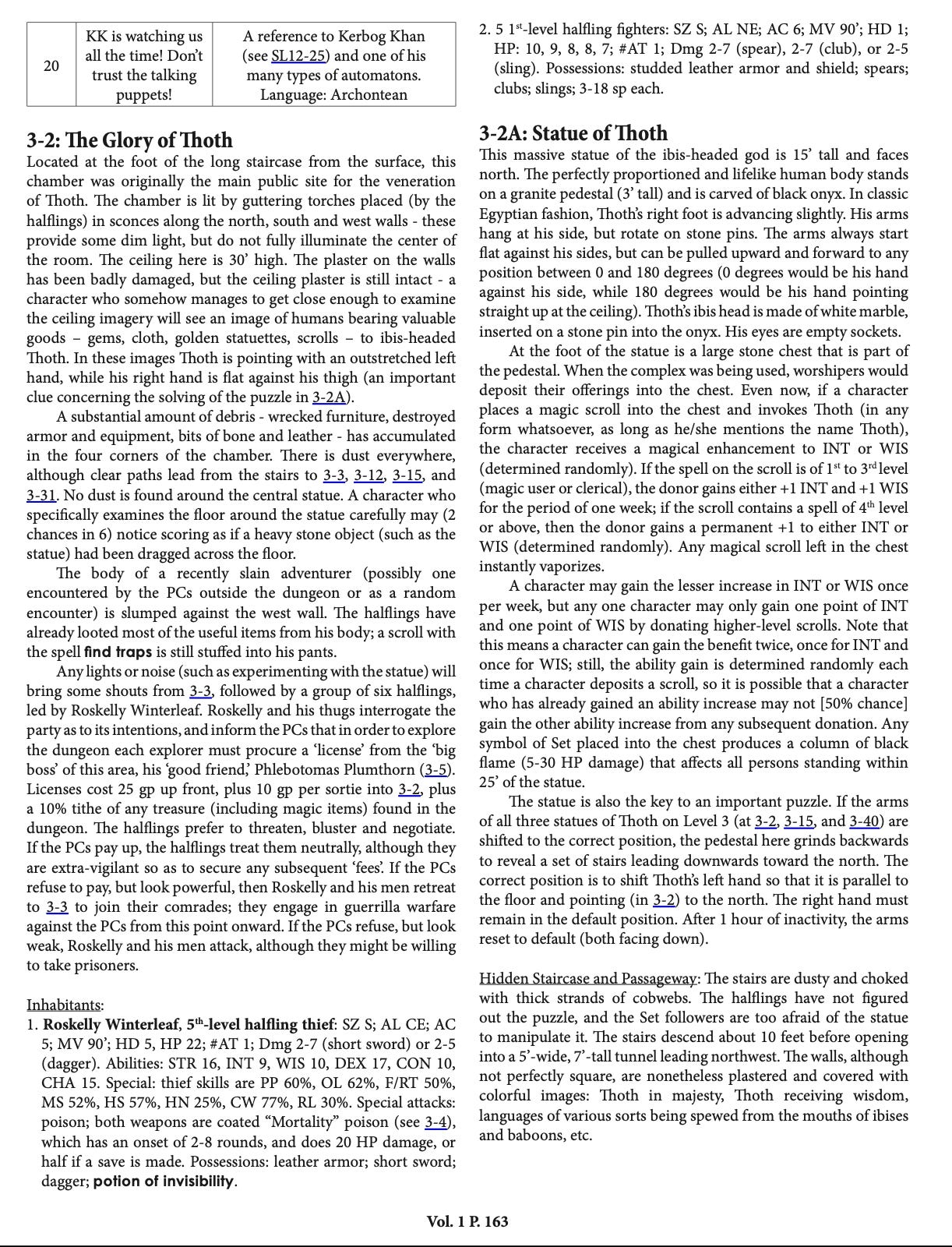
I know there’s a whole article on this already, but I want to re-touch on it. I spun up a gemini gem that rearranges Barton’s descriptions, keeping as much of the detail and original prose as possible. Here’s what it spits out:
3-2: The Glory of Thoth
Note: Any lights or noise (such as experimenting with the statue) will bring some shouts from 3-3, followed by a group of six halflings, led by Roskelly Winterleaf.
Located at the foot of the long staircase from the surface, this 30’-tall chamber is lit by guttering torches placed in sconces along the north, south, and west walls, providing dim light that does not fully illuminate the center of the room. A substantial amount of debris—wrecked furniture, destroyed armor and equipment, bits of bone and leather—has accumulated in the four corners of the chamber. Dust is everywhere, although clear paths lead from the stairs to 3-3, 3-12, 3-15, and 3-31. No dust is found around the central statue. The plaster on the walls has been badly damaged, but the ceiling plaster is still intact. The body of an adventurer is slumped against the west wall.
Central statue: A character who specifically examines the floor around the statue carefully may (2 chances in 6) notice scoring as if a heavy stone object (such as the statue) had been dragged across the floor.
Ceiling plaster: A character who somehow manages to get close enough to examine the ceiling imagery will see an image of humans bearing valuable goods—gems, cloth, golden statuettes, scrolls—to ibis-headed Thoth. In these images Thoth is pointing with an outstretched left hand, while his right hand is flat against his thigh.
Body of an adventurer: The body is recently slain (possibly one encountered by the PCs outside the dungeon or as a random encounter). Most of the useful items have already been looted from his body; a scroll with the spell Find Traps is still stuffed into his pants.
Roskelly Winterleaf: 5th-level halfling thief: SZ S; AL CE; AC 5; MV 90’; HD 5, HP 22; #AT 1; Dmg 2-7 (short sword) or 2-5 (dagger). Abilities: STR 16, INT 9, WIS 10, DEX 17, CON 10, CHA 15. Special: thief skills are PP 60%, OL 62%, F/RT 50%, MS 52%, HS 57%, HN 25%, CW 77%, RL 30%. Special attacks: poison; both weapons are coated “Mortality” poison (see 3-4), which has an onset of 2-8 rounds, and does 20 HP damage, or half if a save is made. Possessions: leather armor; short sword; dagger; potion of invisibility.
Halfling fighters: 5 1st-level halfling fighters: SZ S; AL NE; AC 6; MV 90’; HD 1; HP: 10, 9, 8, 8, 7; #AT 1; Dmg 2-7 (spear), 2-7 (club), or 2-5 (sling). Possessions: studded leather armor and shield; spears; clubs; slings; 3-18 sp each.
GM NOTE: This chamber was originally the main public site for the veneration of Thoth. The torches in the sconces were placed here by the halflings.
GM NOTE: The ceiling imagery provides an important clue concerning the solving of the puzzle in 3-2A.
GM NOTE: The halflings have already looted most of the useful items from the adventurer’s body.
GM NOTE: Roskelly and his thugs interrogate the party as to its intentions, and inform the PCs that in order to explore the dungeon each explorer must procure a ‘license’ from the ‘big boss’ of this area, his ‘good friend,’ Phlebotomas Plumthorn (3-5). Licenses cost 25 gp up front, plus 10 gp per sortie into 3-2, plus a 10% tithe of any treasure (including magic items) found in the dungeon. The halflings prefer to threaten, bluster and negotiate. If the PCs pay up, the halflings treat them neutrally, although they are extra-vigilant so as to secure any subsequent ‘fees’. If the PCs refuse to pay, but look powerful, then Roskelly and his men retreat to 3-3 to join their comrades; they engage in guerrilla warfare against the PCs from this point onward. If the PCs refuse, but look weak, Roskelly and his men attack, although they might be willing to take prisoners.
This is so much easier for me to run.
There’s a lot of room to trim this down and re-arrange still, but it’s already a direct improvement. For instance, “Dust is everywhere, although clear paths lead from the stairs to 3-3, 3-12, 3-15, and 3-31.” This requires the GM to look at the map and translate (3-3 = east, 3-12 = south, 3-15 = west, 3-31 = north-west).
3-5: More Ancient Tombs, with Halfling Leaders
This room is decorated almost identically to 3-4, with formerly gilded luxury paintings now stained with soot and other unknown substances.
This is an anti-pattern! When I’m running a room, I want everything I need to be in the room key.
This is a good point to talk about NPC descriptions. Here’s Roskelly:
[…] followed by a group of six halflings, led by Roskelly Winterleaf. Roskelly and his thugs interrogate the party as to its intentions, and inform the PCs that in order to explore the dungeon each explorer must procure a ‘license’ from the ‘big boss’ of this area, his ‘good friend,’ Phlebotomas Plumthorn (3-5).
[…] The halflings prefer to threaten, bluster and negotiate. If the PCs pay up, the halflings treat them neutrally, although they are extra-vigilant so as to secure any subsequent ‘fees’. If the PCs refuse to pay, but look powerful, then Roskelly and his men retreat to 3-3 to join their comrades; they engage in guerrilla warfare against the PCs from this point onward. If the PCs refuse, but look weak, Roskelly and his men attack, although they might be willing to take prisoners.
Inhabitants:
1. Roskelly Winterleaf, 5th-level halfling thief: SZ S; AL CE; AC 5; MV 90’; HD 5, HP 22; #AT 1; Dmg 2-7 (short sword) or 2-5 (dagger). Abilities: STR 16, INT 9, WIS 10, DEX 17, CON 10, CHA 15. Special: thief skills are PP 60%, OL 62%, F/RT 50%, MS 52%, HS 57%, HN 25%, CW 77%, RL 30%. Special attacks: poison; both weapons are coated “Mortality” poison (see 3-4), which has an onset of 2-8 rounds, and does 20 HP damage, or half if a save is made. Possessions: leather armor; short sword; dagger; potion of invisibility.
What does Roskelly look like? How does he act? I can get a “bully” vibe from the order of battle and air-quoted words (‘license’, ‘big boss’, ‘good friend’, ‘fees’), but that’s me reading subtext.
Here’s Plumthorn:
Negotiating with Plumthorn: Phlebotomas does not typically negotiate with newcomers, leaving the mundane business and dirty work to his lieutenant, Roskelly. Only in the case of pressing need, or if visitors have convinced the guards at 3-3 that they have valuable information, will Plumthorn deign to parlay. In such cases, he might be willing to trade information. Phlebotomas knows the following information about the Halls:
a. A hidden passage exists somewhere in Level 3. Phlebotomas suspects it is connected to the statue in 3-2.
[…]
j. The lower halls are creepy and dangerous, and were not carved by the ibis priests. The stair to Level 5 (3-12) leads to a cave next to a cursed, pillar-ridden hall.
What does Plumthorn look like? How does he act? I get a sneering vibe from him from “mundane business” and “dirty work”. Then, Blandveg has no description at all (other than in the faction write up, where it says he wants arcanum).
Compare to Jon’s depiction of Roskelly in 3d6DTL
“Oi! Who’s there now? Step out — let me see. You’ve got to pay the price, you know!”
You see 6 halflings lead by a female halfling who has Blonde hair which is crazily spiked like a punk-rocker-sort-of-thing, deliberately spiked with oil, and she has a cruel scar on her lip which brings her one lip up into a permanent sneer […]. She comes up, she’s got her hands on her hips.
This is all totally invented! Jon gave her (Jon elected to genderbend; the text says “Roskelly and his thugs”) a distinct Cockney British soccer hooligan persona, invented the hair color and style, invented the scar, and invented the mannerisms (hands on hips). This is wonderful detail, and it brings her character to life at the table. I wish it was in the book!
On the positive side, I love the explicit list of “stuff plumthorn knows”.
3-10: Pool of Youth
Through the mist is visible a 20’-diameter pool rimmed with a 1’-tall, blue-granite lip […] It is possible to restore the pool to its original deep azure blue color and its full functionality, though:this may be accomplished either by mixing three vials of holy water into the sludge, using a potion of sweet water, or by casting purify water or purify food and drink on the liquid.
Some quick math. We have a 20’ diameter pool that’s 1’ high, which is 314 cubic feet of water.
Here’s Purify Water: “This spell makes dirty, contaminated water clean and pure, suitable for consumption. Up to one cubic foot per level of the druid casting the spell can be thus purified. The reverse of the spell, contaminate water, works in exactly the same manner, and even holy/unholy water can be spoiled by its effects.”
Here’s Purify Food and Drink: “Area of Effect: 1 cubic foot/level […] When cast, the spell will make spoiled, rotten, poisonous or otherwise contaminated food and/or water pure and suitable for eating and/or drinking. Up to 1 cubic foot of food and/or drink can be thus made suitable for consumption. The reverse of the spell putrefies food and drink, even spoiling holy water. Unholy water is spoiled by purify water.”
Do we want a 5th level Cleric to cast Purify 63 times?
It’s tough. We want to create a mysterious magical world, but the more loosey-magical you get the less agency the players have. If this was written for a magic system with loosey-goosey magic (like Dungeon World or FATE), I’d be totally on board. Instead, AD&D has extremely specific spell descriptions, so I’d prefer for the world to properly interoperate with that.
3-16: Halls of Thoth’s Beloved
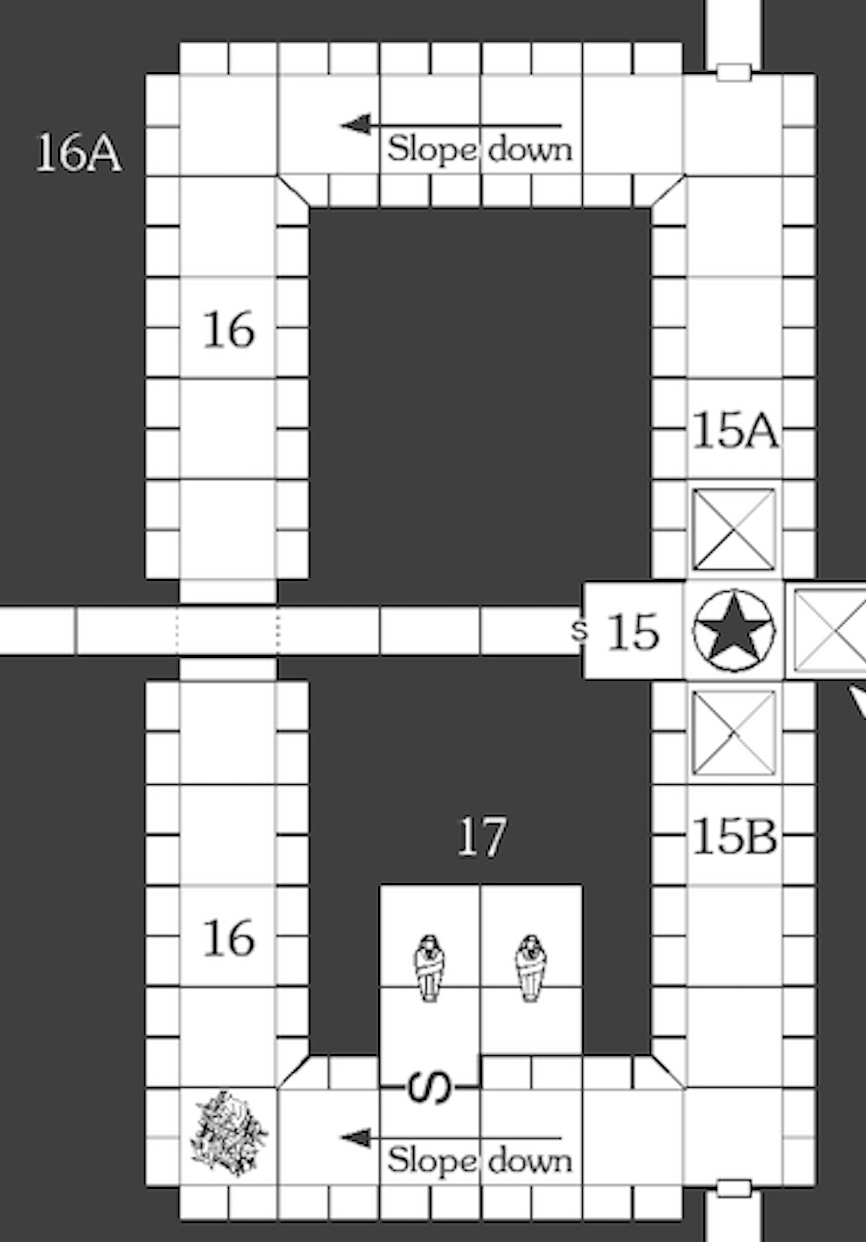
Inhabitants:
1. 9-12 giant rats: SZ S; AL N(E); AC 7; MV 120’; HD 1-4 HP; HP 4(x3), 3(x3), 2(x3), 1(x3); #At 1; Dmg 1-3. Special attacks: 5% chance of disease. The rats attack leaping from niches at the level of PCs’ heads/torsos. This tactic provides a bonus to surprise (surprise on 1-3).
Treasure:
The rats’ nest contains 459 sp, four citrines (50 gp each), a large pearl (500 gp), two aquamarines (100 gp each), a lapis lazuli and gold ring worth 500 gp, and a cursed blacklight torch (see new magic items).
Quick sanity check. We’re told that there’s 9-12 giant rats (1d4+8, 3d2+6, or 1d2•3+6), and that there are 3 rats with 4 hp, 3 rats with 3 hp, 3 rats with 2 hp, and 3 rats with 1 hp. Ignore how suspiciously even this is and say we roll that there are 10 rats. How much HP do they have? Unclear! The whole book is like this! Here, let me shuffle that for you: [1, 2, 2, 3, 3, 4, 1, 2, 4, 4, 1, 3]. Now, if you roll 10 rats, use the first 10 numbers.
Giant Rats are worth 7 + hp XP (because 1e thinks that it’s relevant to give players 9 xp for 2hp rats and 10 xp for 3 hp rats, the difference is obviously relevant and worth the math/complexity). Our ten rats are therefore worth 70 + 1 + 2 + 2 + 3 + 3 + 4 + 1 + 2 + 4 + 4 = 96 xp. They’re guarding a little hoard worth 459s (which is either 23g if you’re playing 1e or 46g if you’re playing osric) and 1400g worth of gems and jewels, which work out to a nice ~15x treasure:monster multiplier.
Rats defeated, we get easy access to 3-16A and 3-17.
The burial niches are mostly bereft of valuables. A party that insists on searching all the niches (560 in total) will be in for a lengthy search indeed (8-12 hours). Despite the risk of random encounters, such a search might reveal one of the following (1 in 6 chance per hour of searching).
Are we rolling 8-12 (4d2+4 maybe?) and then using that to figure out how many searches we roll? Is this wall-clock or man-hours? Then the search results have entries like
“gold signet ring, 25% chance the family name is still an important one in the Archontean empire.” Why have there be a %chance; just make it one of the important signet rings and then specify which one.
“scroll with one of the four canticles of the Litany of Light (see Arden Vul books).“ Why not specify which of the four canticles?
“key to a mundane lock (GM’s choice)” kill me
3-16A: Burial Niche
on the plug is a symbol of the inhabitant of the niche’s family: a black tower with a single window shining forth light into the darkness (GM Note: this is still one of the sigils of clan Krakteros, one of the Five Families [see World of Archontos appendix] that run the Archontean Empire).
Love the explicit GM Note! This brushes up against one of the Open Problems of OSR design: “Does My Weird Guy Know This Specific Thing?” 3.5e/5e/Pathfinder/WWN/etc all have some sort of skill roll that resolves such questions, 1e does not. When I tell my players that the plug has a symbol of a black tower with a single window shining forth light into the darkness, they will always ask if their character recognizes this thing. It’s a totally fair question - their character has been living in this world all of their life and knows a lot about this world that the player does not. Perhaps they’re familiar with the symbol?
This room has us fight a tough skeleton with 3 HD and worth an undefined amount of XP (perhaps, 70 + 2/hp for a total of 110) in order to get a sword+1 (2000g) and 1580g worth of gems and jewels, for a solid ~33x treasure:monster ratio.
3-17: Hidden Tomb
Observant PCs may notice (2 in 6 chance when passing this section of the Halls) that the trash in front of this section of wall has been disturbed in a regular pattern.
What does “Observant PCs” mean - which ones of them are observant? Maybe the intention is that each PC rolls a 2-in-6 and the ones that get it are “observant” in this case?
Inside, 4 ghouls (65+2/hp xp ea → 65*4 + 2*13 + 2*12 + 2*11 + 2*11 = 354xp) guard
4 large (4’ high, 50 lb each) alabaster urns, possibly worth 225 gp each
are they worth 225g or not?
“two rings, each a ring of friendly defense (white gold) (see new magic items), inscribed Ruritanus and Aethelgifu, respectively (command word: ‘Amici’)” (25000g)
These rings are a nightmare. They’re rings of protection +1 (so +1 AC, +1 to saves) on both wearers. One wearer can either activate shield mode (sacrifice 2 AC to grant the other wearer the effects of Shield) or stealth mode (blind yourself to grant the other wearer Invisibility). Invisibility in 1e is unlimited duration, and the ring doesn’t have daily use limits or charges, so this is an infinite invisibility ring with unlimited range. 🙃🙃
Note 2: The rings have a command word, but there’s no in-world clue. What’s the intention for how players are supposed to learn what the rings do?
16 ancient gold solidi (worth 160g)
2,316 ancient copper bits (worth either 116g in 1e or 232g in osric)
1,135 ancient silver pennies (worth 1135g)
spear +1 with lapis inlay on the haft (3000g)
+1 spears are significantly more valuable than +1 swords for some reason
two silver torcs, each inscribed with an ibis head and a cornucopia (each is
worth 70 gp, together they are worth 280 gp).
is the complexity of different g/xp values depending on whether or not we keep them together worth it?
Cool, so 354xp worth of monsters defends 30,591g worth of treasure; a solid 86x treasure:monster ratio.
Earlier, Roskelly established:
Phlebotomas Plumthorn (3-5). Licenses cost 25 gp up front, plus 10 gp per sortie into 3-2, plus a 10% tithe of any treasure (including magic items) found in the dungeon.
Plumthorn wants 10% and Barton specifies that this includes magic items. How does Roskelly (or the characters) know the value of unidentified magic items so we can calculate this tithe? 1e doesn’t have “apparent values” and even telling if something is magical is difficult.
3-23B: Hall of Thoth + 3-24: Secret Treasury
There are easily 200,000 ancient copper bits and 15,000 ancient silver pennies here, among which are scattered 5,000 ancient gold solidi […]
Among the treasures are the following:
3 solid gold statuettes (of a cat, an ibis, and a baboon) worth 900 gp each (weighing 15 lb each)
a gilt wooden bed, now decayed (but with gilding worth 75 gp)
how much does the gilding weigh?
6 jade canopic jars worth 185 gp each (10 lb each)
8 crystal vases, from 1’ to 5’in height (100-600 gp each, but fragile)
how much do the vases weigh? why do they have random gold values?
a set of 12 death-masks made of hammered silver and adorned with crystals; these are of the first 12 high priests of Thoth. The masks are worth 500-2,000 gp each to imperial collectors/historians. There is a 1% chance per mask that a demon is entrapped in the mask.
why not roll this for us? Here: [18, 76, 98, 94, 93, 55, 95, 6, 24, 39, 44, 70]. There are no demons in the masks; great
why do the masks have random gold values?
2 Set animal masks taken from their rivals in antiquity (see new magic items)
Enameled reliquary #1: showing scenes of the deeds of Arden and Vul, containing a femur said to be that of Arden. The bone is a fake, but the relic could easily be sold for 350 gp anyway.
how much does the bone weigh?
why doesn’t this reliquary have a price like the others?
Enameled reliquary #2: showing the three mysteries of Thoth (3-9, 3-10, and 3-11) and containing a human hand and some odd dust (dust of dryness). Worth 175 gp.
how much does the reliquary weigh?
Enameled reliquary #3: showing the three obelisks in the city; a ray emanates from each and the three join at a sunken door. The bottom panel depicts a silver ankh. Inside are a pair of fully charged rudishva lesser power supplies (see new technological items) and 2 silver ankh-keys (see Arden Vul items). The reliquary is worth 250 gp. GM Note: this is a hint to the operation of the obelisks of AV-5, AV-41, and AV-28; doing so opens the doors at AV-34 that lead to the Chamber of the Beacon (SL14-1).
how much does the reliquary weigh?
6 elaborately wrought eggs made of platinum, gold, and lapis. Each is worth 1,000 gp. One is a puzzle-egg; if the puzzle is solved, it opens to reveal a massive black pearl (5,000 gp).
How does one solve the puzzle egg?
13 potions: extra healing x3; invisibility; invulnerability; growth; treasure finding; super-heroism; elixer of youth clairaudience; speed; fire breath; watery form (see new magic items)
harp of charming, made of ebony inset with ivory. The harp is full-sized (8’ tall) and heavy.
how heavy?
gauntlets of ogre power
tome of understanding
A deluxe, folio copy of the Litany of Light (see areas 2-2 through
2-5; worth 475 gp)
a huge codex entitled the First History of the Order of Thoth in Arden Vul (see Arden Vul books)
a parchment codex listing the names of all 239 high priests of Thoth, a few with annotations. Worth 250 gp.
a treatise entitled On the Errors of the Sortians (see Arden Vul
books)
clerical scrolls: holy name [2] (see new spells), spiritual weapon [2], remove curse [3], dispel magic [3], cure serious wounds [4], raise dead [5], neutralize poison [4], sun’s gift [4] (see new spells)
magic user scrolls: Frigg’s caustic kisses [2] (see new spells), ray of enfeeblement [2], blink [3], fireball [3], tiny hut [3], wall of fire [4], dimension door [4], stone shape [5], Pol’s improved eye [5] (see new spells)
illusionist scrolls: darkness [1], gaze reflection [1], improved phantasmal force [2], ultravision [?], fear [3], wraithform [?], emotion phantasmal killer [?], maze [5]
Okay, so solve the raise-the-statue-arms puzzle, defeat a 3HD construct, and get <checks notes> ~107k gold worth of treasure and ~116k gold worth of magic items.
This is enough treasure to get a party of 6 fighters to level 5.
1e has this note:
Under no circumstances can a character gain additional experience points by any means until he or she actually acquires the higher level through the required training/study course. […] ONCE A CHARACTER HAS POINTS WHICH ARE EQUAL TO OR GREATER THAN THE MINIMUM NUMBER NECESSARY TO MOVE UPWARDS IN EXPERIENCE LEVEL, NO FURTHER EXPERIENCE POINTS CAN BE GAINED UNTIL THE CHARACTER ACTUALLY GAINS THE NEW LEVEL.
So if you bring enough treasure back to town to gain two levels, you end up losing XP. Instead, the players are incentivized to intentionally leave the treasure behind, only bring some of it back to town, train, then go back and fetch more, and repeat. All of these old systems have similar rules; BX says you can’t level up twice from one adventure, same with ACKS/OD&D/7voz, etc. It’s so silly and leads to such weird, dissonant behavior.
3-34: Scrutiny of Thoth
A continual light spell was cast here years ago, at the center of the 15’-tall ceiling.
No complaints from me w.r.t. Arden Vul here. Instead, I want to use this to talk about compatibility. Here’s the AD&D 1e version of continual light:
This spell is similar to a light spell, except that it lasts until negated (by a continual darkness or dispel magic spell) and its brightness is very great, being nearly as illuminating as full daylight. It can be cast into air, onto an object, or at a creature.
And here’s the OSRIC 3 version
This spell creates a bright light, illuminating the target (a creature, object, or point in space) and everything in a 60ft radius around the target. […]
You can’t have more than three instances of this spell running at the same time. If you cast it again, your earliest-cast continual light spell that’s still in effect ends. At the end of every complete month the spell has been running, there is a 1 in 12 chance that the spell ends.
The chance that a particular casting of continual light survives X years is equal to
Arden Vul was sacked ~1200 years ago; the probability that a continual light spell cast in antiquity would still be active now is ~7×10⁻545 (aka zero).
There’s a lot of little changes like that in OSRIC 3; mostly monsters, spells, and magic items that have been changed (either by mistake, for legal distinctiveness, or because the authors thought their house rules ought to be canon) and they often have unintended side effects for backwards compatibility. See Hyrum's Law.
With a sufficient number of users of an API,
it does not matter what you promise in the contract:
all observable behaviors of your system
will be depended on by somebody.
3-36B: Tomb of Hithra Paleologos: Tiled and Trapped Entrance
The west wall contains the door to 3-36C in the form of a 5’-diameter circle made of blue granite. The door is magically barred with hold portal (cast by a 12th-level mage) and is trapped. Several inscriptions and images appear on the door. At the top of the circular plug are a pair of orange, heavily-lidded eyes which appear to stare at visitors. Just below the eyes the following phrase (in Mithric) is incised with gold fill into the stone: “Hithra the Paleologos Rests Within. Visitors are Unwanted.” Finally, below the inscription are two rows of five glyphs; the top row of glyphs glows with orange light, while the bottom row glows with purple light. The glyphs in each row depict, in order, a rod of command (Archon = king), a sinuous winged serpent (Dragon = queen), a robed figure making a blessing (High Priest = bishop), a robed figure performing an incantation (Sorcerer = knight), and a gladius (Legionary = pawn). [editor’s note: Barton forgot “Cataphract = rook”]
Opening the Door: The glyphs must be touched in the proper sequence for the door to open. That sequence is this:
1. orange High Priest
2. purple Sorcerer
3. orange Legionary
4. purple Archon.
A clue to this sequence may be found on the surrounding walls, as described below. […]
Opening the door, and avoiding the trap, will be made much easier if observers spend time examining the chessboards that cover the southwest and northwest walls. There are 18 distinct boards represented on these walls, with the pieces arranged differently on each. Despite the variety in the placement and survival of pieces, all 18 boards share the same likely fate: the pieces are arranged in such a way that an orange High Priest will take a purple Sorcerer and thus enable an orange Legionary to place the purple archon into checkmate. It takes an observer with expertise in chess, or a successful roll of 3d8 under INT to recognize this fact.
Man, what a letdown. We have this huge set-piece puzzle door with this awesome chess motif. We’ve bothered to describe how the chess pieces are re-skinned to be Archontean, and then specified that there are 18 puzzle boards that all involve the same checkmate.
Rather than providing the chess boards so the players can try to solve the puzzle, Barton instructs the GM to just have the players roll 3d8 under INT to solve the puzzle.
I searched the lichess database for puzzles that fit the bill; here’s 8 of them.
3-46: Larel One-Eye
Relics of the legendary hero Larel One-Eye (see Tales of Larel One-Eye in Arden Vul books) rest in this chamber. Larel is a figure of legend and one of the heroes of the ancient Archontean empire. His exploits have been spun into a series of moralizing folk-tales which emphasize the value of wit and good cheer over force. These tales are still told in some form in the Archontean Empire today.
Larel is most commonly depicted as a short, pudgy man with ginger hair in a pudding-bowl style, green eyes, and a red eye-patch. His iconic items are his sack, from which he drew myriad useful items, his thin dagger, and his humble grey cloak, patched with a variety of colorful patches.
The chamber is decorated on the north wall with an enormous fresco of Larel wearing a green cap and patched cloak, carrying a sack over his shoulder, with his dagger at his side. The other walls feature scenes from his famous tales, including Larel producing a chicken from his sack so as to distract wolves; Larel using his cloak as a quilt to conceal himself from an angry husband; Larel cleverly spiking four apples on his dagger while distracting the innkeeper with a card trick; Larel absconding from the castle of the wizard Tilgo with the latter’s spell book in his sack, and so forth.
Rather than lying inside a sarcophagus, relics of Larel are draped across various racks in the center of the chamber. A cloak rack contains three cloaks: a fine blue wool one, a simple black linen cloak, and a ratty patched cloak of many colors (Larel’s cloak, see new magic items). A small rack of weapons includes six fine-but-wicked-looking daggers, some curvy, some with gold handles, others bejeweled. A writing desk features a gold apple, a plain silver ‘letter opener’ (actually Larel’s pin, or dagger, see new magic items), and three fairly explicit love notes in Mithric from Larel to three aristocratic women of Archontos. An unlocked oak chest contains a variety of fine clothing, three leather belt pouches, a purple silk purse with a gold-thread drawstring, and a green stocking cap. Stuffed into the cap is a brown sack (Larel’s sack, see new magic items). In the very center of the chamber is a stone pedestal, on top of which is a capped urn filled with ashes - allegedly those of Larel.
Clever PCs can easily walk out of this chamber with some impressive items, but only if they read the frescoes correctly or if they have previously heard the stories of Larel One-Eye. The only danger in the room lies inside the urn. If the cap on the urn is removed (so as to see what’s inside, for instance), an invisible spectral body forms out of the ashes. This spirit of Larel attempts to possess the PC with the greatest combined WIS and CHA; that PC must save vs spells at -3 to resist the possession. If Larel’s spirit is unsuccessful, it makes one more attempt on the PC with the next highest combination of WIS and CHA. If successful, Larel causes the PC to act mischievously, particularly by poking fun at, or humbling, the mighty [the GM should talk privately with the player so as to explain this process]. If Larel’s ashes have been desecrated, his spirit maliciously works to cause major bad luck and misfortune to the possessed PC. If the party has not desecrated the ashes, the spirit causes only minor mischief. Over time Larel’s spirit will cause the possessed PC to exhibit wanderlust, strong erotic needs, and increasing disregard for all authority. It may be difficult to detect the possession, and only exorcism by a high priest (at a cost of 9,000 gp) will rid the possessed PC of the spirit; if exorcised, Larel’s spirit returns to the urn, wherever it happens to be.
Inhabitants:
1. Spirit of Larel, noncombatant
Minor Treasure: fine wool cloak (25 sp), 6 daggers (total 110 gp), gold apple (35 gp), love notes (20 gp each to a collector of antiquities), fine clothing (total 20 gp), purple silk purse (25 gp).
All of these items will detect as magic.
Major Treasures: Larel’s cloak; Larel’s dagger, known commonly as Larel’s pin; and Larel’s sack (see new magic items for each item). A powerful conceal magic effect is in effect on these items: only if detect magic is cast by a 9th-level caster will the fact that they are enchanted be revealed. If the PCs come away with these treasures, they will undoubtedly draw attention from thieves and others who might wish to possess the relics of Larel.
tldr:
There are frescoes of Larel holding his real magic items.
Larel’s real magic items are strewn about the room, and are enchanted to not detect as magic. Other non-magic items are enchanted to falsely detect as magic, but are harmless to take anyway.
The only danger is opening Larel’s urn, in which case someone gets possessed with “strong erotic needs”.
This harkens back to the open problem “Does My Weird Guy Know This Specific Thing?”, but regardless the frescoes were hints enough for my table, who took the pin/cloak/sack.
Then, the items:
Larel’s Cloak: This ratty hooded cloak is covered with patches from different fabrics, rendering it a veritable cloak of many colors. It is in fact a great historical artifact, being the actual cloak worn by Larel One-Eye in most of the adventures that made his reputation. The cloak improves reaction rolls for wearers by +25%, while providing a bonus of +2 to AC. It also allows one to become invisible for three turns, 3/day. A powerful conceal magic effect has been placed on this item: only if detect magic is cast by a 9th-level caster will the fact that it is enchanted be revealed. Experience Point Value: 4,000 G. P. Value: 24,000
Larel’s Pin: This simple dagger appears to be an ornamental, silver, letter opener (albeit a 2’-long letter opener). It is in fact a great historical artifact, being the famous dagger employed by Larel One-Eye in many of his adventures, known to the stories as “Larel’s Pin”. The blade is a dagger +3, with several other powers: 1) it provides a bonus of +1 to DEX to its wielder, and 2) any successful hit using the dagger inflicts slow on the victim (save vs spells to avoid). A powerful conceal magic effect has been placed on this item: only if detect magic is cast by a 9th-level caster will the fact that it is enchanted be revealed. Experience Point Value: 1,000 G. P. Value: 10,000
Larel’s Sack: This ordinary-looking cotton sack is in fact a potent item. It is, moreover, a great historical artifact, as it is the actual magic sack employed by Larel One-Eye to great effect in many of his adventures. At base, it serves as a bag of holding (500 lb limit). More usefully, however, it also possesses some of the features of a robe of useful items: the owner can reach it into it and instantly locate whatever small, mundane item required at that moment. There is no effective limit to the number of items the sack will produce, although some restrictions apply: the sack will not produce items larger than 15 lb in weight or worth more than 15 gp; it will also not produce sentient creatures or monsters (although chickens, mice, etc. are possible); it won’t produce weapons or magical items. A powerful conceal magic effect has been placed on this item: only if detect magic is cast by a 9th-level caster will the fact that it is enchanted be revealed. Experience Point Value: 7,000 G. P. Value: 50,000
The cloak grants +2 AC, and the dagger is +1 DEX (which can give more AC). The sack is a huge bag of holding + better version of the robe of useful items; if you were imagining you’d have a resource management game, after the party gets the sack that’s over. They can store boatloads of treasure in the sack and produce unlimited flasks of oil, unlimited torches, rope. If they wish, they can literally cross a pit by pulling bricks 1 by 1 from the sack until the pit is filled.
My table getting the Ring of Friendly Defense cracked the campaign. Larel’s loot ripped it open.
As a sanity check: the path I posted in the above image has a single guardian on the way to this room; there’s a dust monster (4 HD) in 3-35.
Larel’s stuff is totally undefended. Why is it still here? The random encounter table for this region has:
Skeletons
halflings
rival NPC adventurers
Deino’s beastmen
a set patrol
does that seem right? I’m so, so confused.
3-49: Pit of Fire
A large, 20’-diameter pit of fire sits in the center of this 20’-tall room. The walls are covered with flaking plaster painted orange, an effect which magnifies the effect of the fire. The pit is rimmed with a low (1’-tall) lip of marble, and the fire leaps and crackles to a height of 8’ above it. The top of the lip is inscribed with obscure mystical symbols that require a read magic spell or specialized knowledge to decipher. If deciphered, they read “The fire of Truth cleanses the mind and transports the body of those faithful who proclaim that Thoth Rules!” A large golden key is easily visible in the center of the pit.
The fire pit is inhabited by a medium-sized fire elemental, whose form can be glimpsed by those who spend several rounds gazing at the fire. If someone pronounces the words “Thoth Rules” in any language, he or she will be able to step safely into the pit of fire. Doing so opens a telepathic link to the elemental, through which the elemental states “Thoth values your love. Do you wish to be cleansed or to be transported?”
[…] If the character thinks or says “transported”, he or she and all his comrades are transported immediately to the legendary City of Brass on the plane of fire.
I hope you have the City of Brass ready for play. Super easy, barely an inconvenience.
3-52: Great Seat of Contemplation
The centerpiece of the room is a giant stone chair, the seat of which rises 4’ above the chamber floor and is 5’ wide and deep. The back of the chair rises another 6’ in height and is loosely covered by an extremely worn piece of leather. The seat and arms of the chair are worn, as if by use, and are slightly greasy to the touch. Incised into the chair are two large (2’) symbols or glyphs […]
Glyph of Sight:
The glyph allows the viewer perfect vision within the chasm. That is, one can thoroughly investigate most of the chasm by sitting in this seat (and that is exactly what Grev-Kilj, and the priests of Thoth, did). The effect of this vision takes some time to get used to, as it can be nausea-inducing to swoop up and down the chasm; there is a 50% chance that a user will vomit within 3 rounds of activating the glyph. The glyph is also dangerously attractive to human minds, and users may find it difficult to relinquish the swooping vision it produces. After a turn of use, the user must save vs spells in order to voluntarily leave the seat. If the save is failed, another may be attempted in 6 hours. Someone so ensnared by the seat will feel a great compulsion to return to the seat and use it again. A few of the old rudishva regions of the chasm are cloaked from the sight of the chair, including the Floating Gardens (6-4 and 7-4), area 6-99, and area 9-71; a user will see these areas as impenetrable clouds of roiling darkness. Note that the chair provides perfect vision, as if the chasm was well lit. The chair does not, of course, reveal secret doors or hidden passageways. Complete scans of the chasm will take many days to accomplish.
How do we actually play this at the table? Like, say the player sits in the chair and activates the glyph. What do I actually say to them as the GM? Should I start with the map and then look at every room number that connects to the great chasm:
level 2: 39, 40, 41, 49, 63
level 3: 40, 4, 5, 52, 53, 54, 61
level 4: 154, 155, 156
level 5: 2A, 32, 33, 48, 53, 50, 54, 56, 65, 77, 81, 82, 83
level 6: 1, 2, 3, 4, 5, 6A, 10, 21, 99A, 99B, 100, 104, 128, 130, 168
level 7: 1, 4, 34
level 8: 1, 24, 26, 27, 28, 43
level 9: 2, 3, 4, 5, 6, 7, 31, 32, 65, 66, 67, 83, 85, 87, 88
and just be… ready to describe how all of these rooms look from the perspective of the cavern? Then, some technical questions:
How far does the vision move per round? We’re told there’s a 50% chance the viewer vomits (and stops looking?) after 3 rounds. If that’s the case, we need to know how much they can see in 3 rounds.
Is it like watching a movie, or does the viewer control where they’re looking? Can they zoom out/in?
Say the user fails their save; same general question I usually have about mind-control effects. The party probably isn’t going to wait around for 6 hours (checking random encounters) while one person sits in the chair, so what happens when someone pulls their friend out of the chair?
What does “great compulsion to return to the seat and use it again” mean mechanically? Are they able to resist the compulsion? Is the compulsion curable? How?
This is in the category of things that we’re familiar with in real life, and have an easy time describing from a zoomed out perspective, but that are a nightmare to actually play in a game. Another member of the category is cities. We’re familiar with cities in real life, and can easily imagine walking down a fantasy street. Yet, if we want to actually describe that to players, there’s an overwhelming amount of information we’d need to convey verbally.
3-71: Desecrated Temple of Thoth
Should the sapphires be restored to Thoth, the desecration effect will be removed from the temple. As a reward, Thoth provides experience points sufficient to raise the restorers of his eyes to the middle of their next level of experience.
I’m glad that we got explicit mechanical guidance; “next level of experience” is unambiguous. There’s also a weird amount of variance. A fighter with 4002xp (level 3) is going to be set to 13000xp (level 4; +8,998xp), but a fighter with 7999xp (level 3) is also going to be set to 13000xp (level 4; +5,001xp).
How does this interact with multi-class characters? My table had three Elven fighter/mage/thief triple-classes.
Also, this is worth so much xp if performed at a higher level. When my players restored the sapphires, they were level ~6 already, so it looked like going from ~50k xp to ~100k xp across 7 characters; equivalent to looting ~350k gold.
The Map
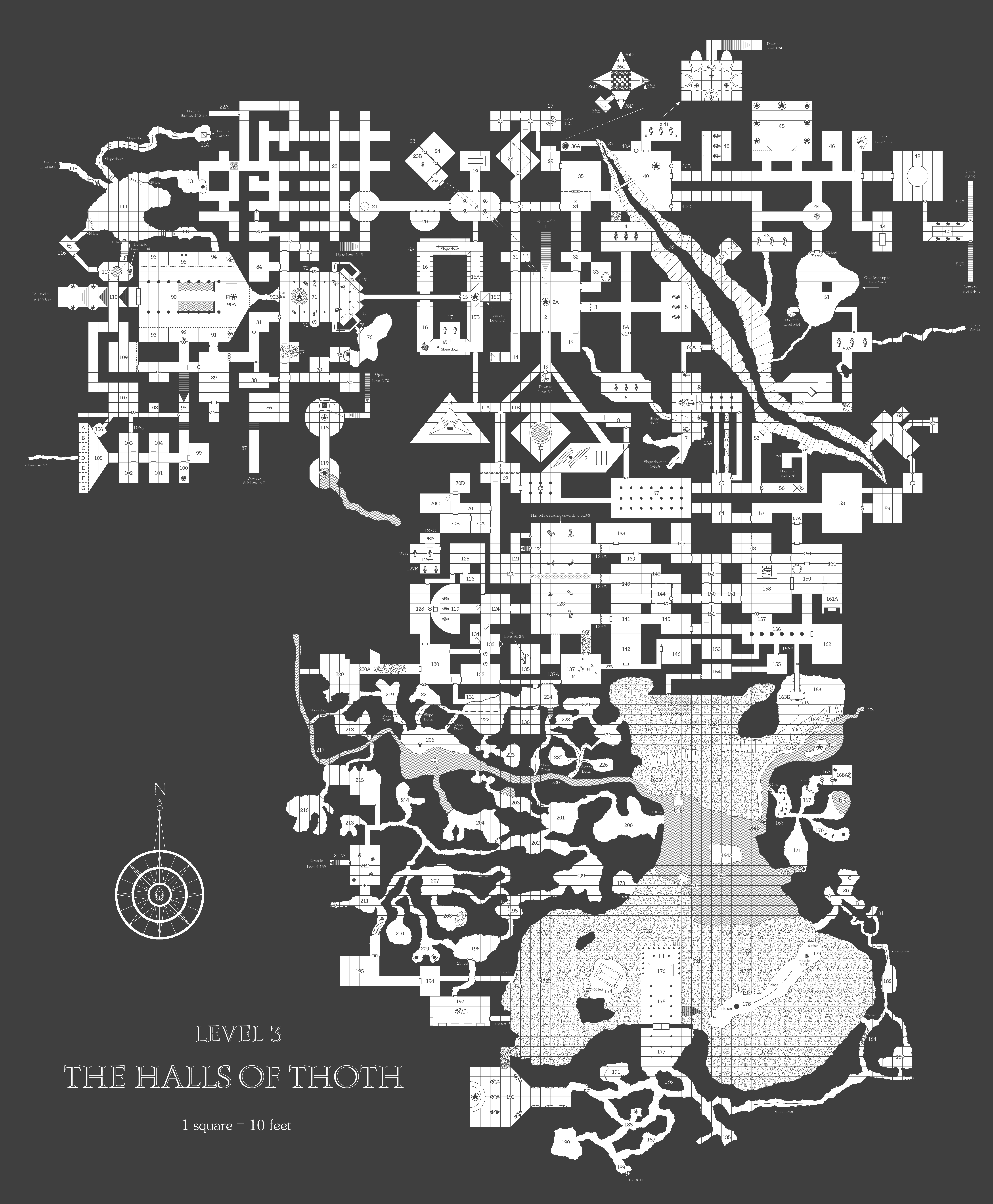
The creators published map packs (for free!), which is helpful. The maps themselves are beautiful, creative, and jaquaysed. The png rendering of the maps is weird.
The gm-facing maps and player facing maps are different sizes. The GM map is 6477x7856 pixels (0.824x). The player map is 6557x8000 pixels (0.820x) so they don’t overlay properly.
The squares are not perfectly square; they’re often taller than they are wide or vice versa, depending on the dungeon level.
I also think that if we want to support a military incursion scenario (the set cult, halflings, and beastmen are all organized and sentient fighting forces), it would be helpful to have labels on the map showing the positions of the forces. Here’s a halfling example:
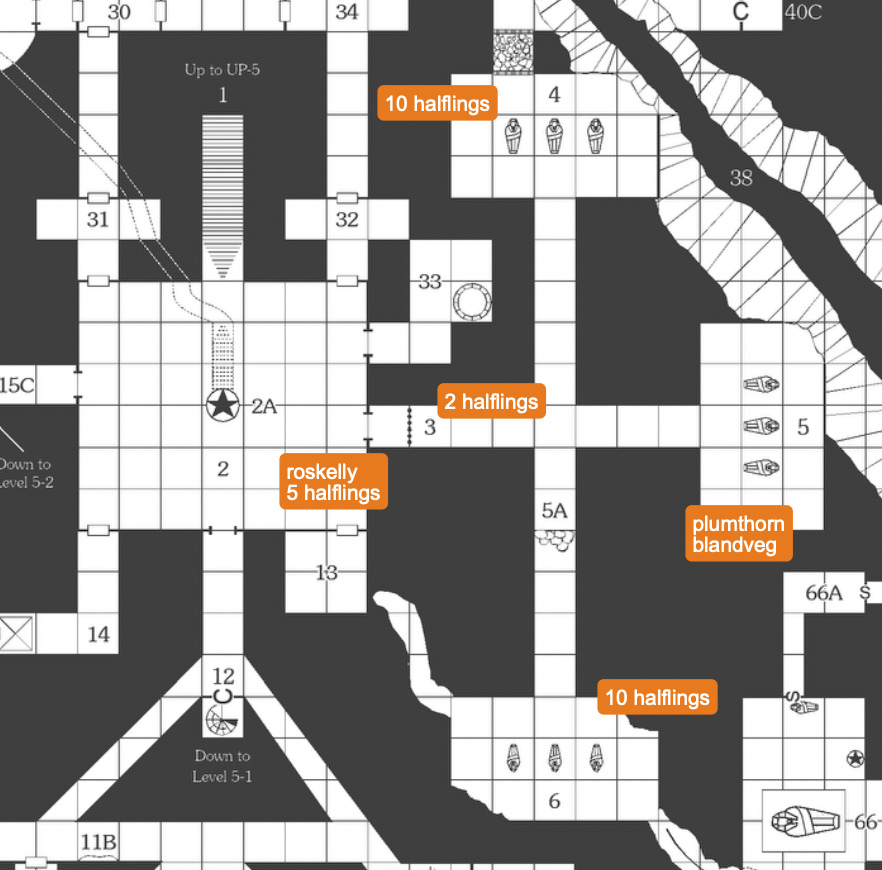
There are 27 halflings keyed to the rooms, plus however many are typically out on patrol. This disagrees with the text in the faction writeup:
Size of Faction and Replacements: Some twenty-two halflings, plus their three leaders, constitute this small faction.
I also think it would be useful to mark the illuminated rooms; that’s something you can see from far away:
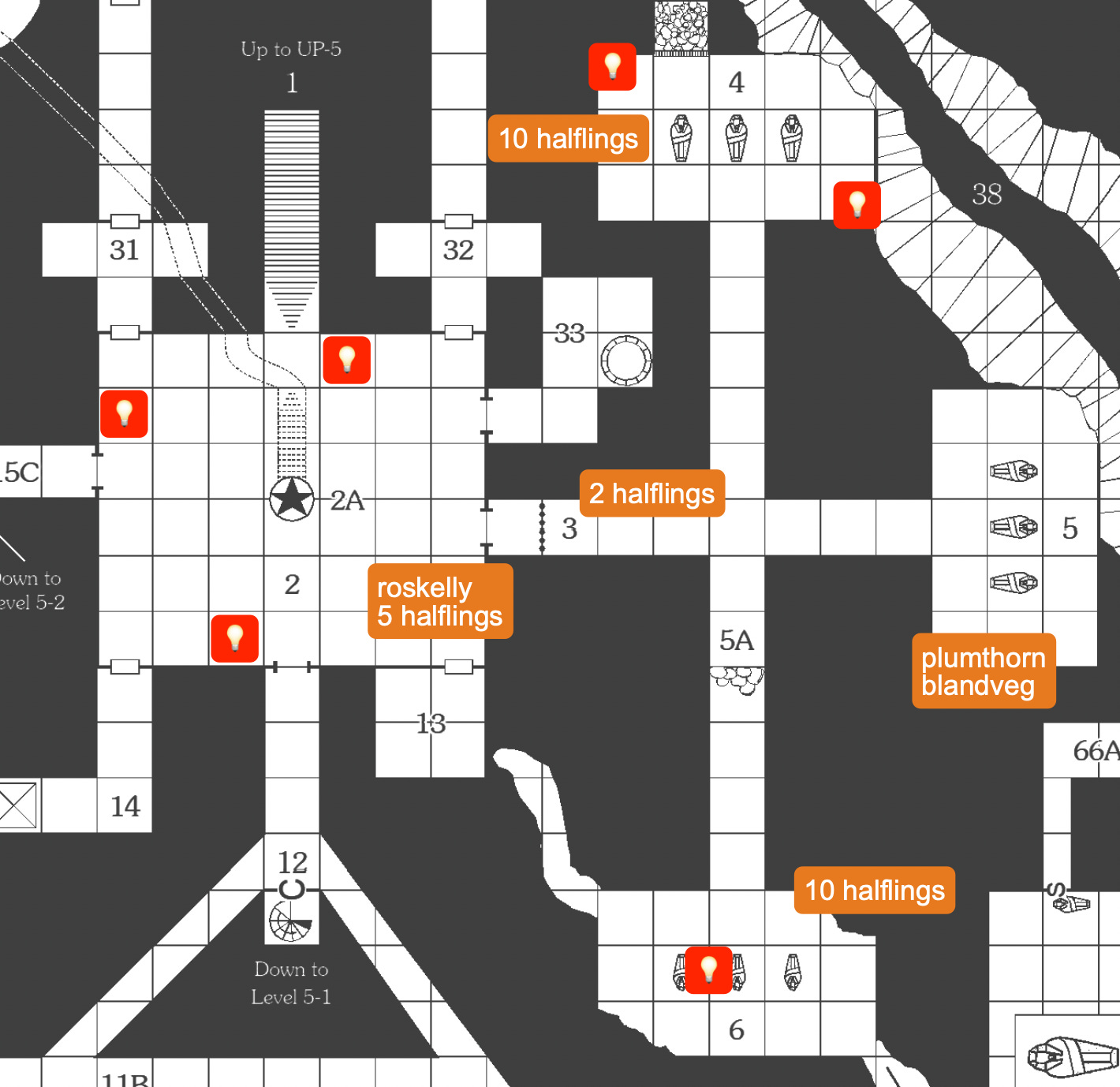
Which reminds me, there’s no description of a light source in Plumthorn’s room. Similarly, how are the halflings near the gate at #3 operating in the dark?
The 1e MM says:
The magic and poison resistance of halflings causes them to save at four levels above their actual. They are exceedingly clever at both quiet movement and hiding. They will surprise on a die roll of 1-4 on a 6-sided die. In natural terrain they must be treated as invisible if they have any form of vegetation in which to conceal themselves. They have no infravision. They shun water.
Tallfellow: A taller (4’+), slimmer halfling, with fairer skin and hair. Tallfellows are very rare. They use more armor (AC 6), ride ponies and carry more spears. It is possible for exceptionally strong (17, 18) tallfellows to work to 5th or 6th level of fighting ability. They can speak elvish and are very friendly with elves. They live for about 180 years on the average.
Stout: This kind of halfling is a bit smaller (3½’+) and stockier than the typical (hairfeet). They use more armor also (AC 6), and employ morning stars in addition to the usual halflingish arms. Very strong stouts (18) are able to work up to 5th level fighting ability. Stouts have infravision and can detect sloping passageways. They have no fear of water and can swim. These halflings are able to speak dwarvish and enjoy dwarven company. Stouts reach the age of 200 or more years.
There are three kinds of halflings; hairfeet (default), tallfellows, and stouts. It’s unclear what sort of halflings Plumthorn’s crew are (and mostly irrelevant since we have stat blocks), but we do need to know if they have infravision or not. Stouts have infravision, but hairfeet and tallfellows don’t. My guess is that they don’t have infravision since they’re lighting candles and torches.
Treasure and XP
In lieu of a full write-up here, I note that there’s way, way too much and hopefully folks can take me at my word. In a smaller module, I’d normally come up with a number for you to divide all of the existing treasure by, but honestly it’s so holistically broken that I’m not sure how to meaningfully help.
Conclusions
There’s a ton of really cool ideas here.
Fire elemental that sends you to the City of Brass
Sliding chutes that dump you in front of the main mystery of the megadungeon (the Obsidian Gates) and to a tutorial NPC (Gog)
Evil extortionists that players will want to kill on first contact, but will lack the power to do so until later on (great for faction play and getting immersed; very strong intro).
A powder keg of four separate warring factions (set/goblins/halflings/beastmen) that are all willing to ally with the PCs.
A recurring statue-arm-puzzle motif that hides great treasure
Tombs of legendary heroes with their legendary artifacts
Rich history that has been layered with present-day needs (aesthetics of ruin)
Recurring gemstone-eye motifs and the power of restoring gods to their former glory
Huge chess-themed set-piece tomb puzzle+battle, with multiple layers of tricks and traps for a huge payoff
Yet, the actual execution of those ideas is messy. The room descriptions are needlessly ambiguous, ill defined, and don’t feel play tested. The prose is wordy and constantly mixes past, present, and hypothetical in a way that makes it very difficult to actually run the rooms. There’s an ungodly amount of treasure; so much that it stretches disbelief that it would still be lying around despite the other adventuring parties exploring the place.
I started my Arden Vul campaign on January 11th 2025 and we’ve played 60+ sessions since then. In all of those sessions, my biggest takeaway is that megadungeons are cursed design.
Consider three statements:
Everything is interconnected, and part of one huge ecology.
The player’s actions have impact, and the dungeon needs to update according to that impact.
There are 2000+ pre-written rooms that represent the state of the dungeon before the players begin exploring it.
I view this as a variation of the good/fast/cheap unattainable triangle. We can pick two of the above and it works:
Interconnected, impactful actions, small scope
Interconnected, static, huge scope
Isolated, impactful actions, huge scope
Yet doing all three at once doesn’t feel feasible. I coped with this at the table by not updating the dungeon, the book already has 2000+ pre-written and interconnected rooms. If you read responses to my other posts (1, 2, 3), folks can smell it.
In that context, I think buying a megadungeon feels doomed. The original sort of megadungeon (where Gygax would write the next level as players were about to get to it) feels a lot less blorby but also feels possible (drops the pre-written aspect). The other viable option is a large-scale hex crawl, where you can still have 2000 rooms but spread across dozens of adventure sites (dropping interconnectivity).
Great post. I’m still optimistic about running Arden Vul, so it’s nice to see some pitfalls outlined. Definitely could have done with a little editor/developer work to go with all the hard writer/designer work. A shame they rejected the offer of annotated map, book 5 in physical form is deranged.
Amazing breakdown. I own this mega dungeon and want to run it someday, but it seems borderline un-runnable without enormous effort. At the same time, clearly many groups are making it work!