
Reflections on Yet Another Retroclone
Slightly Less Early Design Theory

I still love the structure I outlined, and am happy with the implementation of that structure in Sovereign, especially the Running The Game chapter. I don’t think Sovereign is a good fit for my table so I don’t run or revise it any more, but I do think it’s a good fit for a table with less players and I’m quite happy with it.
Rules wise, I’ve updated a lot as I’ve gotten more OSR years under my belt.
3d6DTL
Fast character creation. 3d6 Down the line. Small list of classes (mage, thief, fighter, cleric).
Maybe this is too 🌶️ s p i c y 🌶️ but I’m disillusioned with random attributes. There are a bunch of ways to generate attributes in the broader sphere of OSR games. Here’s some of the high-level concepts
Choice Overload: The more choice you bake into attribute generation, the longer character creation takes. This creates a combinatorial explosion. For example, say you do Method 1 in 1e; 4d6 drop lowest 1, rearrange as you please. You roll your 6 numbers, then pick from 6 options for the first stat, 5 for the second, 4, for the third, and so on. In effect, this gives you 720 choices on just stat arrays. If you then have to choose between 7 races and 9 clases, now we’re up to ~45000+ combinations.
Compare that with how BX does it where you roll 3d6 down the line, and then choose a race+class from a menu of 7 options, and it’s easy to see how much easier this feels.
Nudging: Most of these games have you roll before you pick your race/class. The default 3d6 down the line, in effect, suggests a class for you. If you roll 18 strength and 5 Int, it seems to suggest playing a Fighter over, say, a Magic user. Even in systems where you can rearrange your stats (like 1e), some race/class options are more stat dependent (or have literal restrictions) than others, so if you roll an average array, that might suggest a Magic User (whose power comes from spells that don’t scale on stats) vs a Fighter (who really wants high str/dex/con).
The stronger the nudge is, the less agency the player has, which can rub people the wrong way. A lot of people show up to these games with a character concept they’re excited about. Maybe they want to play a fighter, or they’ve been playing a Cleric for the last year and now want to try out Magic User.
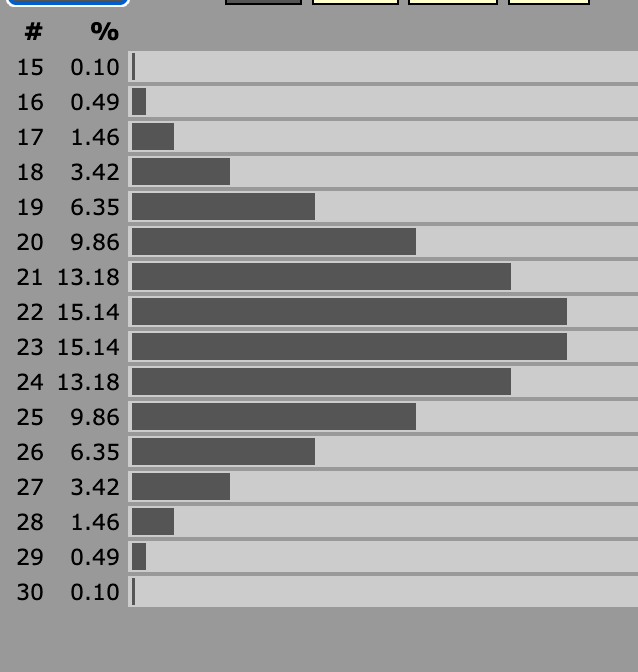
Impact: In BX, the difference between a 16 CON and 8 CON for a magic user is enormous. 16 CON gives +2 hp per level, whereas 8 CON gives -1. Here’s the HP distribution for a 5th level Magic User with 16 CON
compared to 8 CON
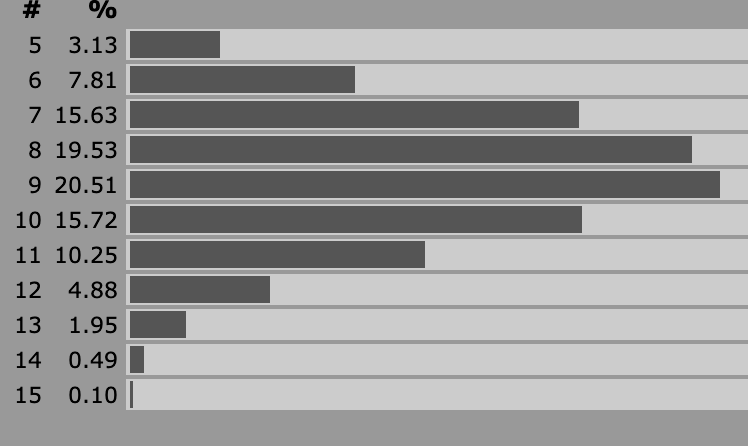
The 16 Con wizard has roughly even odds to survive failing a save vs a fireball (~20 avg damage). The 8 CON wizard is probably dying even if they make their save.
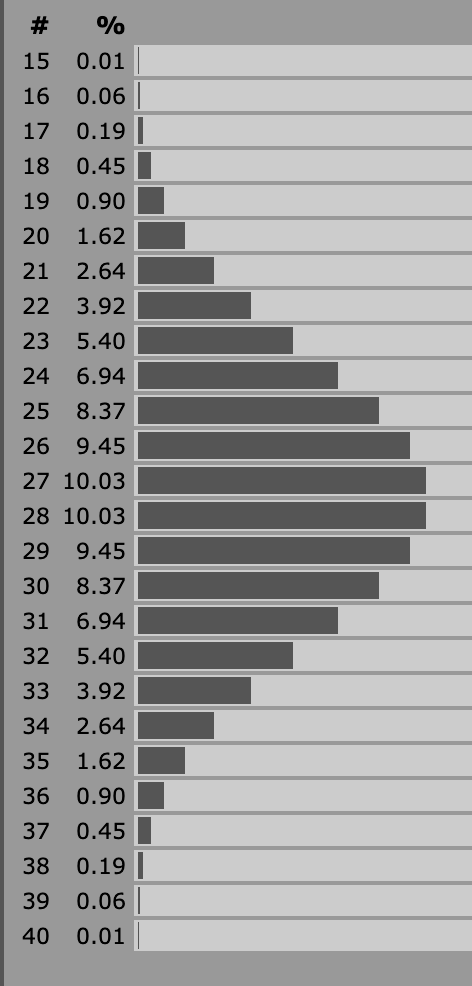
Similarly, here’s the damage distribution for a fighter with 16 STR wielding a d6 weapon across 5 hits:
Compared to 8 Strength
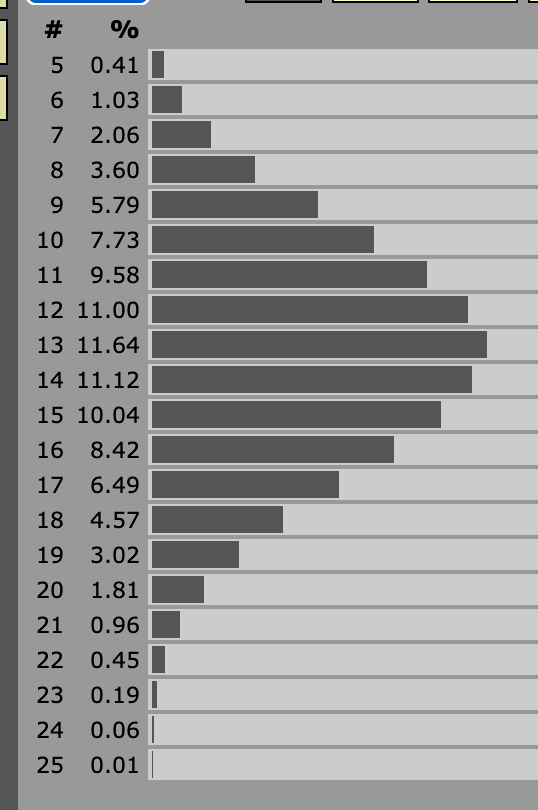
Slightly reframed: relative to an 8 Strength Fighter, a 16 Strength Fighter is functionally identical to starting with a +3 magic weapon that can’t be disarmed and stacks with other magic weapons. Does that seem too impactful for something that you roll at character generation and doesn’t increase as you adventure?
Mental Stats Are Weird: This is a very old debate, but I think it’s worth nailing down what the game’s model of play is. I like this definition from Simulacrum a lot:
The default assumption is that players must overcome a challenge by describing what their characters do to meet it. […]
Failing any of that, the Task system is used: a single roll against a target number (often called a “check). The idea is that you roll to resolve situations with interesting stakes that would
be too tedious / difficult to describe, or
involve a strong element of chance
I think this gets really hairy when you’re defining the mental characteristics of a character. If the player is smarter than their character, does the player (or worse, GM) need to limit the sorts of ideas or plans the character is allowed to have or carry out? If the player is dumber than their character, can they ask the GM something like “what would my very-intelligent character think about this?” Same with wisdom or charisma.
Then for charisma specifically, it does have associated mechanics. All of these old systems have some form of a reaction roll; here’s a survey. At a high level, your Charisma score gives some sort of penalty/bonus to a reaction roll, which in turn spits out results like…
0e: negative < uncertain < positive
1e: violently hostile < hostile < uncertain but 55% prone to negative < neutral < uncertain but 55% prone to positive < friendly < enthusiastically friendly
BX: immediate attack < hostile < uncertain < no attack < enthusiastic friendship
These are abstract results, left to the GM to interpret in context.
If we’re rolling dice, does it matter what I say? If what I say matters, then do we need to roll dice? My best understanding, inspired by Advantage and Impact - Dreaming Dragonslayer
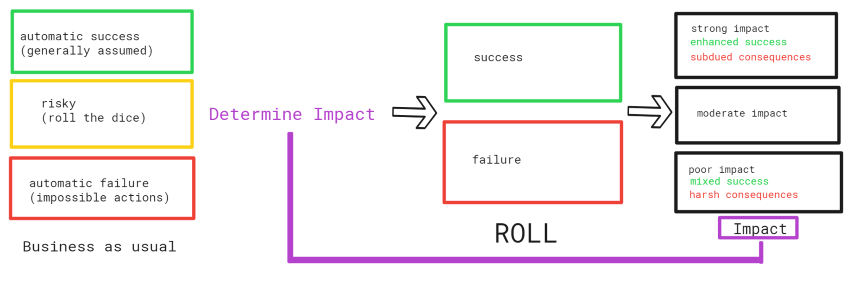
The player skill (what they say, what leverage they use, etc) informs whether a roll needs to be made at all, and how to interpret a result of “no attack” or “uncertain”. The actual stats impact the %chance that a particular result comes up. So a player with bad rizz might have to roll more dice than a player with good rizz, and a low-rizz player piloting a high-charisma character might get less impact out of the same rolls as a low-rizz player piloting the same high-charisma character.
I think that’s a coherent but frustratingly vague model, though, it’s never explicitly explained by any of these texts. I also have a personal distaste for resolution systems with a bunch of tiers of success; I find them to be high overhead for very little gain. It’s much easier to generate 2 outcomes (diplomacy check) than 3 outcomes (PtbA fail/mixed/success), which is easier than 5 outcomes (BX), which is easier than 7 outcomes (1e).
Summarizing:
I want players to be able to play what they want
I don’t want to overload choice at character creation
I don’t want random stats to be especially impactful
Mental stats are weird
I think the cleanest solution here looks like just dropping the stats (sacrilege, admittedly).
If generally fighters have +1 Strength and +1 Constitution, we can bake that in very easily by noting that fighters have +1 damage on all of their attacks, changing their to-hit table to be +1 better, and giving them +1 HP every level.
If that makes all fighters feel too ‘samey’, we can add some options to character creation, like
Choose 2:
+1 HP every level
+1 to hit and damage with Melee Weapons
+1 AC
+1 to hit with missiles
Two additional starting languages
or whatever the list is. If you want drawbacks that are implied by rolling bad stats, you can do the same thing (bake them in or force players to choose them).
Ancestries
Ancestries (including human) all get one small thing.
I think I’d walk this all the way back and make ancestries totally flavor. Even small amounts of mechanical incentive creates pressure to optimize, and now there’s a conflict between “playing what’s good” and “playing what I want”, and I want to totally avoid that when selecting an ancestry.
If someone wants to be an elf or a dwarf or hobbit or whatever, I want them to do it because that’s what they want to roleplay, rather than chasing infravision, bonus damage, ghoul immunity, etc.
Simple Weapons and Armor
Armor is simple (unarmored, leather, chain, plate). 4 simple categories of weapons (d4/d6/d8/d10)
Love this still. If playing 1e or ACKs has taught me anything, it’s that optimization around weapon selection is really dumb.
d4: small, 1 handed weapons that can also be thrown. Example: dagger.
d6: 1-handed weapons that take up 3ft of horizontal frontage (so you can stack 3-wide in a 10ft hall). Example: Short Sword.
d8: 1-handed weapons that take up 5ft of horizontal frontage. Example: Long Sword.
d8+reach: 2-handed weapons that take up 5ft of horizontal frontage but can attack from the second rank. Example: Polearm
d10: Two-handed weapons that take up 5ft of horizontal frontage. Example: Greatsword.
Otherwise, the only differences between the weapons is diegetic and up to the GM (maces can’t cut rope, swords can’t batter down doors, etc).
Abstract Adventuring Gear
Abstract adventuring gear. OSE simple encumbrance: move speed based on armor, go slower when you’re carrying a lot (more than 40ish pounds of non-armor). Be mature about it.
I ended up scrapping this, though for a totally unexpected reason. I expected that having the adventuring gear be abstract would encourage more problem solving with gear. After all, if you can just decide that you have a hand drill or flask or whatever, there’s more problems you can solve with your gear on hand.
The actual play-testing result, though, was that even less gear-use happened. I think this is the same choice-overload thing; without constraints to the problem solving, it’s difficult (and unfulfilling) to generate solutions.
Tracking Rations, Torches, and Ammo
Don’t worry about counting rations, torches, and ammunition. I promise they don’t matter and that these problems are immediately trivial.
Still totally agree here. Bean-counting weight is miserable.
XP
Advancement rules: xp for monsters and treasure brought back to safety.
I think xp for monsters is bad; it makes random encounters (which are supposed to be the cost of caution) a net positive for some parties (if they can farm them). Adding up monster XP is a pain. Instead, we can just decrease the XP requirements for all the classes to account for the XP they’re missing out on.
I’d also nix 1e’s rule of giving XP for magic items. The default 1e rule is that if you use a magic item, you get less XP than if you don’t use it (and then sell it). This feels heavily disassociated to me, and leads to all sorts of weird play. I think selling magic items is an entire can of worms, but in the Arden Vul game, it degenerated really fast before I changed it.
Here’s an example
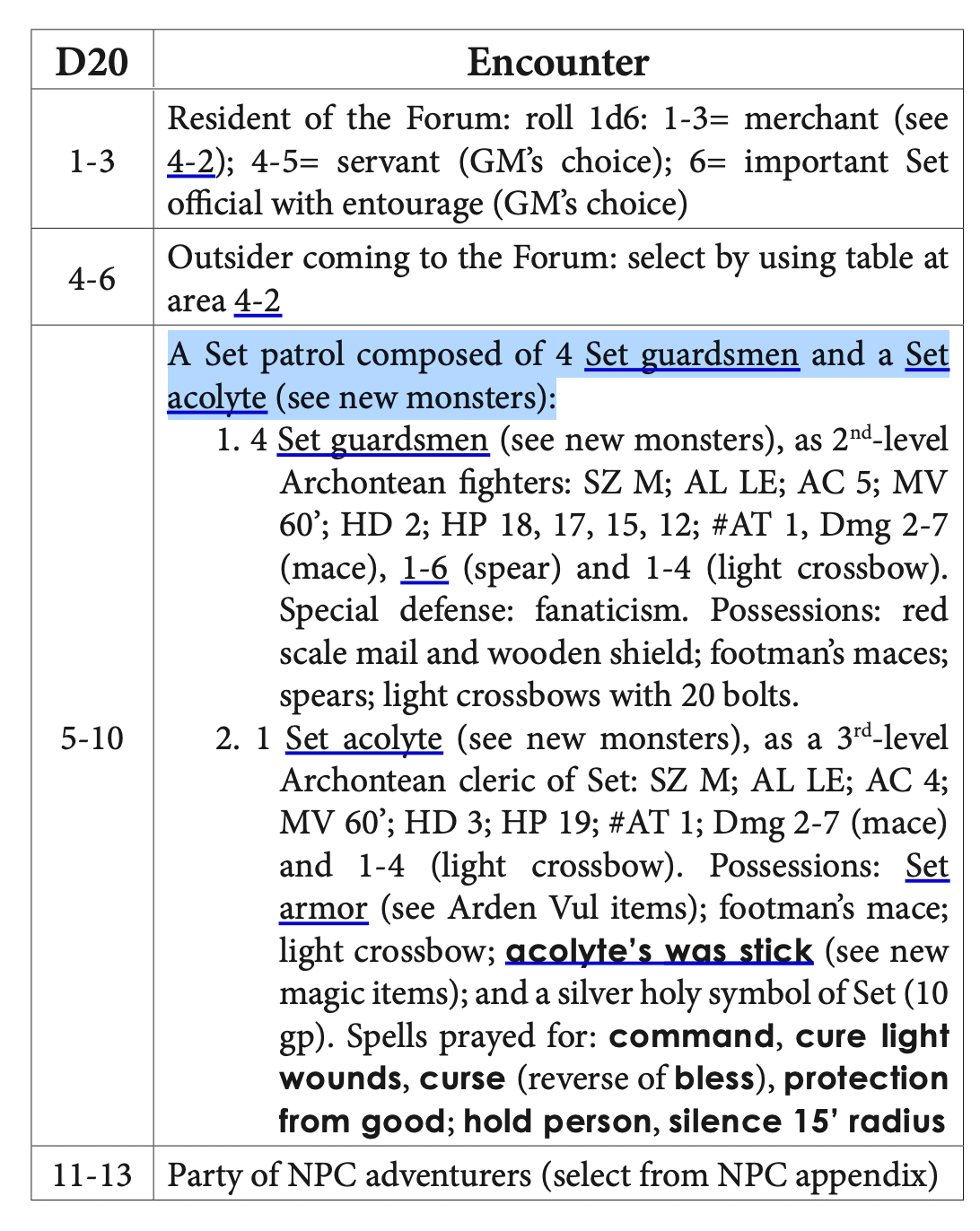
Set patrols are a pretty common wandering monster in Arden Vul; it’s 4x 2nd level fighters and a 3rd level cleric. The clerics all have a Acolyte’s Was Stick.
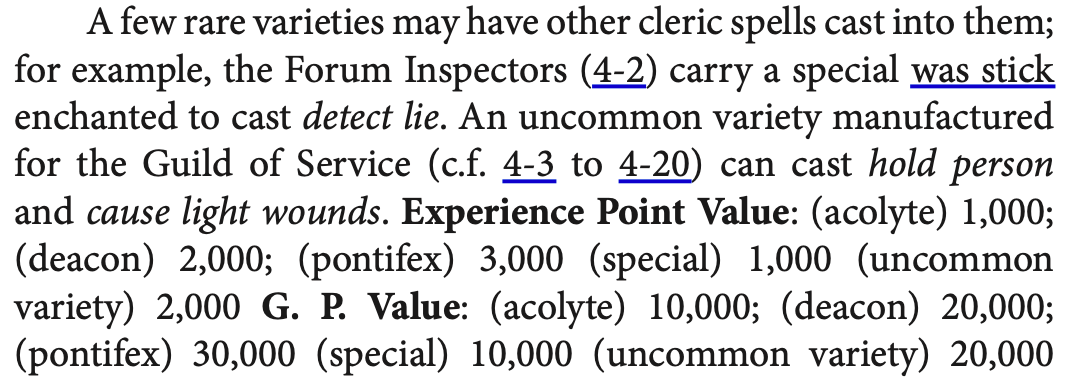
The Acolyte Was Stick is worth 1000xp just for finding it, and sells for 10000g. So each Set Patrol is walking around with a 10000xp item, on top of the monster XP. This gets out of hand very fast.
Prices and Availability
Price and availability guidelines for goods and services, both mundane and magical. Both buying and selling.
I still think this is the most useful part of ACKs 2e that every other game can pull from. I summarized the table here.
It offloads so much to be able to answer:
Can I sell this Acolyte Was Stick?
Can I buy 50 flasks of oil?
Can anyone in this town cast Cure Disease?
This is something that comes up over and over in play. Pathfinder 2e has Settlement Level, which does a similar thing, and I think that’s great too.
I think it’s also really important to provide explicit mechanics for both creating and “leveling up” a town, as a gold sink. Being able to form a “town” near a dungeon is very helpful to cut down on wilderness travel. Being able to spend all the excess money players accumulate on growing the town (so it can provide more services) helps close the loop.
Structure for Rulings
Structure for collaboratively coming up with rulings. Discuss the chance of success, consequences of success, consequences of failure, and cost. Accepting higher costs or greater failure consequences helps negotiate higher chances or success consequences.
I still think this is super useful to explicitly say, and still actively practice in my games. These days, I lean toward just talking out raw percentages. To use an example, my players had set an ambush for Craastinistorex. The default surprise roll is 2-in-6. Rather than just roll that, I said “the default surprise roll is 2-in-6, which is 33%. Very stealthy camouflaged creatures are usually given a 4-in-6, which is 66%. Ya’ll are invisible, prepared, and set up ~100ft away from where you’re expecting her to land. What do you think the chance is that you should get a surprise round?” and we eventually settled on 80%, which the whole table had buy-in for.
These days, I try to use coin-flips as much as possible, and frame more complicated rulings as a sequence of flips, but it’s all the same stuff.
Have you ever examined the Total Party System? Aside from the layout of their books being somewhat lacking, the game design itself addresses most of the issues you raise here. The magic system is truly different from anything else I’ve ever encountered.
Hi Beau, thanks for sharing your wisdom.
Have you landed on some mechanics you like for player characters "creating and growing a town"? Or are you thinking it could it be as simple as a table of cost / time required per settlement category?
I'm keen to have more things the PCs can spend money on. I've tried a carousing system but my players bounced off it pretty quickly after some mishaps.
Separately, there might be a small typo in the second example under your linked Monthly Availability By Price and Population table. My read of the table is a village of 408 would have a 1% chance of being able to buy that 2,000g chalice.