
Common Adventure Pitfalls
Domain Specific Technical Writing

The following is a listing of opinionated technicalities that I frequently see in adventure modules. They’re the sort of thing I find myself repeatedly referencing in reviews. I aim to give adventure writers a list of tropes and patterns to avoid (or apply) so their published adventures are cleaner.
In alphabetical order…
404: Does Not Exist
The pool contains no water, but a gelatinous cylinder! It only attacks if disturbed, or if the insect swarms animate. Fortunately, its treasures are at least plentiful: 4000 gp, Wand of Frost (13 charges), cursed scroll (reader must save vs. death or, like Volokarnos, be devoured by creeping things in 3 turns), potion of healing. — Vaults of Volokarnos
Volokarnos is explicitly a B/X adventure. B/X does not include a Wand of Frost. The adventure does not include a definition for Wand of Frost in an appendix.
The giant broken giant clam shell holds loot collected from the innards of the jellyfish. It contains 3,700 cp, 1,400 sp, 900 gp, coral earrings (75 gp), an algae-covered jade statue of a warlord on a horse (300 gp), an exotic shell necklace with pearls (800gp), a Potion of Gaseous Form, a Cormadhar gem—Hessonite (2,000 gp, see Area #18), and an ancient, barnacle-covered Wand of Fire (7 charges). — Ascent of the Leviathan
(This version of) Ascent of the Leviathan is explicitly for OSE. OSE does not include a Wand of Fire. The adventure does not include a definition for Wand of Fire in an appendix.
If you write that an adventure is compatible for a system, make sure that anything you reference (rules, magic items, monsters, etc) are either in that system or in your appendix.
Double-Linking
Bad
24 | Control Room: […] Pulling lever 4: Deactivates the golden light in Area 29.
[…]
29 | Subterranean Jungle: […] Stone plinth (4’ high). Bathed in golden light (a 10’ diameter pool of light surrounds the plinth). Platinum and sapphire chalice (upon the plinth, worth 2,000gp, full of water). — Hole in the Oak9 | Nuromen’s Apartments: […] The girl’s bony wrist bears a silver bracelet which has her name, “Anthea”, engraved upon it. The girl’s name is the password to the magician’s study (chamber 12).
[…]
12 | Nuromen’s Study: When anyone approaches the copper-plated door to this hall, a corpse face moulded into its surface will animate and state, “NONE MAY PASS UNLESS THEY KNOW THE WORD.” The password is Anthea, the name of Nuromen’s daughter. If this is offered, the face will moan, “You may pass.“ — Necropolis of Nuromen48 | Smuggler’s Port: […] Brutus the Orc-Blooded: HD 4+2; AC 6; Atk battleaxe 1d8; ML 9; C; flaming oil*5, keys (50/a, 51., chest, 52. chests).
[…]
50 | Barracks: […] a) This room is the prison of Jacopo, the orcs’ accountant. — Vaults of Volokarnos
Good
B18 | Cellar: […] West Door (to B20): Strong smell of alcohol wafts from behind it. Locked. The key can be found in [G6] or it can be picked.
[…]
G6 | Sitting Room: […] In the hearth: A brass key with a metallic tag that reads: “Wine Cellar”. Opens [B20]. — Souls for Qovahe
When you put something in a room that directly interacts with another room key (a lever, a key to a lock, etc) place a reference in both places. Usually a module will describe what door a key unlocks when you find the key, but won’t describe where the key can be found when you’re looking at the lock.
For example, the Hole in the Oak light could have been written “Bathed in golden light (a 10’ diameter pool of light surrounds the plinth, disabled by lever 4 in [24]).”
Nuromen’s study could have read “The password is Anthea, the name of Nuromen’s daughter (a clue is in room 9).”
Vaults of Volokarnos could have read “This room is the prison (brutus holds the key) of Jacopo , the orcs’ accountant.”
Factions
Bad
Good
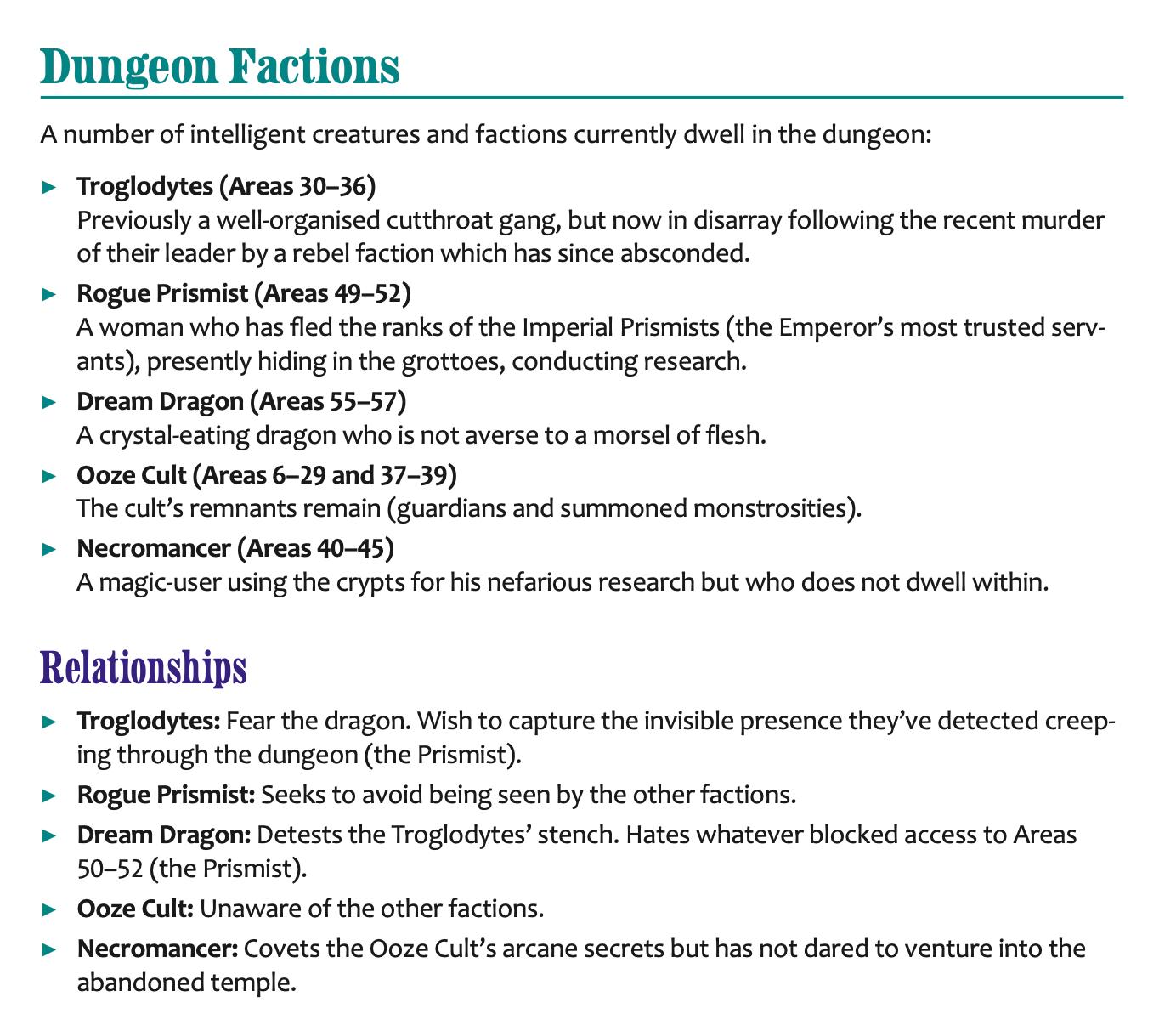
I’m being a little unfair to Incandescent Grottoes here - at least it has something! Most modules (even the good ones) don’t have a faction writeup at all.
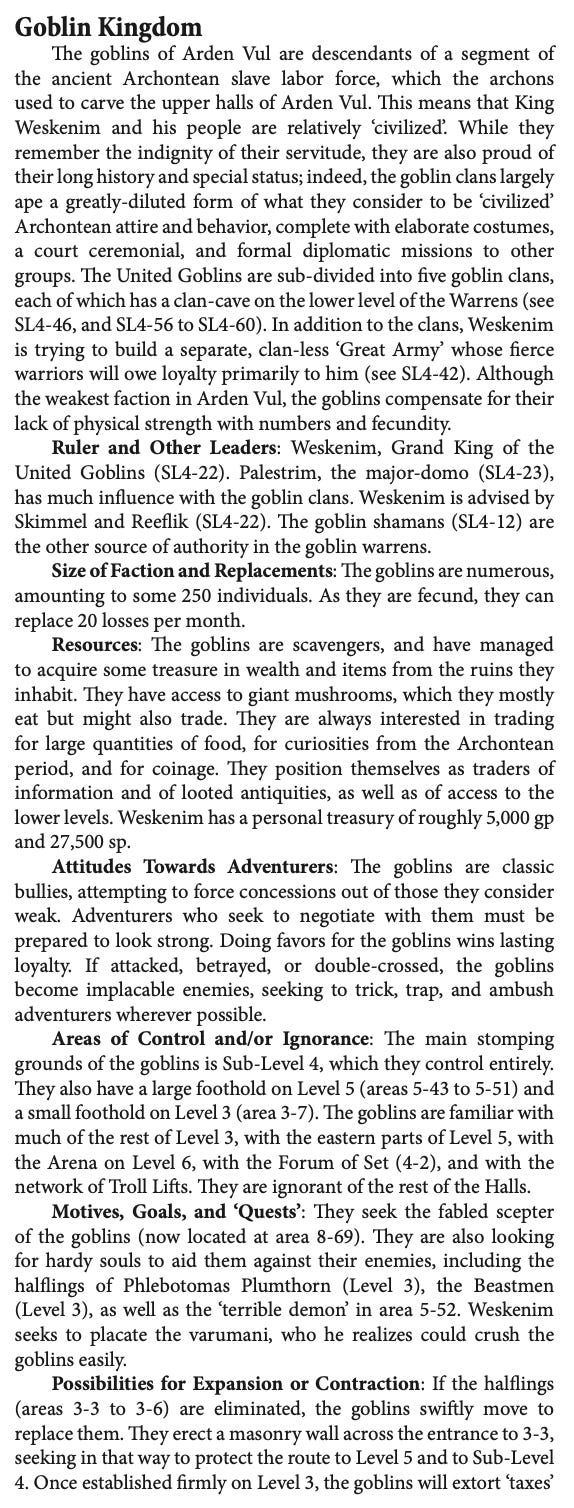
There’s a couple of useful frameworks here. This chubby funster video describes the basic building blocks of GM prep. Summarized:
The core creative building block is the encounter, which is a potential game scene with options for player agency, unlike an event, which changes the outcome regardless of player action.
So from a player-facing perspective, we need to know how to play the faction in encounters, and we also need to know how to treat the faction as event-generators (for when the players don’t interact with them).
Zooming in on the encounter, it’s useful to know how the faction responds to attacks (since that’s something players will frequently do, and a result that reaction rolls produce). Having information about:
Their combat tactics (are they militarized? do they post sentries and guards? do they form ranks to repel invaders?)
Their total numbers (“there are 250 total goblins”)
How quickly they can reinforce if the party comes back later (“the goblins can replace 20 losses per month”)
How they respond to a heavy loss, like the death or their leader (“the goblins leave the dungeon after losing half the numbers or the death of their king, taking their their known treasures with them”)
How territorial the faction is (are they defensive? expansionist? vengeful?)
helps a lot to run the faction as a hostile force.
When the players want to talk to the faction, it’s useful to know:
What the faction wants (“The goblins want assistance against the beastmen”)
What they have/can offer (“The goblins can provide access to the lower levels”)
A framework I like a lot here comes from GFC
[FACTION] want(s) [MOTIVATION], but [OBSTACLE]. Therefore, [PLAN OR METHOD OF SURMOUNTING OBSTACLE].
If there’s no obstacle, why don’t they have what they want? If there’s no plan to overcome the obstacle, what are they doing?
For example, “The goblins want to expand their territory on the third level, but are in a stalemate with the beastmen, therefore the goblins want to recruit adventurers to their aid by offering access to the lower levels through their territory”.
Finally, to treat them as an event, it’s useful to know what the author thinks would happen if the PCs did nothing. Here’s The Raid Mirror - Michael Prescott. The entire document is just the Adventure Front. See also Scenario Timelines - Justin Alexander.
Gotcha Rumors
Bad
A water dragon lairs in a great submerged cavern. — Hole in the Oak
There is no submerged cavern. There is no dragon. Nothing about this is true!
Here’s a slide from a Chubby Funster video that I think is useful. Note “Investigate the Known Danger” and “Prepare for Known Danger”.
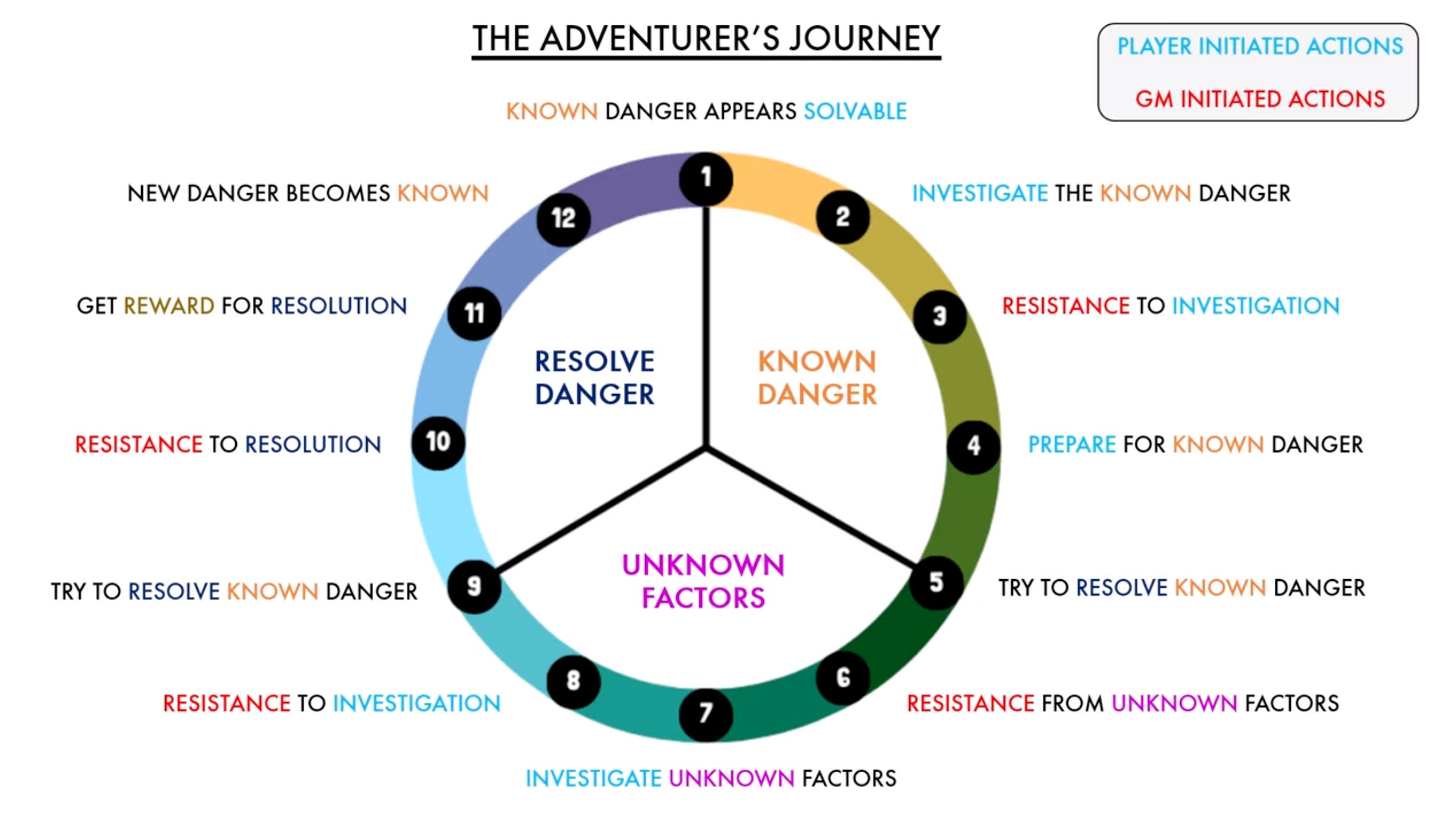
Rumors are a key part of making informed, impactful choices. Before setting out to a dungeon, characters have to decide what to equip themselves with, given limited funds and inventory space. Spellcasters have to pick which spells to prepare ahead of time.
In order to make those decisions, they need information. If you have a rumor that there’s a bunch of lycanthropes where they’re headed, and the players stock up on a bunch of silvered weapons and arrows, and then there aren’t lycanthropes…. GOT EMMMMM.
What are we doing here? The GM is the only window in the world, it’s so easy to lie to players.
Metaphor Refantazio has NPC informants in town that just directly sell you information about what you what sort of monsters you’ll find in the dungeon, and some of what their weaknesses and resistances are. It’s pretty ham-fisted, but it works. That lets you buy equipment and set up team compositions and whatnot ahead of time.
Good
An underground river flows through those caverns. Rotting corpses of the drowned stalk the banks in search of flesh. — Hole in the Oak
This is directly useful. There are undead, and they’re by the river. We should be careful when we get to the river and consider bringing clerics, holy water, etc.
History in Room Keys
Bad
At the second switchback in the Long Stair may be found a 20’-wide entrance into the cliff. Located about 750’ above the valley floor (and 750’ below the plateau), the entrance leads to a low (8’-tall) chamber that once served as a customs and guard post for those ascending the path to Arden Vul. The chamber is neatly shaped rock, without decoration or ornamentation. Any remains of the interior subdivisions and furnishings have long since disappeared. Today all that is found within is a fire-circle and a two-weeks supply of firewood. — Arden Vul
All the foodstuffs as well as the shelves they were stored on have long since disintegrated, so that even rats find no sustenance here. In the hall there is little else to be found, although, as with most other areas, skeletons lie about. A search of the remains will yield a gold ring and a jewelled necklace worth 23gp and 50gp, respectively. — Necropolis of Nuromen
Good
Filled with Phantasms most of the day, beyond the four archways surrounding the Ward in The Entry Chamber (Area 2) is a series of galleries with large, damaged relief Carvings jutting several inches from the plastered stone walls.
The center chamber contains a Throne; the southern chamber a set of stairs spirals both up and down. All three rooms are scattered with small animal bones. — Prison of the Hated Pretender
It’s tricky to show a good example here, but notice that this is a room with history (what did the carvings used to represent? Why are there small animal bones here?), but that history is only implied, since it’s not something that’s player-facing.
If you have to include history in a room key, I recommend separating into a labeled section at the end. For example, the above Arden Vul room could be:
At the second switchback in the Long Stair may be found a 20’-wide entrance into the cliff. Located about 750’ above the valley floor (and 750’ below the plateau), the entrance leads to a low (8’-tall). The chamber is neatly shaped rock, without decoration or ornamentation. In the center, a fire-circle sits near a two-week supply of firewood.
History: The chamber once served as a customs and guard post for those ascending the path to Arden Vul.
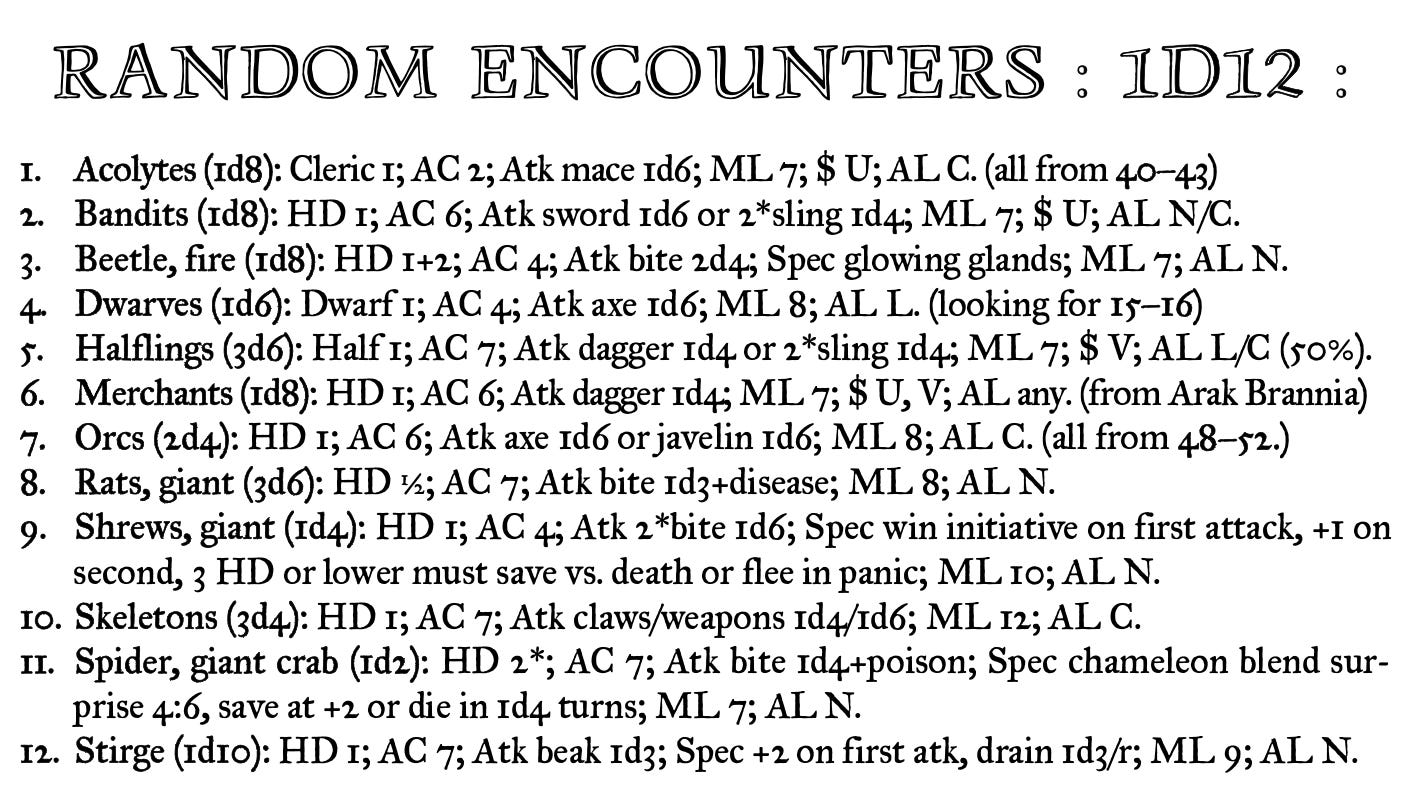
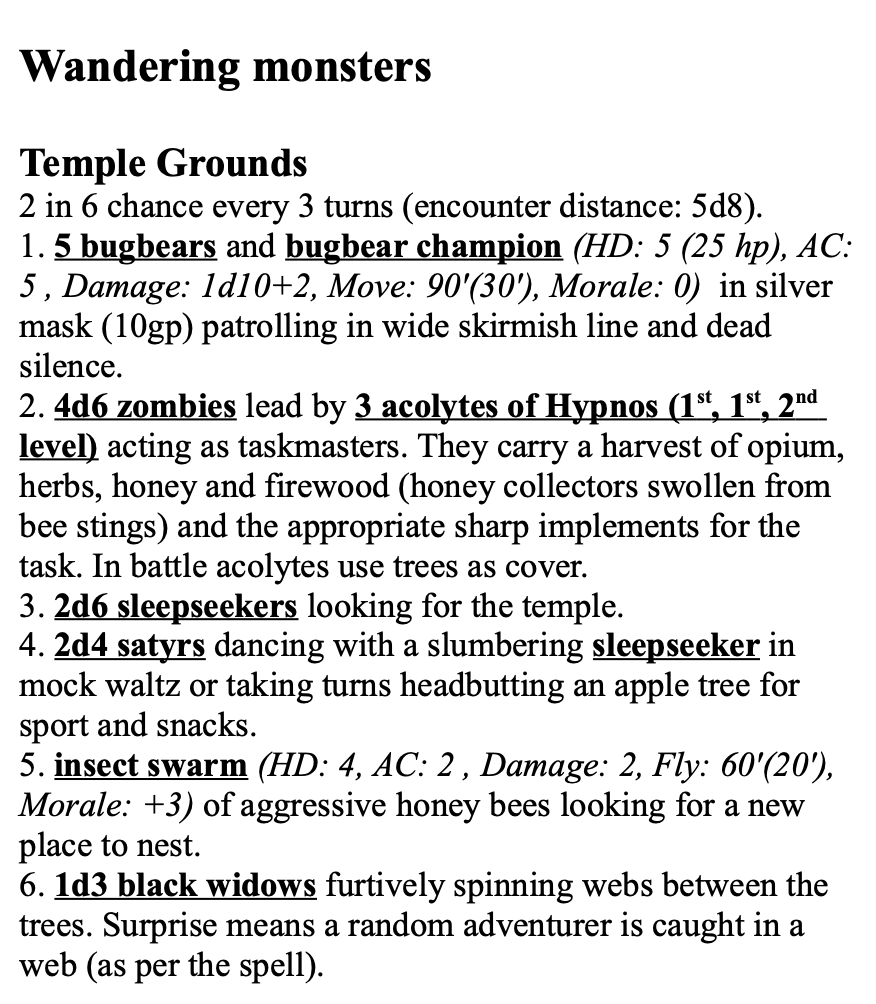
Infinite Random Encounters
Bad
Good
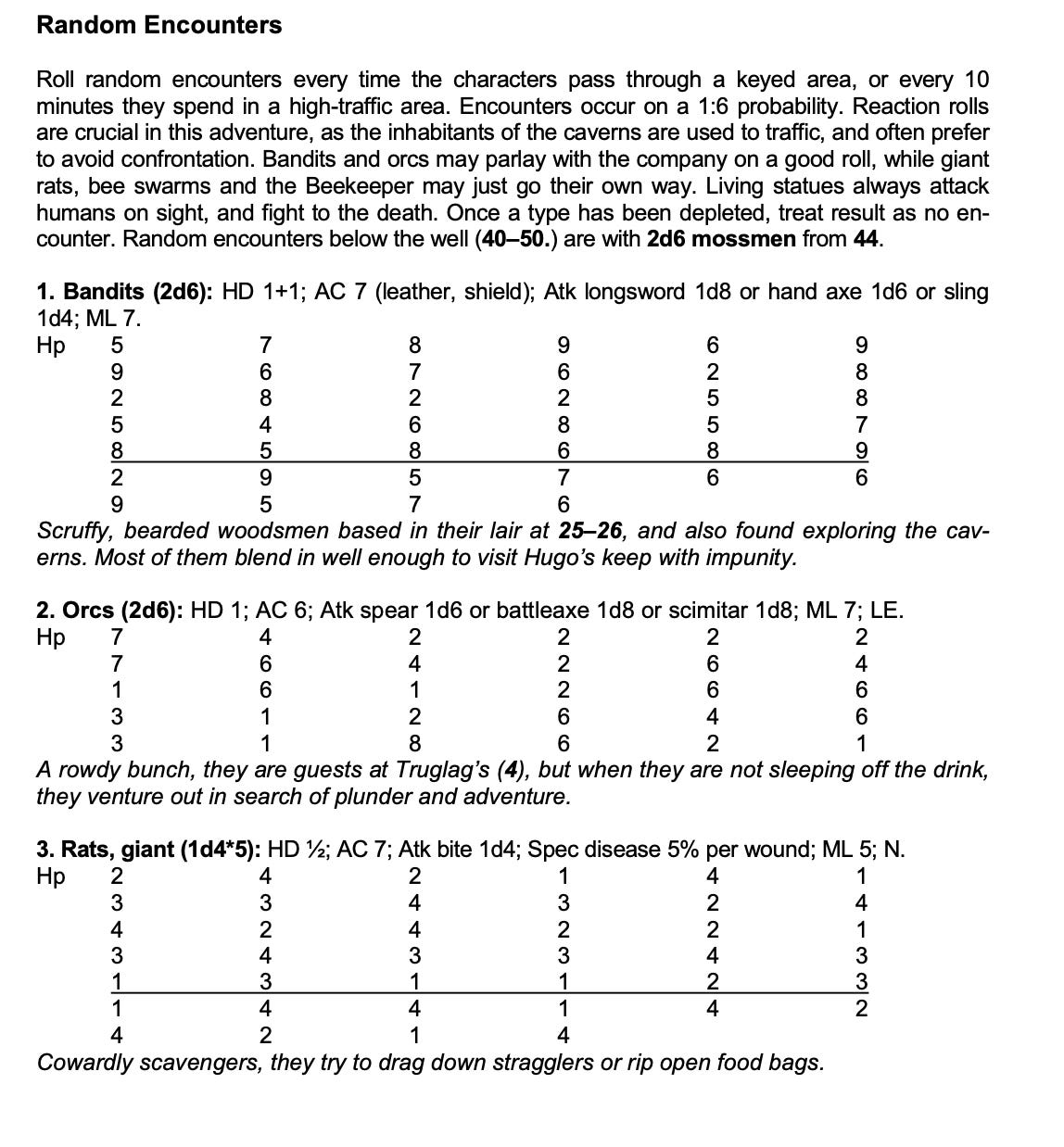
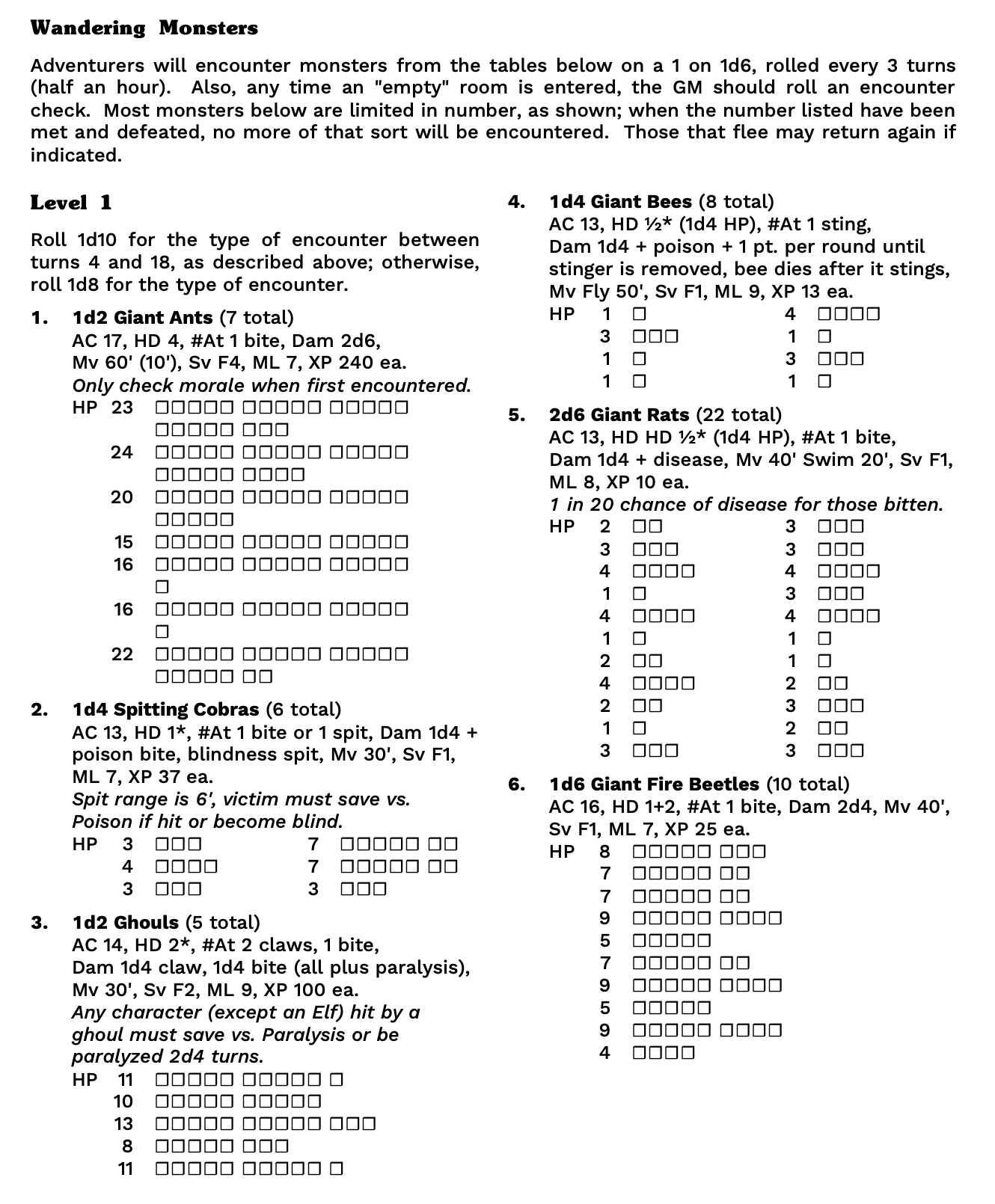
In order to have a faction properly respond to intruders, the GM needs to know how many forces can be rallied. Wandering monsters are part of the faction!
Having information about how many of a thing is wandering around gives the GM guidance about when the PCs have “depleted” the wanderers.
Map Scale
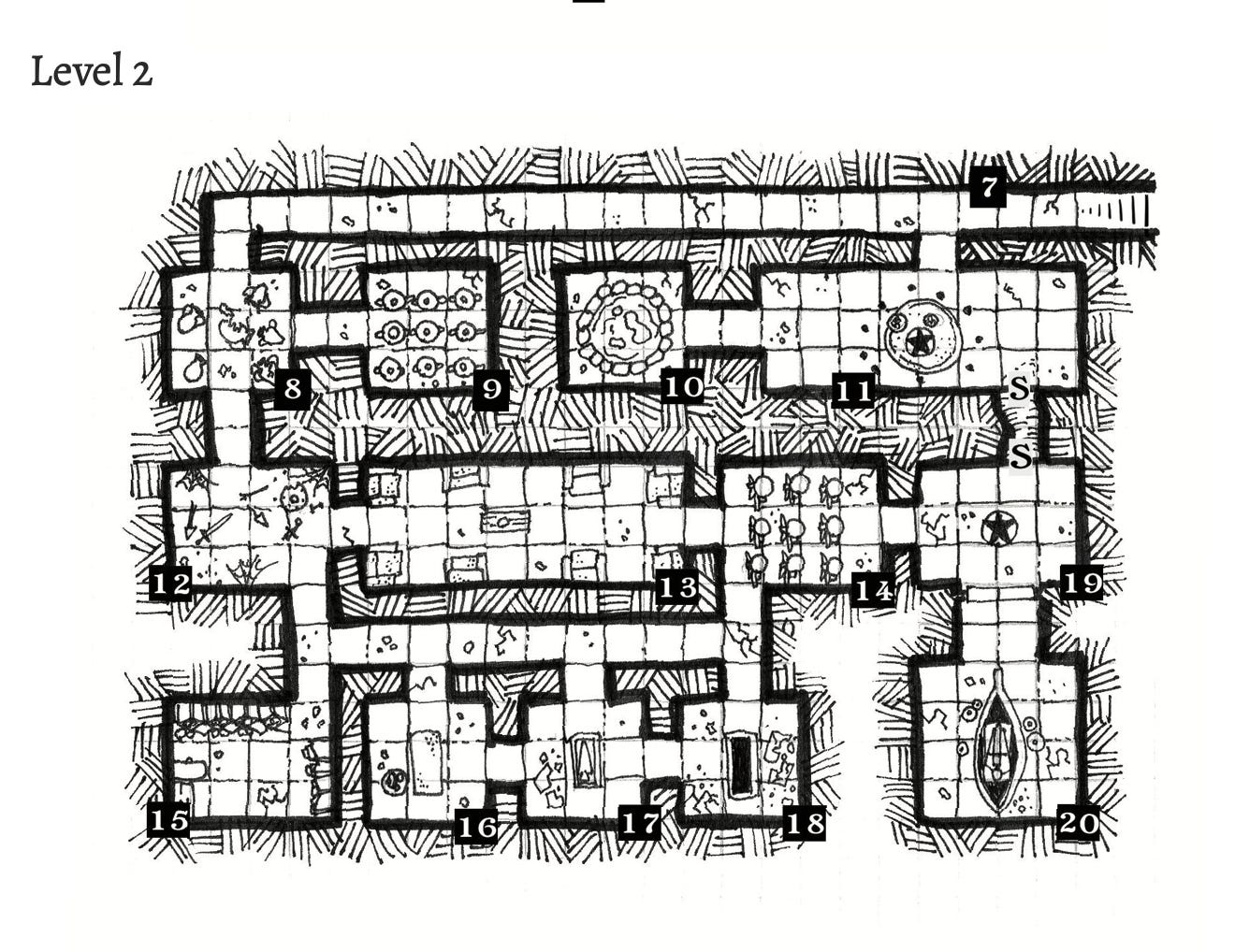
Bad:
Good:
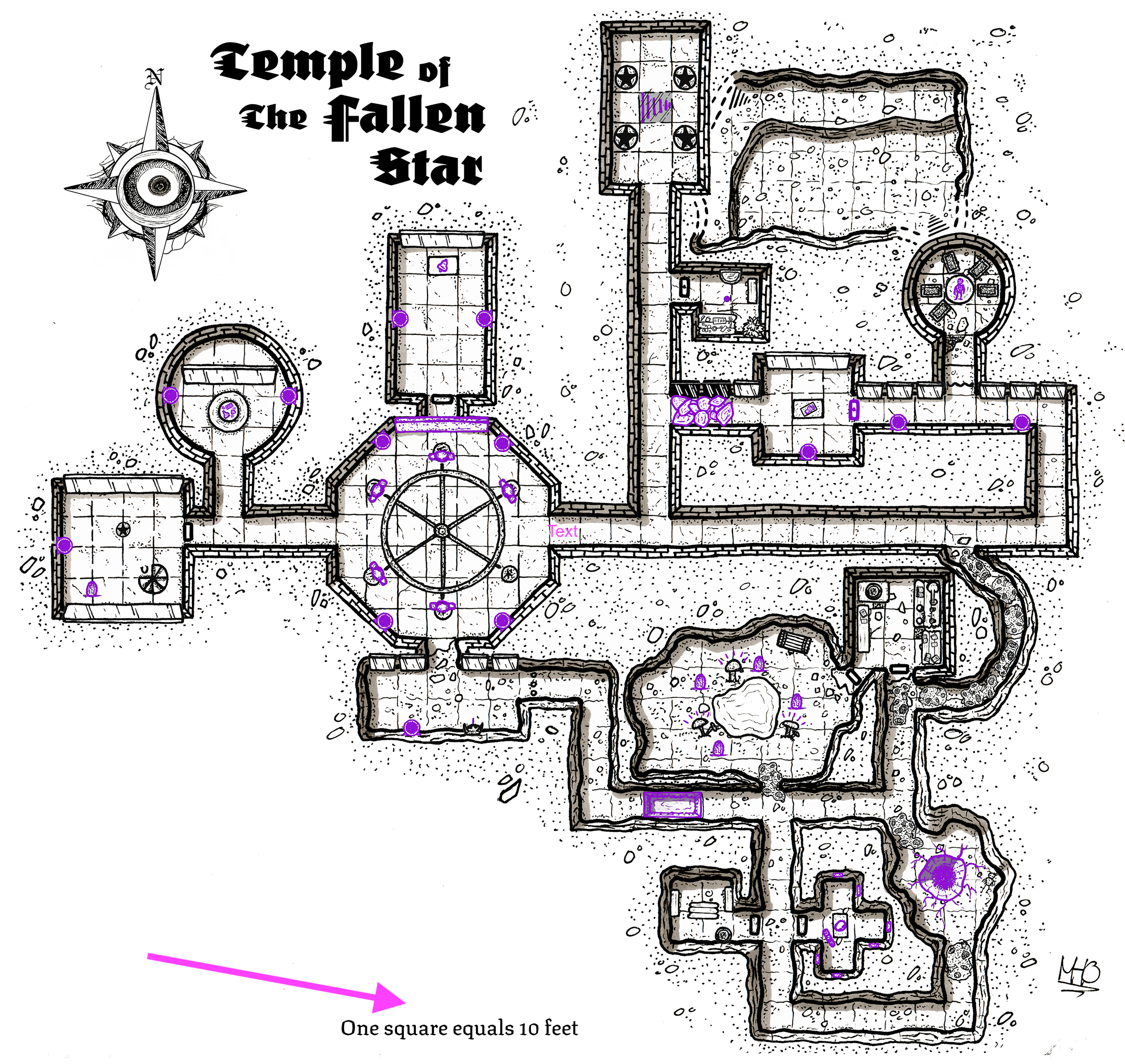
This one is super simple. Just include note on the map that says how big the squares are!
Random Enemies In Keyed Locations
Bad
North Watch Post: Broken pieces of wood; leaf litter and dirt scattered across the floor. During the evening hours there may be 1d3 Goblins encountered here (see area #1 above). If so, they each have short bows & 12 arrows in addition to their melee weapons. They have 1d10+1 ep each. — Stonehell
Knights’ Crypt: 1d6 Goblins. Tired, disheveled. Cautiously poking around in the burial alcoves. They are here to claim the barrow as a new castle and have lost some of their party to the undead in the lower levels. — Black Wyrm of Brandonsford
Good
Cadaver Storage: Fresh humanoid corpses; linens & chemicals; rat-chewed door. Giant Rats (10). Under a flagstone are 3,000 sp & 2 gems (25 gp each). Kobolds store corpses here to trade with the Gentlemen Ghouls (see Level 4D). — Stonehell
Common Area: […] 10 Goblins. 4 are sleeping in the huts, 6 are preparing for war (gearing up, stringing bows, sharpening blades). — Black Wyrm of Brandonsford
Don’t make me roll for the number of enemies in a room! If it’s a thing that exists in the world already, roll it ahead of time. If you write that a room has 1d6 goblins, you’ve created 6 separate universes: one where the room has 1 goblin, another where the room has a 2 goblins, etc. Why are you doing that? What design purpose does it serve?
This one is a little more reasonable to me than having a gem of a random value, but I think it misunderstands what room keys are modeling.
I think the initial push-back might be something like “But Beau, there aren’t always 4 goblins in the room. Sometimes there are 2 goblins in the room and sometimes there’s 5 and so on, so it should be random”.
A room key represents a specific moment: when the PCs enter the room for the first time. Anything else is madness! This is the only (that I’ve heard at least) interpretation that allows us to have rooms with motion to them (otherwise that the motion would probably not have started yet or have already been completed).
Given that’s the case, it doesn’t matter that there’s some variable amount of goblins in the room; the first time the PCs enter the room there’s 4 goblins and it’s totally fine to write that down. See this thread for more.
Random Loot
Bad
Goblin Hideout: Dismal odor; sounds of eating; unfinished hide bedrolls; rotting deer carcass; glowing coals in crude fire pit. Goblins (5) dining on spoiled venison. Each has 1d10+1 ep and one wears a copper nose ring (10 gp value). — Stonehell
Good
Around and beneath the body are thrown 9000 gp and 23 gemstones (10×2, 50×5, 100×12, 500, 1000×3). — Vaults of Volokarnos
Don’t make me roll for treasure! If it’s a thing that exists in the world already, roll it ahead of time. If you write that a room has a gem worth 1d6•100g, you’ve created 6 separate universes: one where the room has a 100g gem, another where the room has a 200g gem, etc. Why are you doing that? What design purpose does it serve?
Tasks that take Time
Bad
The clay statues are broken, but an hour’s work is sufficient to put them together again. — Vaults of Volokarnos
Searching the wreckage: For every ten minutes of searching, roll 1d6 to see what the players find (all items can be found if they search long enough) — Black Wyrm of Brandonsford
Digging in the earth: Can reveal treasures. Each turn the party spends digging, there is a 1-in-6 chance of unearthing something. Roll 1d6 and consult the Unearthed Item table. — Hole in the Oak
Good
This rubble-strewn hallway is impassable beyond the indicated point. Clearing the hall takes 20 man-hours per 5ft square. — Shrine of the Small God
Each man-turn of searching the detritus produces… — Hyqueous Vaults
When you want to give advice for how long a task takes, it’s more precise to use a measure of team-time; often phrased as man-hours (though man-turns might be more appropriate).
“A man-hour or human-hour is the amount of work performed by the average worker in one hour. It is used for estimation of the total amount of uninterrupted labor required to perform a task. For example, researching and writing a college paper might require eighty man-hours, while preparing a family banquet from scratch might require ten man-hours.”
This lets the GM know how much total time the module author imagines the task to take, then the GM can adjust for party size, circumstances, etc. So if reconstructing a room of clay statues takes 4 man-hours (24 man-turns), the GM has an easier time ruling that it takes a party of 8 PCs ~30 minutes (or 3 turns).
Treasure with no Weight
Bad
Bedroom: The doors to this room are always locked and the outer door is also barred. Not at all like the cold and damp dormitories, the Abbot’s quarters hint at a level of luxury. Rich carpets cover the floor (3*200 gp) and precious tapestries (4*300 gp) hang from the walls. — Cloister of the Frog God
Sleeping furs with one giant weasel pelt (2000 gp). — Hyqueous Vaults
Good
Treasure:
Cypress wand (1gp, as club).
Gore drenched rug (10gp washed, 10lbs).
Two fine recliners straw upholstery (25gp 20lbs each).
— Temple of Hypnos - No Artpunk I… Because they are somewhat worn and chipped, the statues are only worth 325 gp each as art objects. Each statue weighs 250 lbs. — Many Gates of the Gann
Give your custom treasure weight! Encumbrance is a core system that these games use to create decisions about inventory, and picking up treasure is the main way that adventurers get loaded (and are forced to make inventory choices) in the course of an adventure.
Giving a weight helps the GM imagine the object (a 80lb giant weasel pelt is way different than a 20lb giant weasel pelt) which is also useful for all of the OSR challenges.
This is especially important for objects that greatly vary in sizes, like rugs, tapestries, and jars. A 3x5’ rug might weight 5 pounds while a 12x15x floor rug might weigh hundreds of pounds.
Uncertainty
Bad
Examining the alcoves: Each contains a pile of smashed bone and twisted wooden fragments (some kind of smashed frame?), splattered with a brown residue (dried blood). — Incandescent Grottoes
A circle of druids is said to make its home within the forest; it is not clear whether the druids support the humans or the humanoids. — Arden Vul
Though it is uncertain, explorers of the ruins believe the builders may have used it as a rite of passage or kind of trial of willpower due to the demonic imagery found in the statue hall. — In the Shadow of Tower Silveraxe
It’s totally fine if player-facing information is uncertain; part of the fun is puzzling together the real history of a place (especially if that history is useful). It’s not okay when the GM-facing information is uncertain. Are the twisted wooden fragments part of a smashed frame or not? Are there druids in the forest or not? If there are, do they support the humans, humanoids, or something else? Did the builders use the site for a rite of passage or not? I’m here to run your adventure, and I need to know what it is.
Very Specific Random Encounters
Leprechaun Fisherman. Crying for help. His beard is tangled in his line along with a struggling salmon. Save him without cutting his beard and he’ll give a 100GP gemstone as thanks. Damage the beard and he’ll polymorph his savior’s armor into something embarrassing. — Black Wyrm of Brandonsford
Specificity is great, generally, but does not mix well with random events that are intended to repeat. The first time this happens it’s interesting; the second time it happens it’s weird. Stuff like this is great for room keys, where it’s one-off content. If you want a unique, specific encounter, consider using encounter lists instead.
Weasel Words
Bad
However, after 1d6 rounds of searching, there are 12 beautiful shells that may fetch 10 gp each and a total of 5 milky white pearls, 50 gp each. After the 7th round, searchers may discover the Mask of Orideous. — Ascent of the Leviathan
From the marble ledge, the sharp-eyed may spot two narrow paths that hug the cliff face. — Arden Vul
Often mistaken as mere gems, these beautiful large orange crystals held magical qualities to the ancient civilization of the builders. There may be mechanisms within dungeons that use the power of the crystals to operate. — In the Shadow of Tower Silveraxe
Good
Close inspection may reveal (1-4 in 20) areas that appear to be worked by human hands (e.g., EX-9, EX-14). — Arden Vul
Plinth contains a secret compartment: it opens when the statue is rotated to face north. — Aberrant Reflections
I grew up in a context (Magic: The Gathering) where the inclusion of ‘may’ or ‘can’ was very important. If that word is there, the player can choose to trigger the effect. For example: “at the beginning of your turn, you may draw a card”. Usually you want to draw a card, but not all the time. If that was the rule, in circumstances where you don’t want to draw a card you can choose not to (like if someone has an effect out that makes you take damage each time you draw, or they have a monster whose power is equal to the number of cards in your hand or whatever). Conversely, if the rule was “at the beginning of your turn, draw a card”, now you don’t have a choice.
When I read “After the 7th round, searchers may discover the Mask of Orideous”, I see that I have a choice about whether or not the searchers discover the Mask (or I need to make some sort of ruling or whatever).
I don’t think that’s the intent.
Compare to “After the 7th round, searchers discover the Mask of Orideous” or “From the marble ledge, two narrow paths that hug the cliff face are visible”.
The extra optionality pads sentence length and introduces needless ambiguity. Cut it!
Further Reading
Good adventure design is a lot more than the above. If you had a 10-room dungeon filled with nothing but specific numbers of orcs with exact treasure, it would pass all of my above tests. In order to make good things (instead of not making bad things) consider…
Adventure Design
NPCs
Dungeon Design
Editing
Room Keys
Content
Excellent advice. I think you and Bryce need to do a collab "How to Write an OSR Adventure that does not suck"
Really great write up! I always appreciate how meticulous your approach is when analyzing adventures.
The random numbers for planned encounters is something which always drives me mad, I know a lot of people enjoy rolling dice as often as possible but it's such a waste of the very limited table time my group has.
Recently I've been trying to pre-roll such things before game sessions but I inevitably lose time searching my notes for it anyways.