


Now that my Arden Vul game is finished, we’re playing a Draw Steel game in its native setting, starting with the Delian Tomb. I expect this will run for a year, during which I won’t be running OSR modules. I’m taking that opportunity to reflect on the last 3 years of playing/running/analyzing OSR.
Note: I use “OSR” loosely, for the vibe-cluster that the Old School Primer and the Principia Apocrypha gesture at1; I’m not litigating the boundary here.
Dungeon Turns
This is one of the strongest parts of OSR games. The travel rules tend to be awful, but the core dungeon loop is strong, carried by the Dungeon Turn.
Various activities (getting in a fight, negotiating with NPCs, superficially searching a room, thoroughly searching a spot, picking a lock, moving to a different room, etc) all take a Turn (~10 minutes). Turns have innate costs: they trigger wandering encounter checks, which trigger fights that either drain resources or put the compound on high-alert. Spells frequently have durations measured in turns, and light sources expire after a set amount of turns (6 for torches, 24 for lamp oil).
This creates this worker-placement-style game where each PC wants to do something useful with each turn, and being overly cautious is punished with resource-drain. It’s a fantastic hook to hang other mechanics or rulings on as players will frequently want to balance risk vs time vs success-chance vs success-impact. Its absence is felt in modern dungeon crawling that lacks structure and pacing.
A++, highly recommend.
Catalogs
Magic items, monsters, spells, and modules. The OSR catalog is very strong (the module catalog is what brought me in).
The catalog compounds over time. New monsters can be remixed into old adventures. Old magic items can be imported (or re-skinned) and dropped into new adventures. Custom monsters from modules you’ll never play can be re-contextualized into your home game shamelessly.
Bryce and Ben are saints, filtering out the good modules so the rest of us don’t have to. I love the 1e monster manual. I love the treasure in the 1e DMG (even if the pricing is bad). I love the spell list in BX (OD&D is too vague, 1e is overwritten).
These catalogs survived evolutionary pressure, even if the specific text has been mutated and adapted over the generations. They’re a gold mine.
Be An Impartial Arbiter
Portray the world and embody its denizens genuinely, as they would react to the character’s behavior. […] Be fair and impartial.
This rabbit hole goes deep. I wrote up this reddit comment in my halls of thoth review:
My party kills the halflings. The goblins expand into the halfling area. This involves the goblins spreading out, both in terms of where they normally sleep and patrol, but also they’d redistribute their possessions, furniture, and treasure. This means all of the room keys in the goblin warrens are out-of-date and need to be rewritten. I should also update the level 3 random encounters to include goblins, and then probably also adjust the frequency for encounters in the goblin warrens (since it’s now less populated).
The beastmen also want the new territory, or now that the goblins are spread thin, the lizardmen (who hate the gobbos) take that as an opportunity to attack, incurring losses on each side. That should adjust both of their forces, and at the very least it should probably deplete their armory as the soldiers start equipping themselves. This broadly means the beastmen room keys on level 3 are out of date and need to be rewritten.
But now that the lizardmen are distracted, that’s the perfect opportunity for the fishmen in the drowned canyon to move in, which causes...
Where do the demands of impartiality and genuine reaction end? In Arden Vul, we have the big repair-the-broken-pieces-of-Arden puzzle. If my impartial ruling is that Arden’s marble leg weighs 27000lbs, is that… okay? I took something intended to be a fun gaming puzzle and ruled it so miserably difficult to try to interact with that the table skipped it.
This principle is in internal conflict with another principle from the Principia “Cleverness Rewarded, Not Thwarted”. How can I simultaneously achieve “Be fair and impartial” and “Clever solutions should usually work as long as they’re within the realm of possibility”?
Sandra Snan has Blorb Principles, the most important of which are “No Paper after Seeing Rock” and the “Tiers of Truth” (prep > rules > improv).
There was a trainwreck of a reddit thread where the OP’s party had come across a big hoard that was going to take multiple trips to haul back, and was looking for advice on how to game it out. The top-voted response advocates (especially in the nested replies) for the GM to invent bandits to steal the hoard out from under the players.
This fundamentally comes from a difference in opinion on principles. Both myself and the commenter probably think we’re being impartial enough — they stop calculating at “oh dang gold draws bandits, and bandits are a thing so we’re good”. I think “if there were bandits, they should have already produced some evidence of their existence and would need to have authentic probabilities that they catch wind of the info, then authentic probabilities that they find the place, and authentic probabilities that they make it safely to the hoard, and then they need somewhere to take it to, and then they’ll definitely leave evidence behind, and then ….”
So unless I already telegraphed to the players that there were Bandits, I’m constrained by the lack of evidence of their existence according to the “No Paper after Seeing Rock” principle. Attempting to actually play like this is exhausting!
In On Difficulty, I’m grappling with the idea that for clearing a bar to feel meaningful, you can’t adjust the height of the bar as you jump. Yet, there’s a very narrow band of bar-heights that are interesting to try to clear. It’s easy to succeed at authentically portraying a world that isn’t actually fun to play in. Real life has succeeded (by being authentic to its own rules ad nauseam) in creating human experiences that are less than stellar for millions of people.
One of the lines from Lux’s upcoming gamemaster’s guidelines that resonated was
Instead of conventional realism, it is better to think in terms of a kind of thematic appropriateness. The question then is not how exactly a dungeon would work in reality, but rather, how to stock it with encounters tightly or loosely connected to its general theme
or the entire idea behind Invisible Rulebooks - Rolltop Indigo:
you're playing the kind of rootin' tootin' character who likes to shoot the ten-gallon hats right off the bad guys to let 'em know who's boss. Bang!, pling!, and off the hat goes, embarrassing the bad guy without endangering him.
I find it easy to accept that rootin’ tootin’ cowboy movie logic is very different from real-life logic, and that stuff that could happen in real life (like guns being deafeningly loud, or slightly missing causing the bad guy to have a hole in their head) would never happen in a rootin’ tootin’ RPG. Similarly, I think the idea is that D&D dungeon logic is supposed to also be different and so I’m supposed to take my engineer hat off.
Here’s a concrete example:
3-10: Pool of Youth
[…] Through the mist is visible a 20’-diameter pool rimmed with a 1’-tall, blue-granite lip. […]
Cleansing the Pool: The pool has been used as a latrine by monsters and by passing Set guardsmen for many decades. […] It is possible to restore the pool […] this may be accomplished either by mixing three vials of holy water into the sludge, using a potion of sweet water, or by casting purify water or purify food and drink on the liquid.
This isn’t how those spells work! Those spells purify a specific amount of gallons of liquid (1 cubic foot per caster level) and the pool has ~300 cubic feet of water. We’re given engineering terms (exact pool dimensions, exact volumes of purified liquid in the spell descriptions) but it feels like we’re expected to use “Cleverness Rewarded, Not Thwarted” logic and be very lenient with what works.
If that’s what we want, I need for the spells/items/abilities/etc to be less specific (which games like Pirate Borg or Knave accomplish). Trying to use these principles with games that that weren’t built to support them (BX/1e/etc) causes friction.
Rulings Over Rules
Here’s a play-example from Finch’s Primer
The Pit Trap (Modern Style)
GM: “A ten-foot wide corridor leads north into the darkness.”
John the Rogue: “I check for traps.”
GM: “What’s your target number for checking?”
John the Rogue: “15.”
GM: Decides that the pit trap in front of the party is “standard,” so all John has to do is roll a 15 or better. “Roll a d20.”
John the Rogue: “16.”
GM: “Probing ahead of you, you find a thin crack in the floor – it looks like there’s a pit trap.”
John the Rogue: “Can I disarm it?”
GM: “What’s your target number for that?”
John the Rogue: “12. I rolled a 14.”
GM: “Okay, moving carefully, you’re able to jam the mechanism so the trap won’t open.”
John the Rogue: “We walk across. I go first.”The Pit Trap (Old Style)
GM: “A ten-foot wide corridor leads north into the darkness.”
[…]
John the Roguish: “I’m suspicious. Can I see any cracks in the floor, maybe shaped in a square?”
GM: Mulls this over, because there’s a pit trap right where John is looking. But it’s dark, so “No, there are about a million cracks in the floor. You wouldn’t see a pit trap that easily, anyway.” […]
John the Roguish: “Okay. I take out my waterskin from my backpack. And I’m going to pour some water onto the floor. Does it trickle through the floor anywhere, or reveal some kind of pattern?”
GM: “Yeah, the water seems to be puddling a little bit around a square shape in the floor where the square is a little higher than the rest of the floor.”
[…]
John the Roguish: “Can I disarm [the pit trap]?”
GM: “How?”
John the Roguish: “I don’t know, maybe make a die roll to jam the mechanism?”
GM: “You can’t see a mechanism. You step on it, there’s a hinge, you fall. What are you going to jam?”
John the Roguish: “I don’t know. Okay, let’s just walk around it.”
GM: “You walk around it, then. There’s about a two-foot clearance on each side.”
So the Modern style has a lot of rules, and using those rules makes the conversation reduce to a boring ritual of rolling d20s against target numbers, whereas in the Old Style we’re engaging directly with the fictional world.
Yet…2
Time spent searching for anything (secret passages, hidden treasure, etc.), […], hiding, will be adjudged by the referee as to what portion of a turn will be used by the activity. Typically […]searching a ten foot section of wall for secret passages will require a full turn.
— OD&D vol 3, page 8
Secret passages will be located on the roll of a 1 or a 2 (on a six-sided die) by men, dwarves or hobbits. […] At the referee’s option, Elves may be allowed the chance to sense any secret door they pass, a 1 or a 2 indicating that they become aware that something is there.
— OD&D vol 3, page 8
In the original game and in all subsequent editions, we already have rules that allow players to roll dice to find secret doors. Are we to believe that it’s only possible to find secret doors this way, and this sort of thing would not work for finding a pit trap? What is a pit trap if not a brittle secret door to a dead-end corridor?
I totally understand that we should not attempt to write a rule for every situation and edge case; not only would that be madness, it would also be counter-productive. It’s easy to remember or look up 40 rules, it’s hard with 40,000 rules. That said, I believe in completeness; if you have a rule that says that characters need to eat food every day, you probably ought to provide rules for acquiring food (buying/gathering) and what happens if you don’t eat food.
If you explicitly recommend using pits as traps
ROOM TRAPS:
[…]
Pit: 1d6 points of damage per 10ft fallen
— BX, B52
then it would be useful to include rules for jumping over dangerous things. If default pits are 10ft wide, and the GM makes a ruling that PCs can jump 1d6+10 feet in some other context, then now how-do-we-cross-this-pit is trivially solved (they can jump it risklessly).
If you include encumbrance rules where armor, weapons, adventuring equipment, and treasure all must be stored in some sort of container (backpacks, sacks, etc) and all slow you down, then I expect containers to have capacities and for armor, weapons, equipment, and treasure to all have encumbrance values.
If you include combat rules for facing (attacking from a flank gives +2 to hit, attacking from behind gives +4 to hit), then I expect rules for how facing is tracked or changed in a combat round.
If you place gold-valued jewelry in your dungeons and jewelers that are masters at appraising jewelry in your setting, then that implies that players are not masters of appraisal. I expect rules for appraising treasure and selling treasure. Do the NPCs that the PCs are trying to sell the jewelry to know the value (or believe the PCs)? How much jewelry can they convert to money? Do people tend to accept jewelry as payment for goods or services? Are there any taxes on treasure or wealth brought out of the dungeon?
There’s a blurb in AX3: Capital of the Borderlands
SELLING TREASURE
Under Auran law, treasure is defined as ancient, forgotten deposits of wealth with no present owner. If a person finds treasure on his own land or on unowned land, the finder is entitled to keep it. However, if the treasure is found on another person’s land, then the finder is only entitled to keep half of the find, with the other half going to the owner of the land. The Undercity of Cyfaraun is considered city property, so half of any treasure found there (including in the Nethercity below it) should legally be paid to the public treasury.
Sharp-eyed tax collectors with great skill at appraising the value of a wide array of trade goods regularly patrol the city gates, the Emporium, and the Merchant Guildhouse. In normal times they are not particularly diligent, but with the recent wars on the Empire’s western frontiers, the public purse is stretched thin and the collectors are incentivized to extract revenue. Adventurers openly disposing of treasure in the city might be approached by such officials and quizzed about where they acquired such antiquities, 50% of the assessed value hanging in the balance. The base chance of getting approached is 5% per transaction, with an additional 1% chance per 1,000gp of treasure the party has previously sold or banked in the last month.
Adventurers who loath the idea of turning over 50% of their treasure to the city can get better prices by selling to the Argollëan Family (see p. 73). The Family pays 65% of value of treasure, or up to 80% of the value of treasure to friends of the syndicate. Regardless of whether they incur taxes, adventurers still gain full XP for treasure brought to the city.
These three paragraphs on the world-building and in-game economy are load bearing! Yet, this stuff is relegated to forgettable lines in the third book of an adventure series rather than being system-level mechanics or have their framework shouted at a high volume, repeated multiple times for emphasis in the DMG.
These kind of things need to not be buried in setting/module text and instead either be directly player facing (be opinionated about the sort of game your game is) or be GM facing as explicit setting-building guidance.
Off the top of my head, here’s stuff I see left up to rulings that ought to be rules or have guidance chapters:
Typical adventuring movement: swimming, jumping, climbing
Magic item and treasure economy: taxes, liquidity, crafting, and appraisals
Stealth: sneaking around and setting ambushes
Encumbrance: weights for adventuring equipment, custom treasure, and food for mounts
Combat stuff other than attacking: forced movement, retrieving items from packs, activating magic items, being invisible, how “sticky” melee is, flanking, and facing
Rumors: how many initial rumors do PCs get, how they get more, and how they follow up on them
Noise: how sound travels and how this is impacted by doors/walls
Light: how many people in the party need to be carrying a light source to not incur penalties
The more impact an idea has on the game, and the further the ‘normal’ GM’s base understanding is from the system author’s intent, the more important it is to have explicit guidance.
3d6 Down The Line
Here’s the original effect of stats:
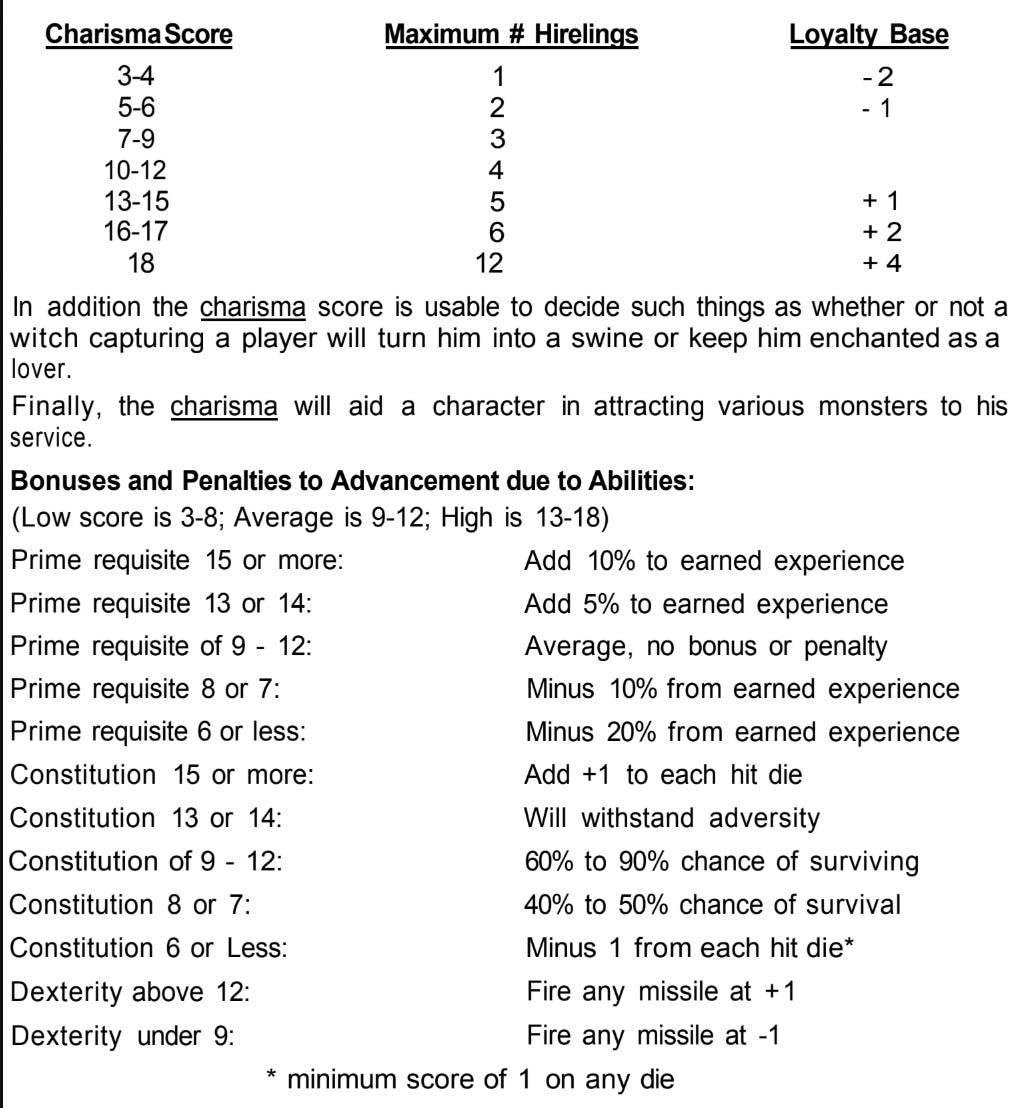
So strength and intelligence did nothing (except provide an XP bonus), 15+ CON gave a ~29% HP boost and other values affect your ability to ‘withstand adversity’, 13+ DEX or 8- DEX give +/-1 to hit with missiles respectively, and charisma helps hire more dudes more loyally.
Given the low impact (all 9s wouldn’t feel like a meaningfully worse character than all 18s), I can see why we’re okay rolling for stats (though I question the value of having the stats at all).
Then, compare to BX. We roll the same way, but 18 STR gives you +3 to hit, +3 damage with melee weapons (like starting the game with a +3 magic weapon), and raises the chance to open stuck doors from 33% to 83%. 18 INT gives you… 3 more languages. 18 WIS gives you +3 to saves vs magic. 18 DEX gives you +3 AC, +3 to hit with missiles, and +2 initiative rolls. 18 CON gives a cleric ~86% more HP. 18 CHA gives you 3 more retainer slots with +3 morale each.
This is a huge lottery! Characters that high-rolled are absurdly mechanically advantaged relative to average characters. Fortunately gambling is all the rage. I just don’t think it’s a good idea to put so much mechanical weight behind one pull of the slot machine.
That said, I understand the motivation - we want to speed up character creation and reduce the number of options. 3d6 down the line is choiceless, whereas rolling 3d6 six times and arranging as you please has ~720 options. Combine that with race and class choices and you have a combinatorial explosion.
If the game plays totally fine when you roll an average character, that’s strong signal that the stats aren’t load-bearing. Taking a note from 0e, I see there are a few “perks”:
+X% XP
+1 HP per dice
+1 to hit with missiles
+1 henchman
We can invent a few more perks:
+1 damage on melee attacks
+1 AC
+1 language
+1 to notice secret doors
and maybe tweak the numbers a bit make each option feel roughly equally attractive and just let players pick a couple.
Light Management
Continual light has been a 2nd level Magic-User spell since volume 1 of OD&D. It costs the caster nothing but a slot to cast and lasts forever. In a 5 year period, a magic user could have produced ~2000 objects enchanted with continual light that last forever. Presumably the setting has more than one magic user that can cast the spell.
What do you think would be a fair price for a pebble that has already (potentially hundreds of years ago) been enchanted with continual light?
If you pick a high number, one that a 1st level party couldn’t afford after their first adventure, keep in mind that they’ll be able to produce that kind of value once a day after they hit 3rd level.
If you pick a low number, one that a 1st level party could afford, you have to accept that light management does not meaningfully exist in games where continual light is a spell.
I’ve seen a few attempts to fix this. 7voz has the most surgical fix I’ve seen: continual light can only be cast at an unmoving point in space, not on an object. Shadowdark and Dolmenwood both just cut the spell. ACKS 2e has this extra “perpetual” mechanic that fixes the world-building implications (no fully-illuminated villages) but totally removes torch-management.
Say you think this is all poppycock.
How much does oil cost and weigh? One flask of oil lasts ~4 hours. It’s also the sort of thing where we’re doing all of this tracking (okay each of the 3 lantern-bearers need to reduce your oil duration from 22 to 21 turns!) and never once in my years of playing has there been a payoff.
My suggestion is to require that half (maybe a third?) of the party members need to use a hand on light (and so can’t use a shield or two-hand a weapon). Like just actually hard-require it, lower the encumbrance thresholds by ~20% to account for the light you won’t track, and then never think about it again.
Compatibility
This has been a personal bugbear for a while. When I read other people talk about compatibility, it feels surface-level. They’ll talk about how the unarmored AC value in 1e is 10, but in BX it’s 9, so the main thing you need to do is subtract 1.
This entirely misses the point!
There are more shared concepts between BX and 1e than there are between BX and 3.5e, and so it’s easier to translate between BX and 1e. They’re more compatible.
An entirely separate idea is translating meaning. For instance, let’s look at a ghoul in combat vs a 1st level fighter in Delving Deeper (a 0e clone) and 1e.
In Delving Deeper, 1st level fighters have 1d6+2 HP and attack for 1d6 damage, hitting ghouls 45% of the time. They’ll probably have 2 AC. Ghouls have 2d6 HP and attack for 1d6 damage, hitting 30% of the time, where they’ll cause paralysis 65% of the time.
Here’s a quick simulation script.
The fighter wins ~37% of the time, and kills a ghoul who doesn’t fight back in ~5.5 rounds, though we’re only 90% confident that it’ll kill the ghoul within 10 rounds. The ghoul kills a fighter who doesn’t fight back in ~4.3 rounds, and we’re 90% confident that it’ll kill the fighter within 9 rounds.
In 1e, there’s a lot of variance to how strong a fighter can be. A bog-standard fighter has 1d10 HP (though this can go as high as 1d10+4 with CON), attacks for 1d8 (though this can go as high as 1d8+6 with STR), hitting ghouls 35% (though this can go as high as 50% with STR) of the time. They’ll probably have AC 3 (though this can as low as -1 with DEX). Ghouls have 2d8 HP and attack three times for 1d3/1d3/1d6 respectively, hitting 40% of the time (though this can be as low as 20% of the time with DEX), causing paralysis on 65% of hits.
The bog-standard fighter wins ~7% of the time, and kills a ghoul who doesn’t fight back in ~7.2 rounds, though it takes 14 rounds before we’re 90% confident. The ghoul kills the fighter in ~1.5 rounds, and it only takes 3 rounds before we’re 90% confident.
A giga-rolled fighter (18/00 STR, 18 CON, 18 DEX) wins 51% of the time, killing the ghoul in ~2.6 rounds on average (5 to be 90% confident). The ghoul kills the fighter in ~2.8 rounds (6 to be 90% confident).
Somewhere in between (16 STR, CON, and DEX), wins 14% of the time, killing the ghoul in 6 rounds on average (12 to be 90% confident). The ghoul kills the fighter in ~2.0 rounds (4 to be 90% confident).
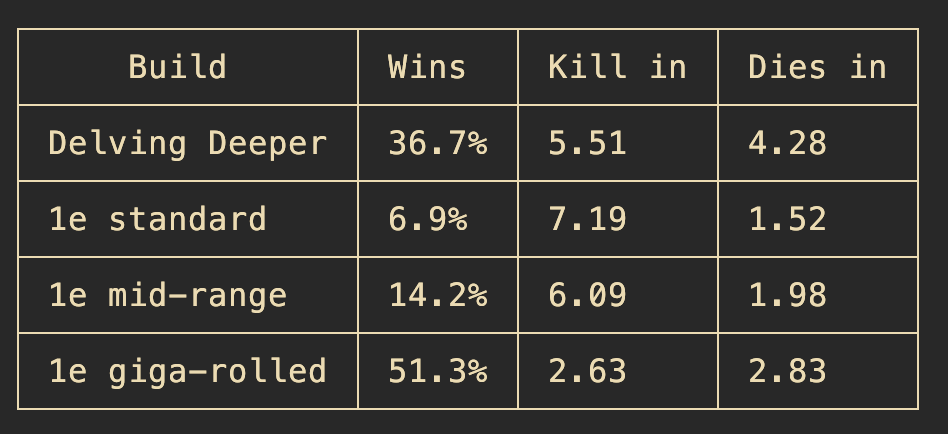
And that’s translating the system’s monster to its own stat block instead of reading the source stat block directly. If we have the Delving Deeper fighter try to battle a 1e ghoul that attacks 3 times, the 37% winrate drops to 14%.
The same encounter in different systems that use the same language, numbers, and concepts can have drastically different feelings. Ghoul encounters in 1e are way more threatening than they are in Delving Deeper, so when you try to play a Delving Deeper module in 1e and your party immediately TPKs to ghouls, this is because it doesn’t translate well.
This is the tip of the iceberg! Here’s a NPC spellcaster from a 1e module:
Anna Ligareon, 7th-level female Archontean illusionist: SZ M; AL LE; AC 5; MV 120’; HD 7; HP 22; #AT 1; Dmg 4-9 (staff of striking). Abilities: STR 10, INT 17, WIS 15, DEX 11, CON 9, CHA 16. Possessions: guildmaster’s gold ring (200 gp); Ligareon signet ring; bracers of defense (AC 5); staff of striking; potion of fly; oil of etherealness. Spells memorized: audible glamour, color spray, hypnotism, phantasmal force; detect magic, hypnotic pattern, invisibility; non-detection, suggestion
Now open up the delving deeper SRD and ctrl+f each of those magic items and spells.
staff of striking: does not exist
bracers of defense: does not exist
potion of fly: renamed ‘potion of flight’
oil of etherealness: does not exist
audible glamour: does not exist
color spray: exists
hypnotic pattern: does not exist
invisibility: exists
non-detection: does not exist
suggestion: does not exist
Modern editions of these games abandoning the OGL have only made this worse. BX has Cure Light Wounds. Adventures written for BX have Cure Light Wounds. ACKS 1e had Cure Light Wounds, 2e uses Cure Light Injury. Each instance of this creates translation work as I need to go look up the item in the original system, figure out what it does, and then go find your legally distinct copy of it.
I would love to see Venn diagrams of different systems’ catalogs: the amount of overlap in monsters, magic items, and spells. The impression the OSR gives off is that you can buy one book (let’s say you buy OSE classic), and then be able to run any OSR adventure. This just isn’t the case, unless you love making up monsters, magic items, and spells based on just the name.
Don’t even get me started on talking about compatibility across totally different engines (C&C, T&T, Knave, Cairn, Errant, etc).
One last vector.
In 1e, Continual Light is “nearly as illuminating as full daylight”. Note nearly. In ACKS 2e, Illumination, Perpetual “produces full daylight out to 30ft”. Note full daylight. The difference between “nearly daylight” and “full daylight” is that full daylight will absolutely table an important subset of powerful undead, like Spectres.
Dungeons get designed with a level range (and assumed party capability in mind). If you look at T1: Village of Hommlet, all of the big single-enemy encounters (the snake, the ogre, the lobster) all have >4+1 HD. This is because, presumably, Gary was well aware that a single <=4+1 HD enemy immediately bricks to the Sleep spell.
The same goes for a host of other breakpoints, like vertical traversal, divination, teleportation, incorporeality, etc. If 1e assumes that you can’t just see every secret door but WWN gives you always-on true sight, stuff is going to feel weird.
High-Level Play
Low-level play works well. HP values make sense relative to damage so combat wraps up in a fun amount of rounds. If it takes ~3 rounds to decide a combat, then having a surprise round (which is the main mechanical reward for clever play) is a huge advantage. If it takes ~8 rounds to decide a combat, then now having an extra round is worth a lot less.
We can see this numerically: check out a Minotaur which does 2d6 (~7) damage, but has ~27 HP (~3.9x ratio) as a 6 HD example, vs an Orc, which does 1d6 (~3.5) damage but has 4.5 HP (~1.3x ratio).
The same (kind of) goes for players, where in OD&D or B/X, a 1st level fighter probably hits for ~4.5 and the same amount of HP, but a 7th level fighter has ~32 HP and is likely hitting for ~7.5 with a +3 weapon.
Meanwhile, a fireball from a 7th level wizard is hitting for 7d6 (~25) in a 20ft radius. I know exponential wizard vs linear fighter has always been a meme, but man is it rough here.
The fighter at my table ended up being wild, but a lot of that was that 1e has crazy dual-wielding rules3 and Arden Vul has a bonkers amount of loot.
Old system designers and module authors experienced how much of a slog “normal” combat was and elected to try to solve the problem with gratuitous amounts of save-or-die effects on higher level magic items and monsters, leading to games of rocket-tag by invisible flying assassins, which the game system straight up wasn’t built to handle.
Then, on an exploration level, PCs get access to more and more options (flying carpets, boots that let them walk on walls, spells that let them divine exactly where the macguffin is, etc). This makes it more and more difficult to actually challenge a party, and especially difficult to challenge a generic party, since a module author has no real baseline to operate against and tables diverge more and more as play continues.
In order to cope with this, module authors lean on highly contrived situations where the macguffin is in a pocket dimension that strips player’s abilities away, or in a mage tower where a weird subset of spells don’t work or whatever. Ick.
Finally, the XP numbers start getting weird: it takes 56000 xp to go from level 7 to level 8. So it takes ~280000 XP for a party of 5 fighters to level up. That’s over 1000 dead minotaurs! That’s ~5 dragon’s hoards!
I get the broad sense that very few people’s OSR games last until this point and that they instead keep playing levels 1 to 3 before campaign fizzles out (hence the obsession with torches and whatnot).
Underlying Models
The map is not the territory! When we play a game of D&D, the territory is the actual game being played at the specific table with the specific people. Within that game, there are different mental imaginings of the same fictional situation, and so the GM is the only one that sees the territory and the players merely have a map4.
A lot of the communication we have at the table exists to detect and resolve inaccuracies in the map — the players enter a room and now they have a different imagining than the GM. The GM describes the room, and then the players ask questions until they feel like their map matches.
The game system and modules perform the same work; one of their main purposes is to get the GM and author imagining the same thing. This sort of work goes more smoothly if we can grok the underlying structure and then smoothly interpolate the not-explicitly-defined spaces in between things we directly observe, or extrapolate past them.
Trying to grok the underlying structure is only possible if the underlying structure is coherent.
I recognize the above is extremely abstract, so let’s look at some examples.
HP
When you fall N•10 feet, you suffer Nd6 damage
When you are hit by a spear, you suffer 1d6 damage
When you drink a potion of healing, you regain 1d6+1 HP
Characters gain more HP as they level up, and even more if they have high constitution
Characters do not experience loss of capability in any form until they hit 0 HP.
This is the sort of thing that I don’t think is possible to square: people have been arguing about this for 30 years.
Say you like to imagine that HP represents some combination of “luck” and “meat”. So a 7th level fighter with 50 HP will still die to a spear like anyone else, it’s just that you have to grind through all of their luck/skill/etc first before you can actually land a telling blow. In this model, why can the 7th level fighter leap off of a 100ft cliff, plummet to the ground, and then stand up and be totally fine? Do healing potions give you luck back?
Okay, so then instead let’s imagine that they’re all meat-points; are we to believe that these 7th level fighters are just that durable? They can leap off of cliffs and their bones are just fine, or get stabbed ten times and not really worry about it and keep fighting? If so, that sounds super-heroic and requires having a different fictional understanding of what “leveling up” means and how this world is operating.
Stance
Imagine that you had some sort of magical item that activates when you have 1 HP. You want your character to intentionally take damage (like by standing in fire, harming yourself, etc) until you have 1 HP to activate the item. How does this work?
The party is split up even though the players are all sitting at the same table. One group gets in trouble. All of the players know, but the other group’s characters wouldn’t know. Can the other group rush over to help?
Is your character an extension of your will that you can control absolutely, or do we need to only do what we think they would do? Do our characters ever know more than us? They have been living in the setting their whole lives, after all. Do they ever know less than us?
In my Arden Vul game, the first party went up the short stair and TPK’d, learning that the area was dangerous, and some of what was inside. Does the second party need to pretend like they don’t have that information?
Attributes
Your character has 12 Strength. Can you make your fighter eat a bunch of steak/eggs/milk, do a bunch of calisthenics and raise their strength?
Your character has 7 intelligence. Are you allowed to come up with smart plans? Are you allowed to have your character speak consistently eloquently?
Your character has 7 Charisma. Are you allowed to describe them as attractive? Are you allowed to play them as confident/charming/someone people want to be around?
More abstractly, what do the attributes represent? Why can’t they be non-magically changed? To what degree do they constrain roleplay?
Room Descriptions
The previous three were all player-facing, so here’s a GM one. What does a room description represent? Say there’s a room with a snoring giant next to a roiling cook-pot and a gagged monk inside a sack. This is a time-sensitive thing! Giants don’t sleep forever, it only takes so long to boil a cook-pot, it only takes so long to cook and eat a monk.
In the real world, stuff just happens on some sort of global clock. You can imagine that the giant started boiling the pot on fantasy august 3rd at 4:09pm and then fell asleep at 4:14pm. He’ll be sleeping until 4:52pm. Then he’ll wake up and boil the monk at 4:56pm, who will die at 4:58pm. The monk will be finished cooking at 5:30pm, and the giant will finish eating him at 5:45pm.
If the PCs arrive before 4:09pm, then the giant is awake and the cook pot hasn’t been boiled yet. If the PCs arrive after 5:45pm (or wait a day to investigate the house), it’s too late and all of this is already over and the giant is doing something else.
This is a nightmare. This is not how these modules (or adventures at all) operate. This is the wrong model.
Instead, best I can tell, it looks something like…
The giant started boiling the pot on <day the PCs arrived, up until a fiat limit after which the GM declares the PCs are too late to save the monk> at <20 minutes before the PCs looked into the room> and then fell asleep at <15 minutes before the PCs looked into the room>. He’ll be sleeping until <23 minutes after the PCs look into the room>. then he’ll wake up and boil the monk <29 minutes after the PCs look into the room>, who will die <31 minutes after the PCs look into the room>. The monk will be finished cooking <63 minutes after the PCs look into the room>, and the giant will finish eating him <78 minutes after the PCs look into the room>.
Or you can imagine a tiny turn calendar for the event:
2 turns: the giant wakes up
3 turns: he moves to boil the monk
6 turns: he starts eating
8 turns: he finishes eating
This is more playable, and less of a nightmare to try to build an adventure around, but it stretches belief.
Modules constantly and inexplicably flip between models. One room will be implied to be keyed based on when PCs arrive. Another room will have a random amount of creatures in it (there are currently 1d6 cultists hanging out in the kitchen), which implies that the author is trying to model how the room is operating independently of the party’s arrival.
I understand that many of these are lossy abstractions that exist to facilitate play. We have hit points because we don’t want to get into the physics of what happens when something is stabbed.
I’m not demanding perfect abstractions. I’m asking for the system designers and module authors to provide explainers about the specific models and abstractions they’ve chosen. This requires for them to be aware about their underlying assumptions, which is tough but not impossible.
Looking Forward
Here’s the core game loop:
Learn about an adventure (finding rumors, investigating rumors, talking to NPCs)
Prepare for the adventure (shopping, logistics, hiring help)
Travel to the adventure site (overland travel rules, wilderness encounters, logistics)
Adventure at the site (resource management, dungeon encounters, talking to NPCs)
Return to safety (xp, offload treasure)
Repeat
???
Strongholds!
Bad news: most of these are in a rough spot. Good news: it’s not hopeless! If you’re trying to write an up-and-coming OSR game, there is room to improve and have a more coherent project.
Finding Rumors: This should be handled on a player-facing system level (default mechanics for gathering rumors from a town), an adventure level (guidance for the GM on how to incorporate your module’s rumors into existing settings), and gm-facing world-building level (guidelines for world-building and campaign creation for how to come up with rumors and put them in the world).
Investigating Rumors: If you tell the players “The dread pirate Carmelo the Cursed buried his treasure in these very woods”.
Who told them that? Can they talk to that person?
Who is Carmelo? What was his curse? What sort of treasure did he have? Where can they discover more information?
Games like Call of Cthulhu have a library use skill, and explicitly have bread-crumbs where most of the game is following up on leads like this. OSR doesn’t have that! If the intent is that this isn’t the sort of thing that players ought to be doing, we should be clear about that.
If we don’t want this to be the game, I recommend providing GM guidance on how to hand-wave and abstract the information so you can refocus time and attention on the adventure, and player-facing guidance outlining this expectation.
Player: “Can we research who Carmelo was?”
GM: Yeah, it’ll take 2 days of downtime to ask around, that okay?
Player: Yeah, we have a week while Turjan learns his new spell.
GM: Checking around town, you find out…
Talking to NPCs: OSR games have a variety of reaction rolls that solve the problem well. Draw Steel also has a neat “negotiation” mechanic where NPCs have a disposition that climbs a ladder: [No, and… < No < No, But… < Yes, but… < Yes < Yes, and…], and attempts to climb the ladder lowers a patience score. ACKS has a similar idea where NPCs have a disposition: [hostile < bad < indifferent < neutral < friendly] and each attempt to shift their disposition takes more and more time.
A lot of this comes down to the age-old philosophical debate of roll-play vs role-play: do you want non-charismatic players to be able to play as charismatic characters?
I think both approaches are coherent. If you want roll-play, then I recommend having actual mechanics for influencing (ideally with more than 1 roll). If you want role-play, I recommend removing charisma-based social mechanics so that it exists purely in-the-fiction and players stop looking at their character sheets to figure out who should be the one talking.
Shopping: The main things to pin down are:
What level of abstraction does shopping happen at? Do we shop with particular NPCs, or zoom out to whole towns? The system should be opinionated and inform players about this expectation.
Which items are available for purchase? How do we convey this information efficiently to the players?
What are the rules around players selling treasure to NPCs? In world of warcraft, all vendors have infinite money and buy every item. Do we want that to be the case here? If not, how does it actually work? This can range from formulas (like what ACKS has) to gm-facing guidance to make it part of the world-building layer and NPC merchant stat blocks.
How does appraisal work? Do players automatically know the value of all items? If not, how do you keep track of this information (and award XP at the end of an adventure)? Do NPCs know the values of items? Is it possible to trick them into buying something for more money than it’s worth?
Logistics: Carts, food, water, beasts of burden, and carrying capacities. Games frequently drop the ball here and forget to define one of the above. Common missing elements are how gathering food/water from the wilderness works, how much horse food weighs/costs, and how much horses eat per day.
I do seriously question if this is a valuable corner of the game or if the game is better off skipping it.
Hiring Help: Need to decide how many henchmen each PC can have. The old games have very high limits (4+CHA means that 5 PCs can have ~20 Henchmen, which is… a lot), so consider reducing those (or have explicit guidance on how the table can manage that many character sheets).
We also need guidance on how henchman recruitment works; trying to invent them out of thin air (ah yes, roll for #henchman, in the settlement, then roll for what percentage of them are interested, then generate a full character sheet for each one) is a non-starter.
Overland Travel Rules: has its own whole post
Resource Management: This works better if we can actually feel the pressure. If combat boils down to save-or-die, or generally everyone dies in ~1 hit, then HP isn’t a meaningful resource to manage. Raise accuracy and lower damage so that players can watch their bar dwindle. 4e-derivative games accomplish this by having a relatively small HP pool, and then a larger pool that lets them recover HP (so they feel the excitement of “almost dying”, and then the resource drain of their recoveries). WWN tried the same thing with System Strain but at my table it never was relevant.
We have
HP
Spell Slots
Consumables (scrolls, potions, wands, etc)
Daily/Weekly/etc use magic items
Light
We want the amount of this stuff that players can bring to an adventure to be tuned so that with “poor” play, they run out of one of them, and with “good” play, they get close to running out. This requires an understanding of how long you want an adventure to be, that way you can work backwards.
If you want players to explore ~20 rooms at the adventure site per adventure, and you think that’ll take ~30 turns, and you let your players have 1 lamp, then they can cover the whole adventure’s light requirements with 2 flasks of oil. 2 flasks of oil is not difficult to carry. Instead, these numbers need to be tuned so that there’s actual pressure!
Dungeon Encounters: This is a problem handled at a module-design level (though, that means the system should provide guidance to GMs and module authors about how to create good encounters).
The default strategy is to have tanky people (high HP, high AC) in the front and high damage (pole arms, bows, spells) behind them. The PCs, even at first level, have better AC values than almost the entire catalog of monsters, so this works really well. It’s the job of the encounter designer to build situations that reduce the effectiveness of the default strategy.
XP: XP-for-gold is a great system! There’s room to play with the formula, especially if on a world-building level you don’t want second-level adventurers to be heinously rich. You could give 10xp per gold, and then give out a lot less treasure, for example.
Strongholds: Either come up with a coherent way to tie them into the loop or cut them. Why should players spend their funds on strongholds? The original texts specify that players earn some amount of gold per peasant in their domain, but have no guidance around how to calculate or change how many peasants are in a domain. The payoff is also dubious: we’re spending all of this gold so that we can have peasants that… slowly generate us gold? Is the ROI even worth it to adventurers?
Instead, let players spend gold to improve their adventuring loop (better rumors, shorter travel, better market availability, more henchmen, etc).
Summary
Phew!
Here’s the punchy list of points if you just want something to copy+paste.
The dungeon turn is fantastic. It makes time a resource and gives every other mechanic something to hang on.
The catalogs (monsters, magic items, spells, modules) are the gold mine. They compound, and they survived evolutionary pressure.
There are limits to how impartial you should try to be. Pass it and it hurts yourself and the game.
The OSR’s principles contradict each other. For example, “be an impartial arbiter” and “reward cleverness” pull in opposite directions.
“Rulings not rules” cuts both ways. Some printed rules would be better off unwritten; a lot of load-bearing systems should have been written down.
3d6 down the line puts too much mechanical weight on one pull of the slot machine. Find another way to distinguish characters.
Continual light makes the light-management mini-game incoherent. If you want that game, the system has to actually support it.
Broad OSR compatibility is overstated, and moving off the OGL is actively damaging the shared catalog.
High-level play is broken: HP-to-damage ratios, save-or-die, and the XP curve all stop working.
Systems and modules should ship explainers for their underlying models. Tell us about the economy, HP, attributes, what a room description represents, what initiative represents, how literally to read a spell.
The core game loop is under-supported at almost every step. Plenty of room to improve.
There are a lot of other manifestos.
Fighters get this weird attack sequence thing as they level up. On odd-numbered rounds they can attack twice (once before everyone else, once after). For each of those attacks, if they’re dual-wielding, they can make an attack with each weapon at a -2 penalty with their main hand and -4 with their offhand. Their dexterity modifier offsets this penalty, to a minimum of -0/-1 (which was what happened with my fighter).
With the strength spell and gauntlets of ogre power, we’re looking at a flat +5 mod to damage on each weapon, plus each weapon’s magic damage bonus meant on odd-rounds we were looking at ~4 attacks that were reliably totaling over 50, killing anything 10 HD or lower immediately.
For D&D, but not all RPGs!
You all meet at a tavern. You've come to this borderland region to quest for the Tower of the Mage Who Tried To Get Rich By Casting Continual Light Once Each Day But Got Punished By GM Fiat. Adventurers whisper of the piles of gold he hoarded, but also of the doom that befall him. Will you dare to face Blinding Rays? Visitors from the Plane of Sun? Mirror golems? Deceitful apprentices? Will you summit the tower to do ultimate battle with the demented wizard himself? Will you learn the lesson of the tower, or will the same arrogance and doom befall yourselves? These questions swirl in your minds as a sunburnt man with mad, radiant eyes enters the tavern, screams and collapses. What do you do?
"Rulings over Rules" is one standard OSR doctrine I often find myself at odds with. Like yes, sure, we don't need rules for how cutting a rope with a sword works, you can just think that through logically. And yes, if a situation is very infrequent then it's unreasonable to expect the rulebook to contains specific rules for it.
But "just think it through logically and come up with a ruling" is actually quite hard:
* The specifics of the ruling have a huge impact on the particular situation in which you are making the ruling. Your players are fleeing from a threat which will certainly TPK them. They encounter a 15 foot wide bottomless pit. Let's come up with some ruling for how easy it is for them to jump across. Make sure to be totally impartial. Good luck.
* The situation might intersect/overlap with something provided by a class feature or game mechanic. The classic example is the Thief, where the existence of Thief skill checks implies other classes can't do these things... or can do them, it's just more difficult? Or can do them in easy cases but not at all in hard cases? What about this thing which is kinda adjacent to the skill but not exactly like it? Does my Thief get a bonus? Does this "taint" this action for other classes?
* There's some numeric/probabilistic component, and you want the maths to work out nicely and not interact in a degenerate way with other mechanics.
* Common sub-case: ability scores or other character features should reasonably influence the chance of success. But what should the mapping be, to achieve the intuitively desired result, and to not have it be too little or too much?
* Many rulings fail this on even a very basic level, making something objectively quite difficult succeed for free, or making something objectively quite easy into a 2-in-6 chance of success.
* The specifics can swing a particular action from totally useless, player feels silly for even trying, to completely overpowered and will now be abused forever. The space in between the two is often quite narrow. And it can depend heavily on specific mechanical details or worldbuilding elements which are hard to reason through precisely on the fly.
* "Just think it through logically" is actually quite hard because the real world is complex, unintuitive and full of fiddly details. See https://johnsalvatier.org/blog/2017/reality-has-a-surprising-amount-of-detail
* Even when you do get it right, realism often conflicts with fun and interesting gameplay. For instance if you know anything about climbing then you know that 99% of things people just straightforwardly do with climbing/ropes in RPGs are totally impossible even with modern climbing gear. But you probably still allow them because it's much more fun than the alternative.
* Like you say, the bar usually isn't "realism" as such, it's like, a mixture of realism and a sort of verisimilitude with a rough genre/set of tropes associated with the game/setting.
* And if you're not purely designing for realism, you've opened a whole other can of worms regarding what a good rule even is.
* Game design is quadratic. The more rulings you make the more interactions between your rulings you have to consider to make sure it all works nicely.
* Making the ruling at the point where the action is being attempted can often lead to the player thinking "well, if I'd known it was going to work like that I'd never have done this in the first place!". You can avoid the worst of this by letting the player decide if they want to do it after you've explained your ruling, but this doesn't help with longer-term things ("oh, well if I'd know it was so difficult to climb a rope I never would've planned to sneak up around the back and go in through the window!"), as you have to draw the line on takebacksies somewhere. Decisions are much more fun when they're informed, and if the rulebook is made up on the fly then you can't make informed decisions.
* Explaining / expressing it in a concise and easy-to-understand fashion is difficult. Especially verbally. And if you just describe it verbally you'll have to re-explain it several times as people miss or forget different elements.
* Ideally it's fairly mechanically elegant, doesn't require some cumbersome procedure, or introduce some new mechanic when it could be handled using an existing one. (See OSE's half a dozen resolution mechanics which could all just use unified d20 roll-under or something).
Now of course you don't need to get all of this perfect right away. You start with something simple which you write into a document (because of course rulings should be consistent). You refine it as you get more experience using it and have more time to come up with something better. And eventually end up with a nice rule... sorry, "ruling", which you've written into your book. A "rulingbook", we could call it...
Again, I'd understand if the action in question is uncommon. But your https://rancourt.substack.com/p/common-osr-system-questions is full of extremely common things which are inexplicably left up to rulings in the majority of OSR systems. What are we even doing here? Why are we publishing half-finished rulebooks and requiring every individual GM to finish designing the game themselves, instead of just doing it once? Just so we can claim our game is "rules-light" and feel superior to those silly modern gamers who like to have rules already written down? Because looking up a rule in a rulebook is supposedly slower and more momentum-breaking than designing a new one from scratch?
And the cherry on the top is that a lot of these systems don't even seem to be designed to make rulings easy. You can design a system such that it's (relatively) easy to figure out how to slot rulings in, and have them work nicely with the rest of the system, and be more confident the numbers will work out, etc. If you have a rules-light system, purportedly with rulings filling in the gap, but you haven't even designed it to be easy to make rulings...
(oh and one final pet peeve. often such missing elements are handwaved away because, well, "obviously", you should do X... but then it turns out that everyone has a different value for X. or, "obviously" it doesn't need to be spelled out because there's a rule written in some random sourcebook for an unrelated system)
(this turned into a bit of a big rant, sorry)