

One of the most frequent criticisms I got on my knave review was that I was overly fixated/confused about the game not defining what “in melee” means. Here’s one
The fixation on defining melee. The word is used in its literal meaning, it defines itself. If you’ve ever read any fantasy literature or played any kind of fantasy adventuring game, you know what melee means.
I think this is horribly wrong! The praxis matters, and I think a lot of different tables are invisibly making different assumptions that lead to very different outcomes and then communication difficulty when trying to talk about their experiences.
The aim for this post is to go through a bunch of rulesets and then demonstrate how the same situation and plan can play out differently based on the ruleset.
Defining Melee
Different games name/model this differently, but the concept is universal. Something wants to do bodily harm to you directly, and preventing this is difficult. If you stop trying to prevent them (ie, by turning your back to them, by reading a scroll instead of watching them, by picking up something off the ground, etc), then we something special ought to happen.
Here’s a litany of examples:
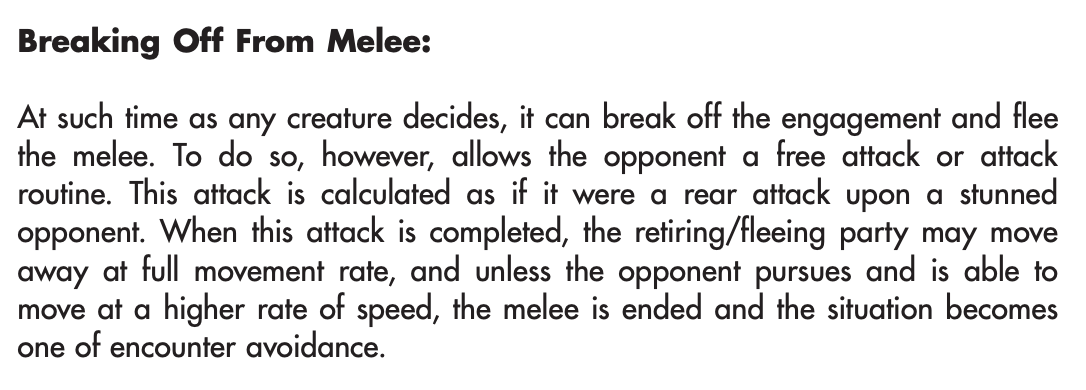
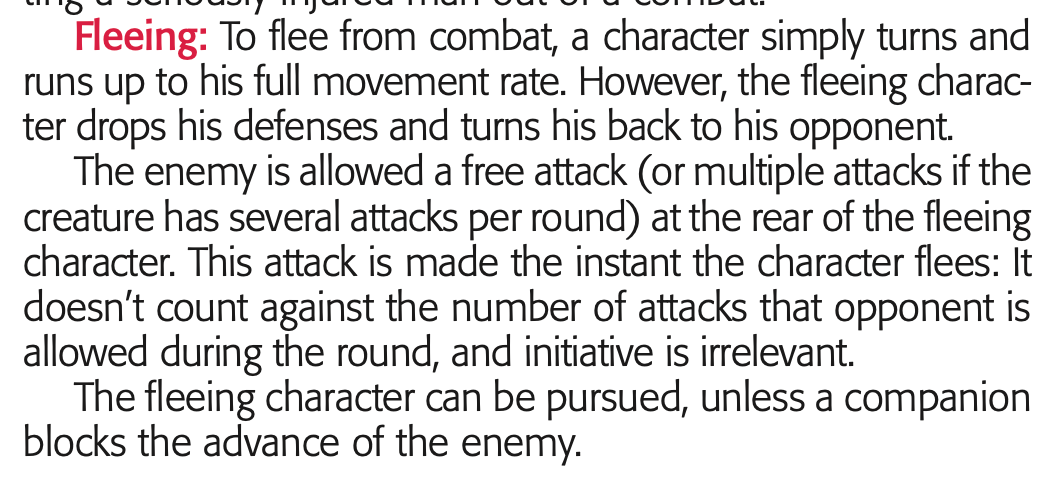
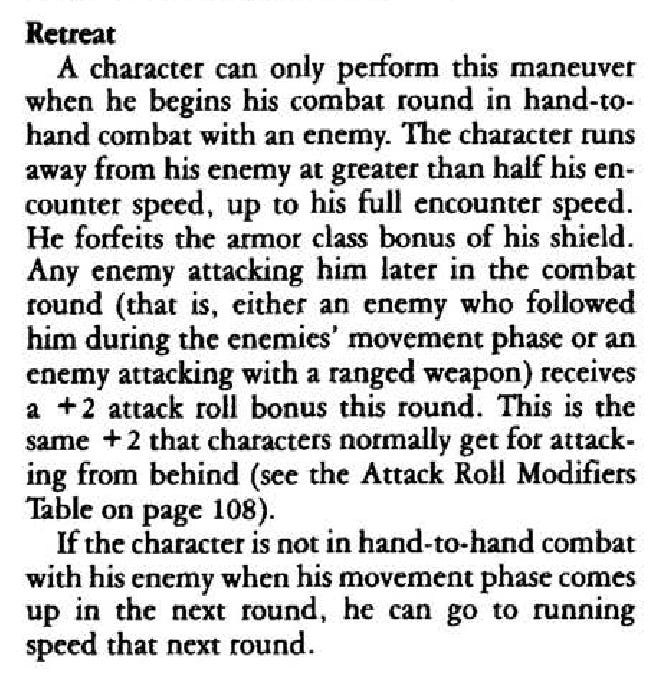
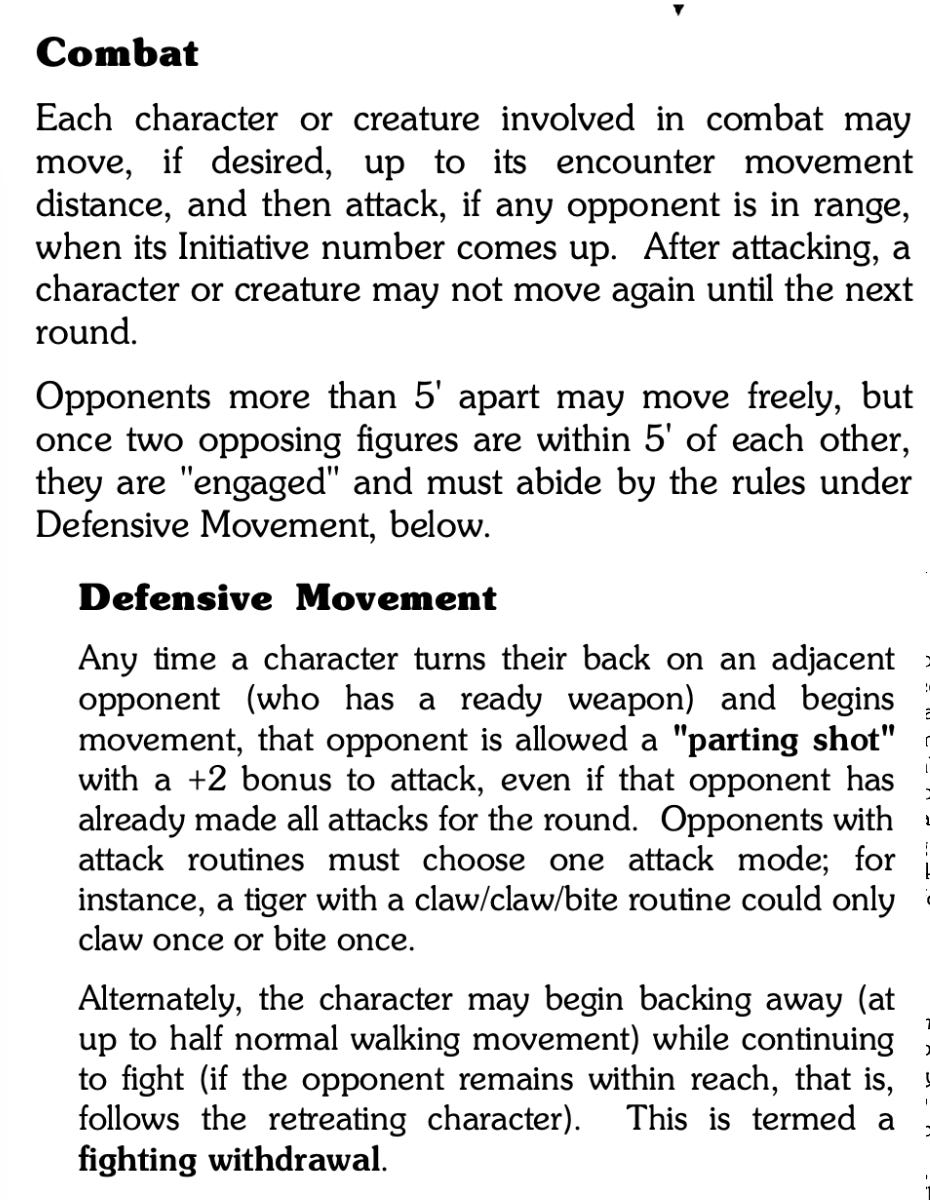
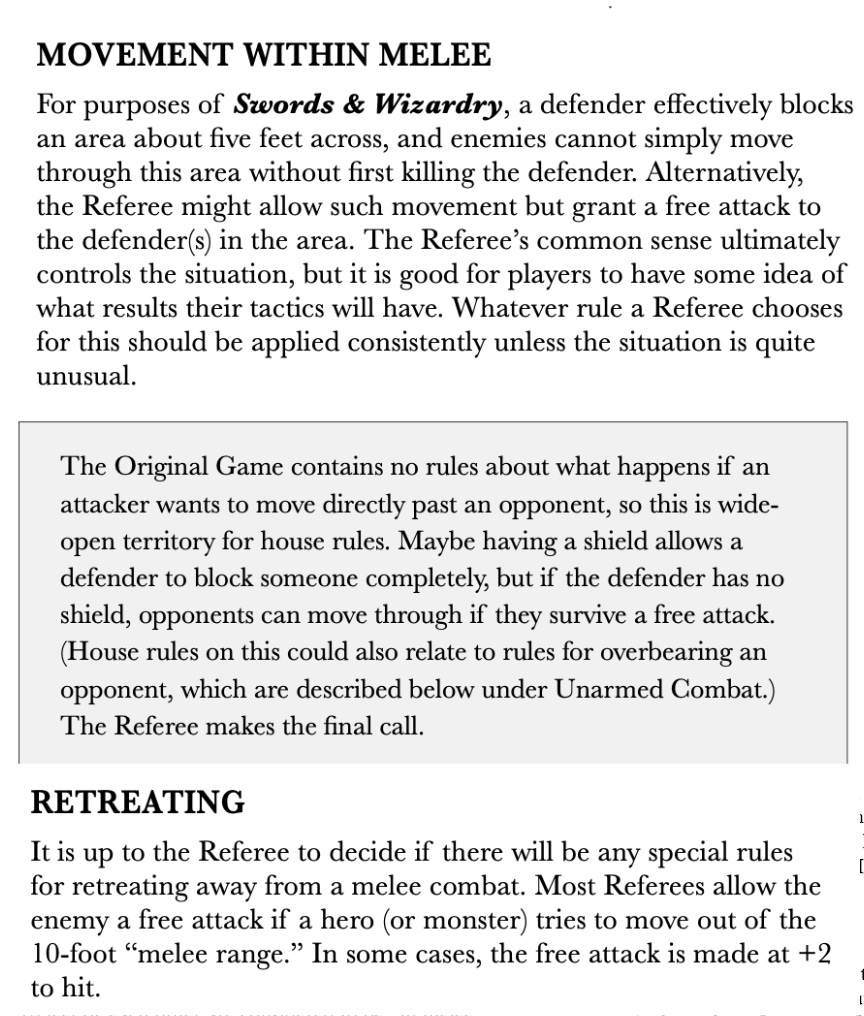

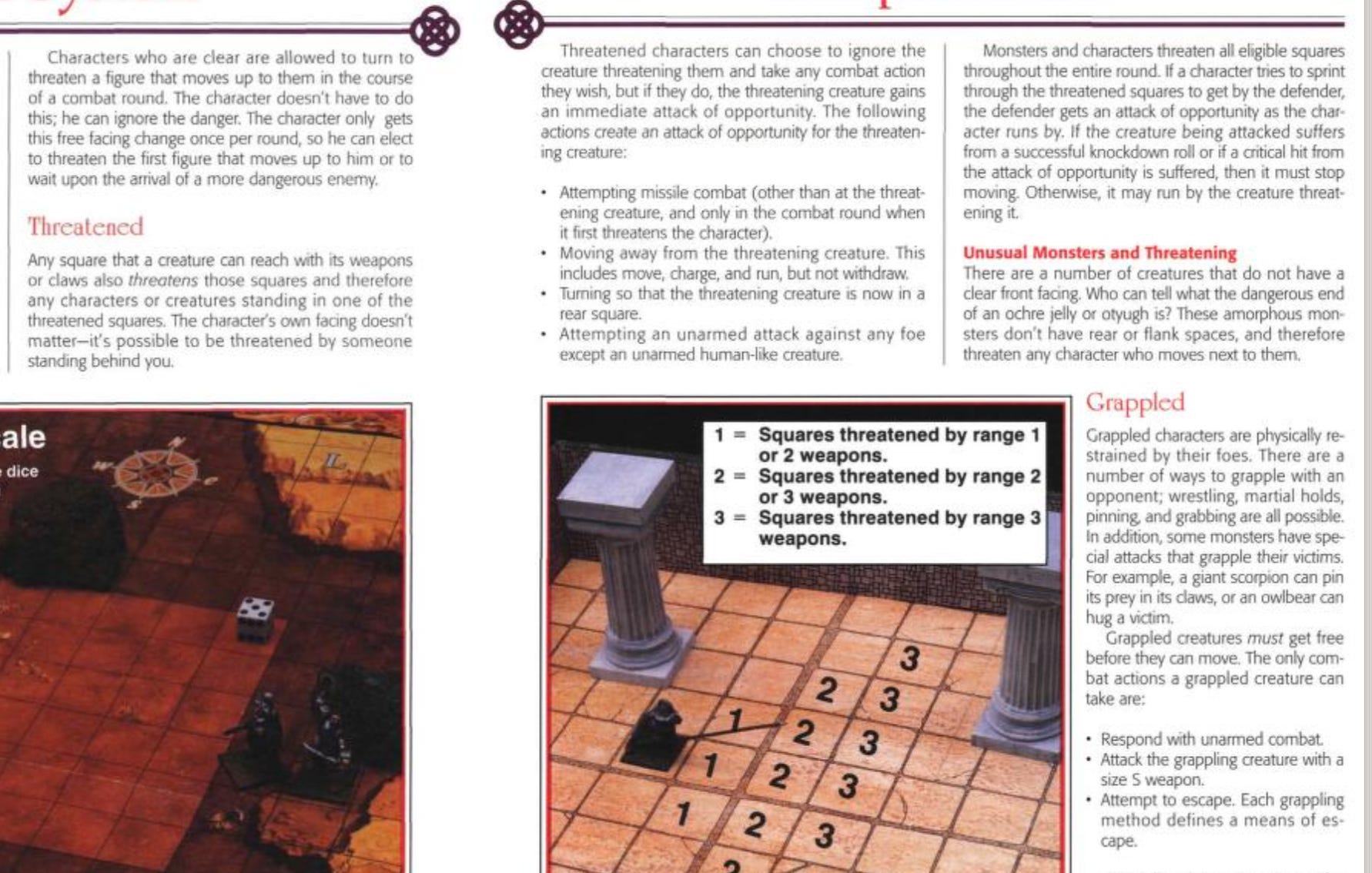
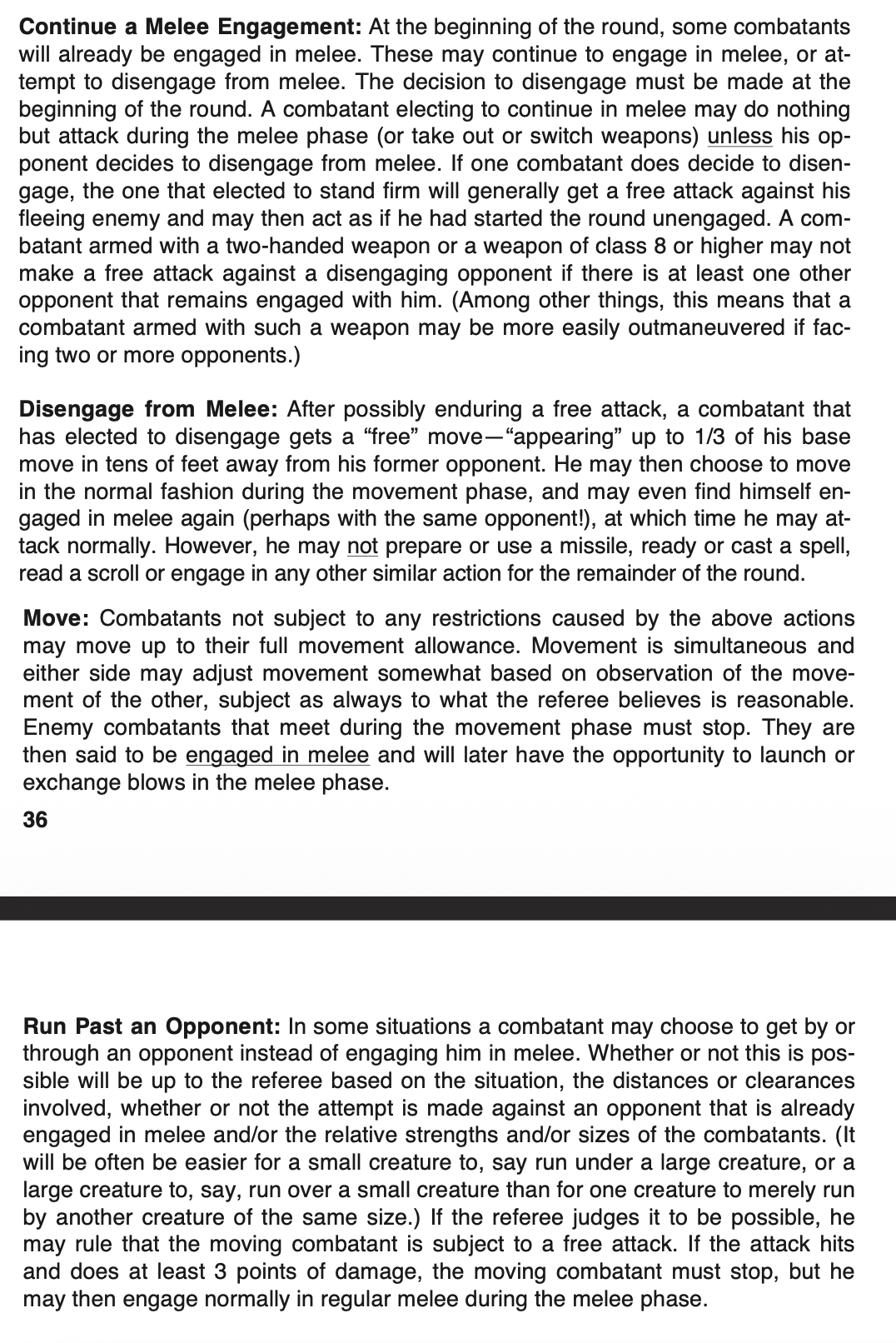
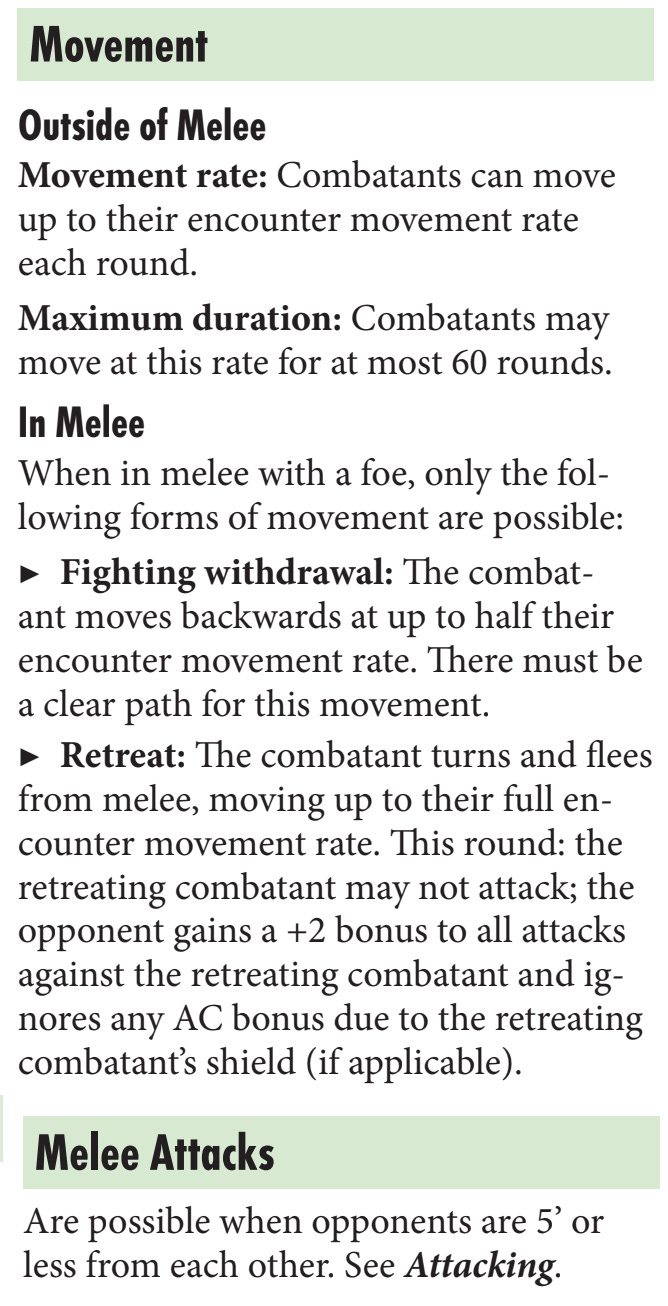
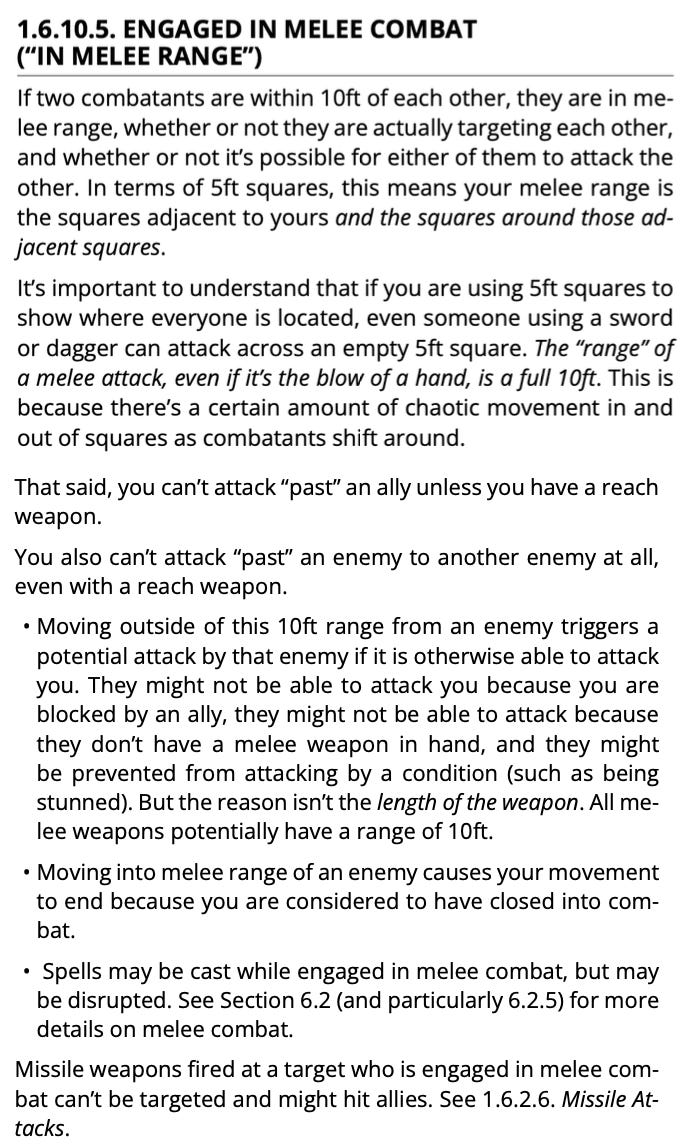

I think that’s enough to demonstrate the confusion :)
So! These systems (including Knave) have mechanics that in some way hang on being “in melee”.
Yet, hardly any of them define what “in melee” means. Some common variations:
You are “in melee” if you’re within X feet (usually 5, sometimes 10) of an enemy.
You are “in melee” if at least one of the entities is within melee range (varies by size/weapon) of the other.
You’re “in melee” if at least one of the entities has already attacked the other with a melee weapon.
Then, the common effects of being “in melee”:
Movement restriction: Many games have you halt movement when you’re “in melee” with an opponent. Many penalize leaving melee in some way, like by reducing movement speed, constraining you to “backwards” movement, giving your opponent a free attack, etc.
Ranged attacks: Some games give you a penalty for making a ranged attack while you’re “in melee”. Some games provide a penalty for attacking a foe who is “in melee” with one of your allies (often by making you randomly select a target).
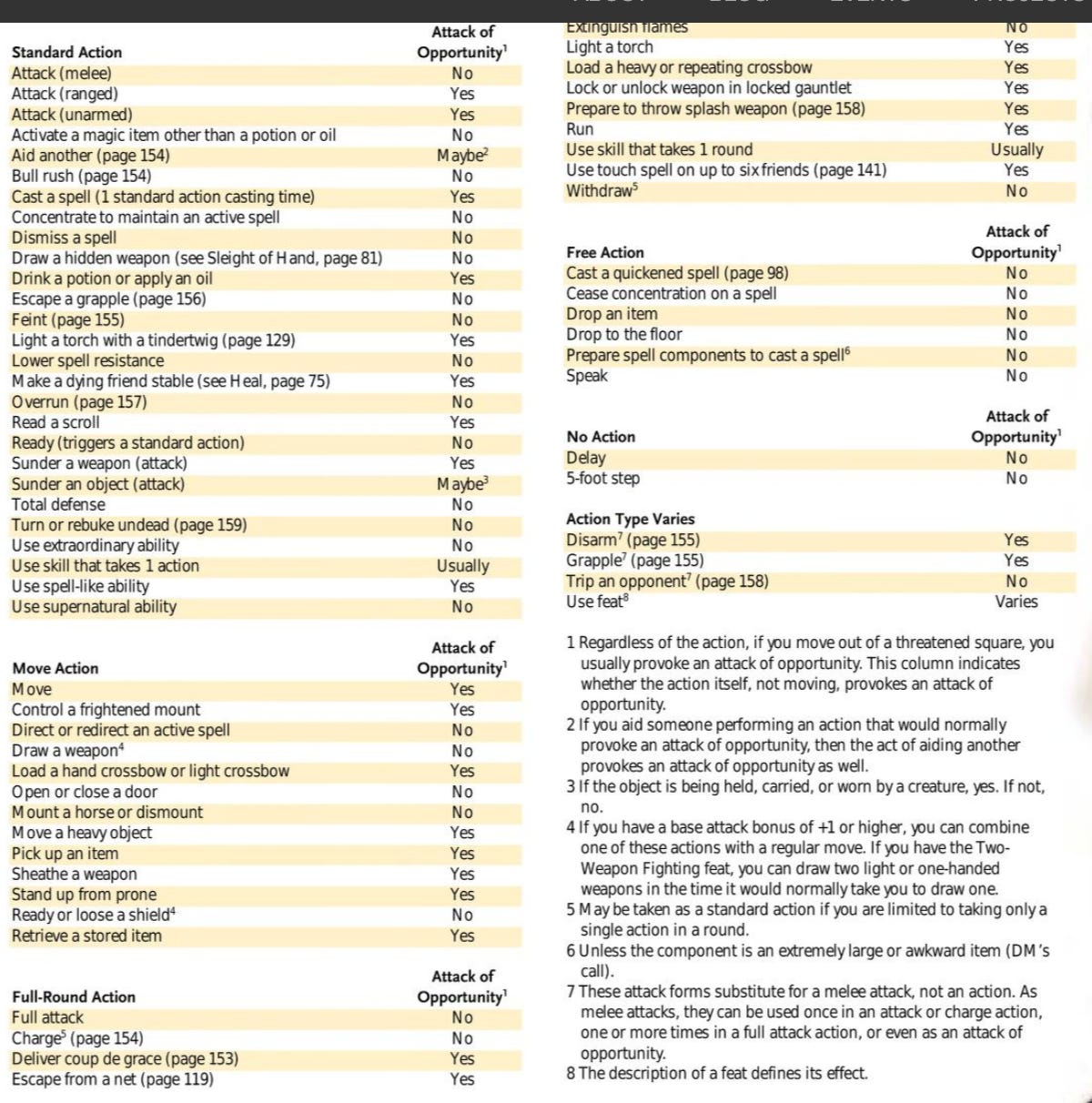
Other games take it much further - D&D 3.5e is notorious for handing out “Attacks of Opportunity” like candy:
I Want To Hit The Squishy
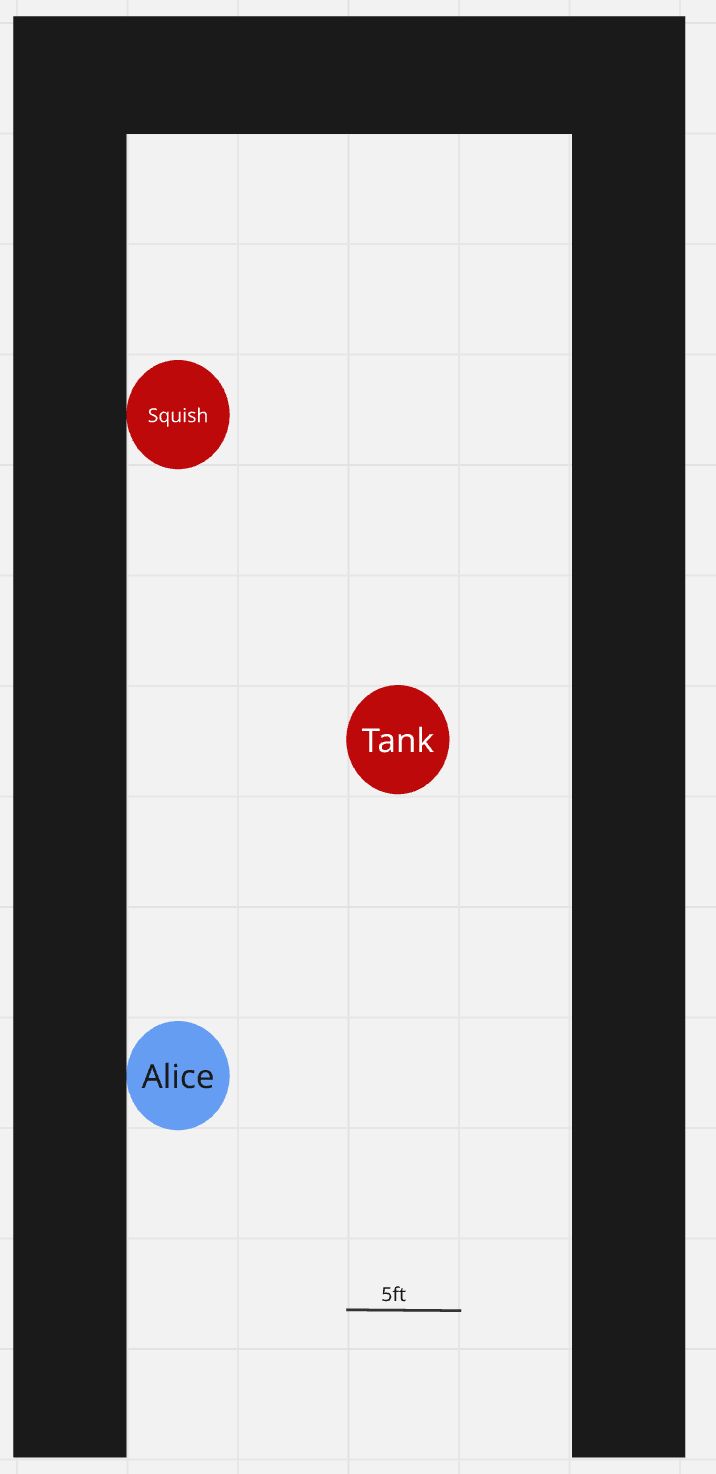
There’s a well-armored fighter in a 20ft-wide hallway. Behind the tank, a squishy magic user wants to bombard your party with magic. Alice wants to run up to the squishy caster and stab them. Can she?
In a host of games, it’s unclear. If the game uses the AD&D (or chainmail) definition of 1” = 10ft engagement range, then the tank covers the whole hallway. OSRIC 3 specifies that you must a charge within 10ft of your target, but says nothing about circling around or crossing through someone’s engagement range.
If the game assumes a 5ft engagement range (or has the Combat & Tactics idea of threatened squares), then you don’t have a problem - you’re able to stay more than 5ft away and reach the squishy caster.
What if we tighten the hallway?
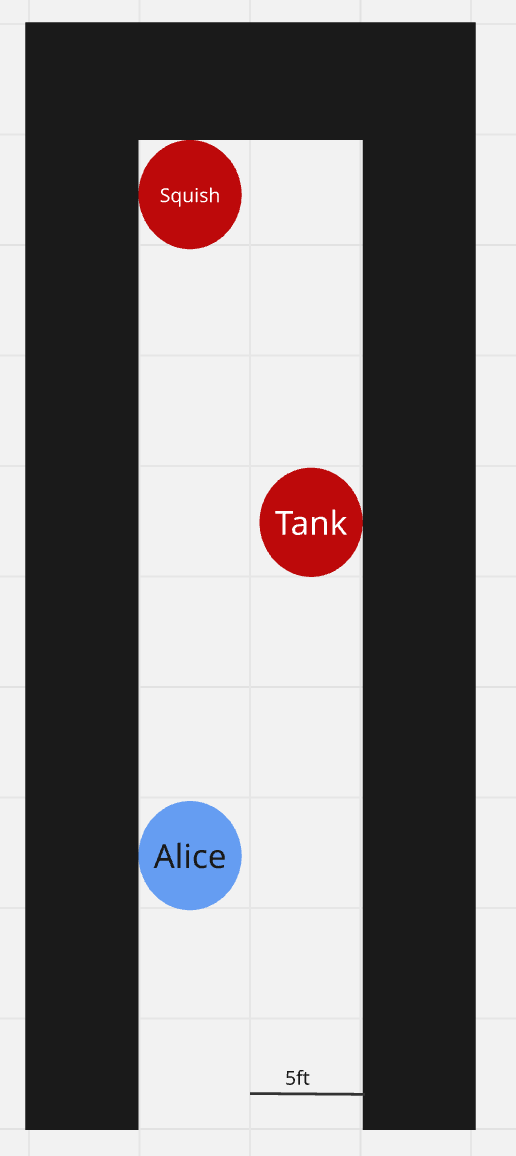
It’s still unclear for OSRIC for the same reason as above.
If the game includes a halt-when-engaged rule (like ACKS 2e and maybe BX), now Alice has to stop when she comes within 5ft of the tank. Aferward, only “backward” movement is possible.
Dolmenwood, on the other hand, explicitly specifies that at least one of the combatants must have already attacked each other to be considered “in combat” (which IMO is one of the larger departures that Dolmenwood makes from BX), so you can run right past and hit the squishy.
In between, you have games that allow this sort of movement at a cost. D&D 3.5e gives each opponent an opportunity attack each time you leave any threatened square (edit: though you only get one per round).
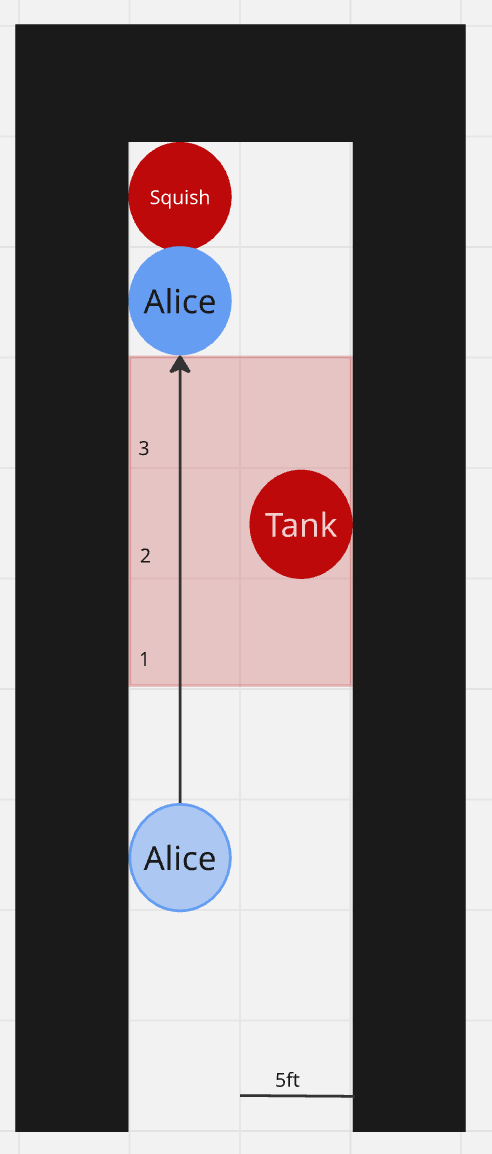
I marked all of the Tank’s threatened squares with the translucent red. Since Alice exited three red squares, the Tank would get 3 attacks of opportunities against her. edit: In 3.5e you can only get one AoO per round.
D&D 5e (and Crows) instead lets your circle around enemies without penalty, but the moment you attempt to leave a threatened square, they get their attack. Some games place limits (like 1 per round, or they use a limited resource like a ‘reaction’) on the number of such attacks someone gets to make.
I Want To Flank
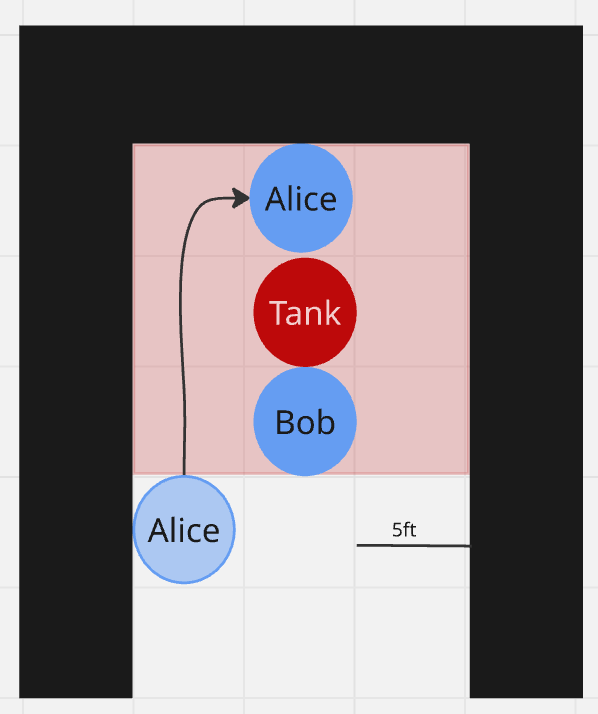
A lot of games have a lot of flanking rules!
In the OSR, most of the time they look like this
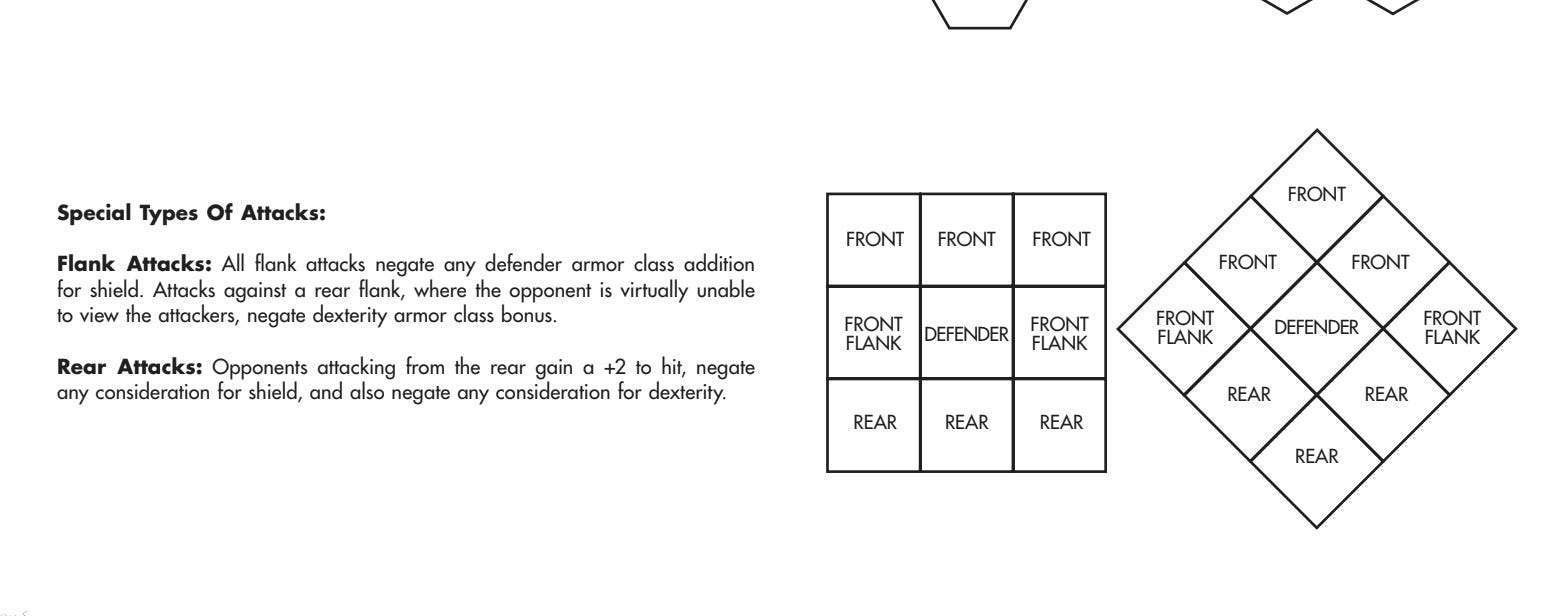
In more modern games, like this
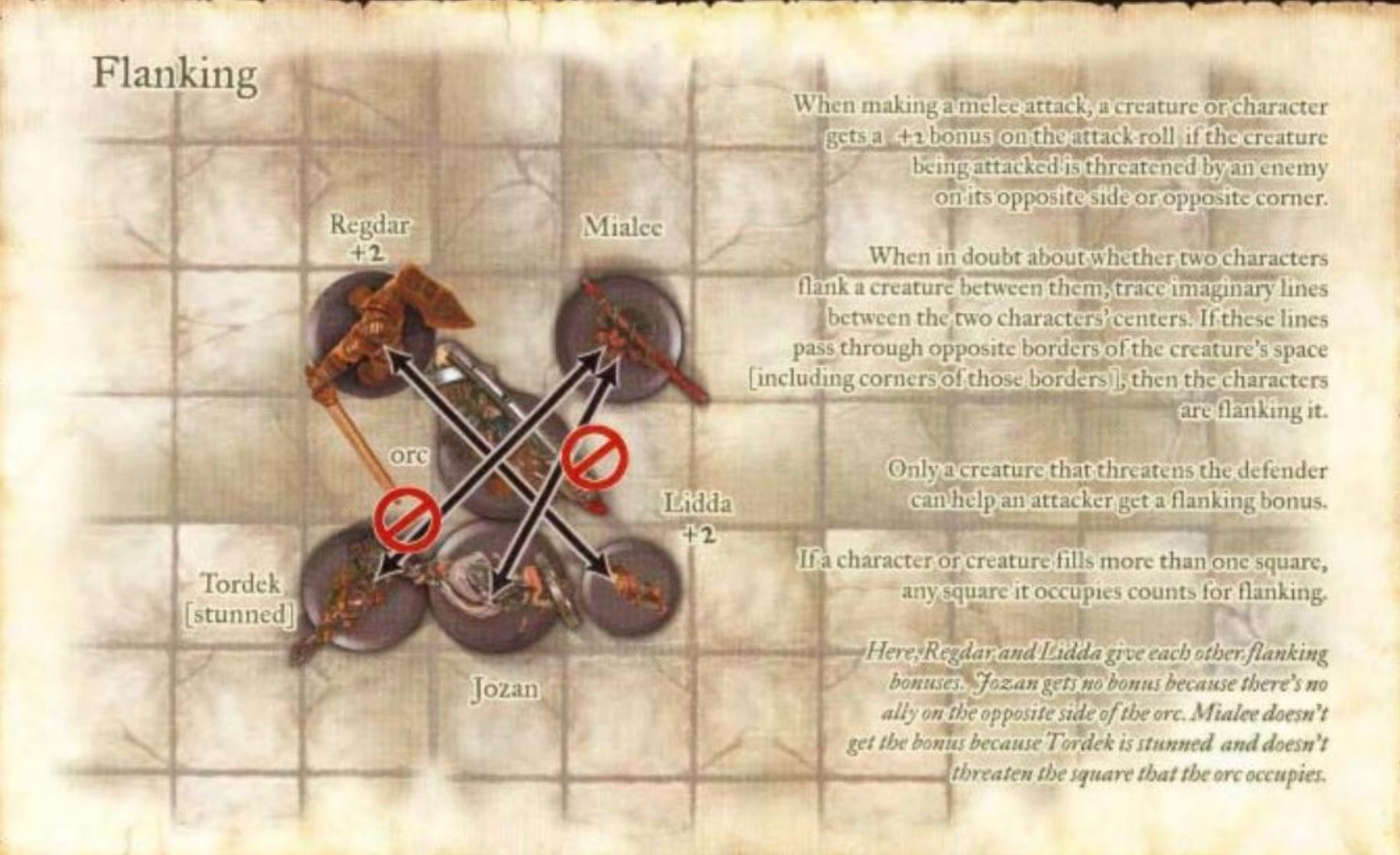
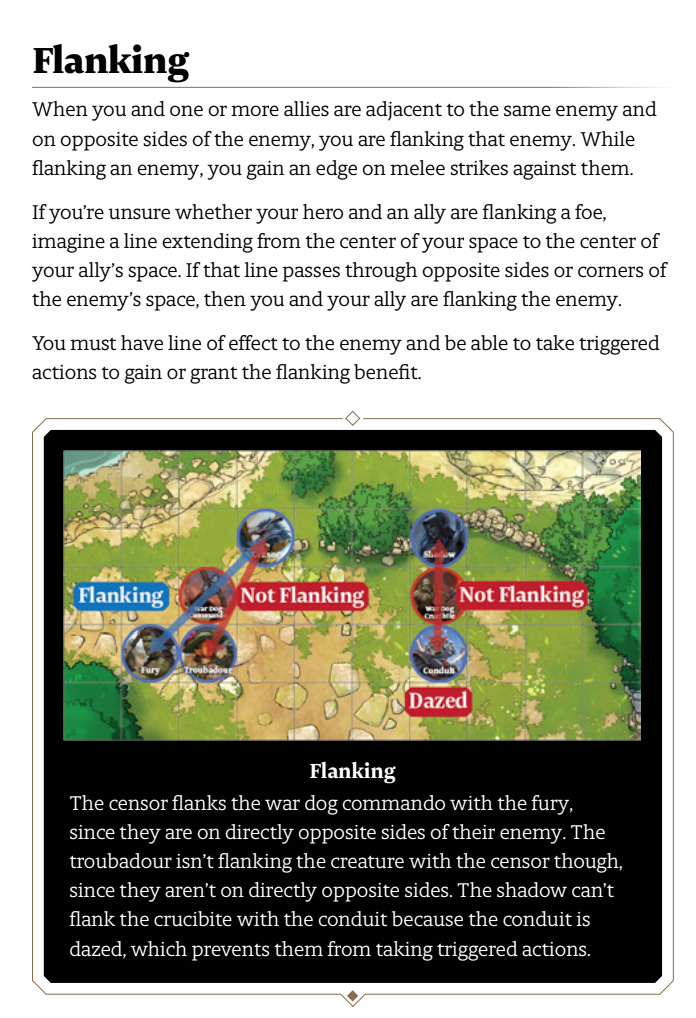
I vastly prefer the modern approach, mainly because I’ve never seen a game other than ACKS and GURPS attempt to define a system for tracking and changing a character’s facing. Is your facing stuck like in final fantasy tactics? Does your facing also determine your line of sight? And so on.
Regardless, most of these systems eventually mechanically encourage PCs to be on opposite sides of the same enemy. This usually involves circling around an enemy somehow, often within it’s range of attack. Given that’s the case, we now have to answer all of the same sorts of questions about what “in melee” means, and how movement works when you’re “in melee” that we did while investigating the “I want to attack the squishy” case.
Order of Operations
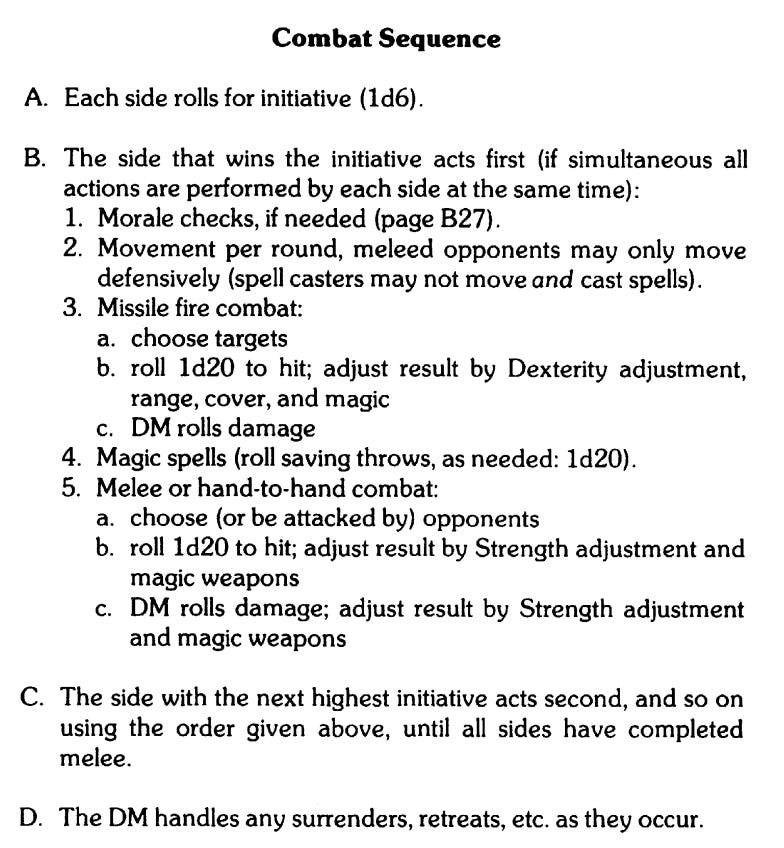
This is commonly referred to as side-based initiative (which is quite popular and works well), but what I don’t often see talked about is that we use phase-based order for an entire side. ALL of the PCs move before ANY of them shoot or attack.
For instance
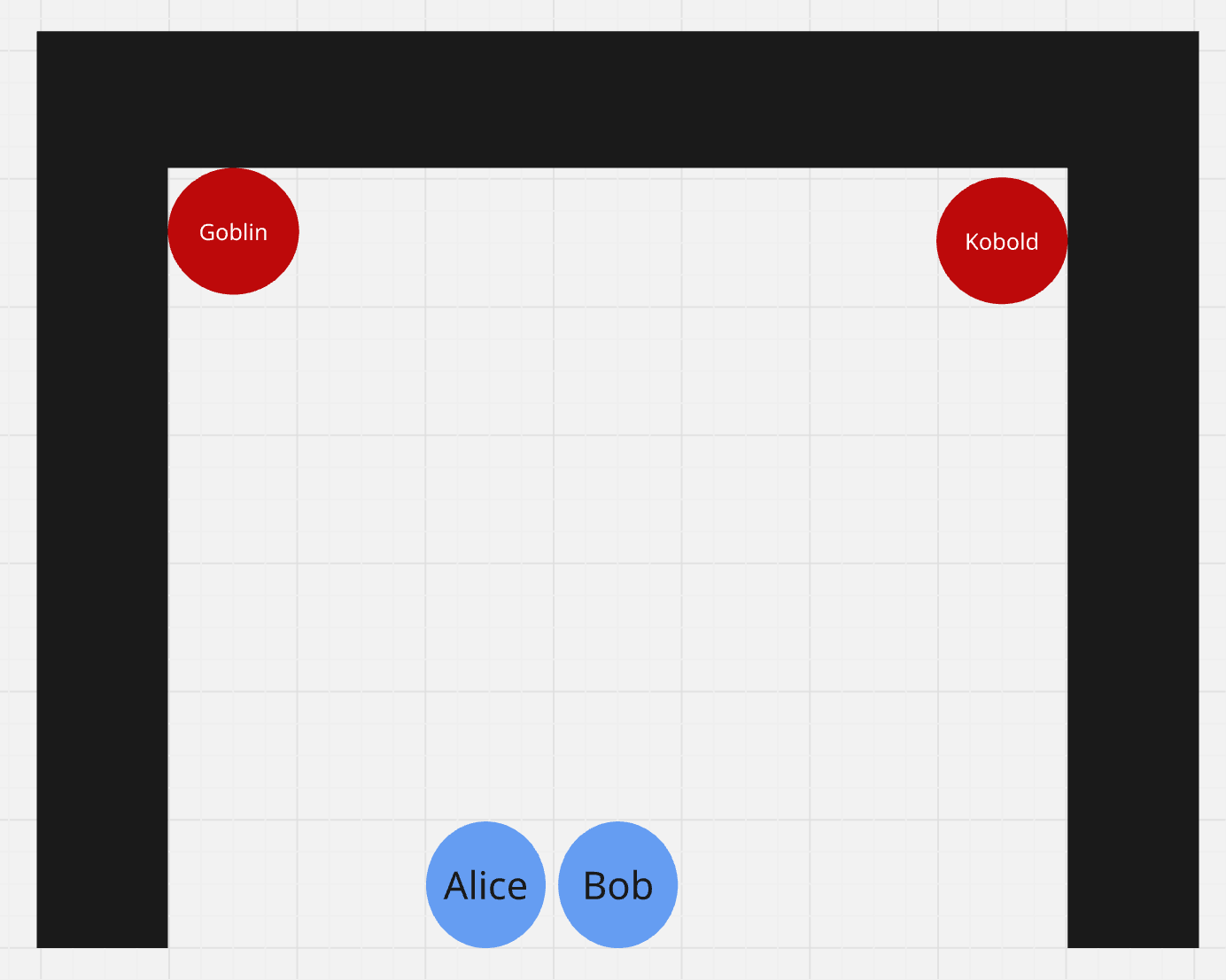
Here, Alice and Bob must commit to either splitting up or attacking the same target. Similarly, they can’t wait until after their allies with ranged weapons attack before they move in.
Then it’s missiles before spells before melee. Given this is the case, the archers have to commit to attacking a target before the fireball goes off, whereas the melee combatants can wait to pick a target until after they see which enemies made their save (or didn’t). The same goes for buff spells - the archers cannot wait to shoot until they’ve been blessed.
On the upside for melee combatants, this allows them to both move into flanking positions before either attack.
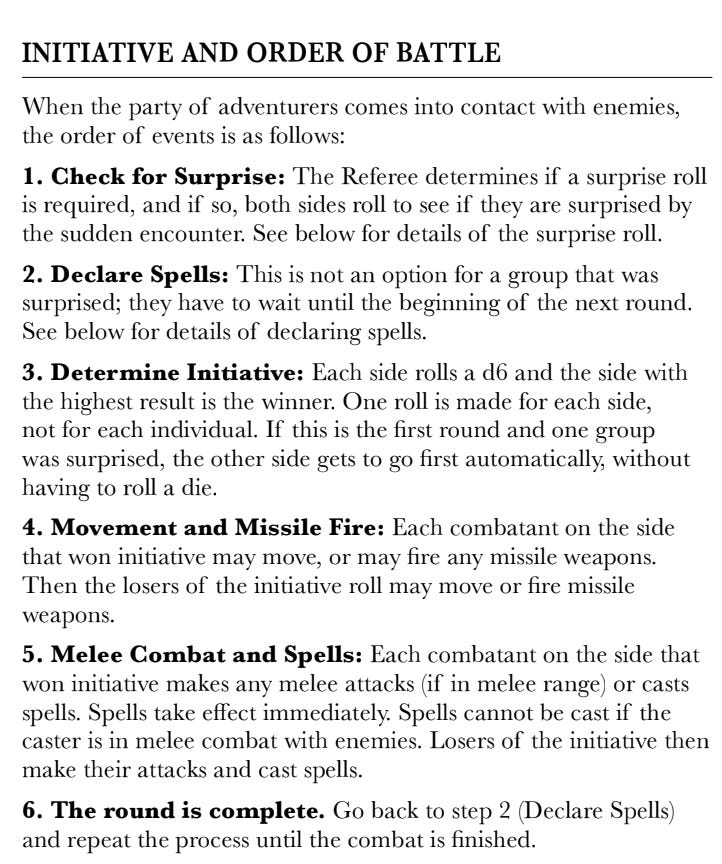
So winner missile+movement > loser missile+movement > winner melee+spell > loser melee+spell.
I think this introduces needless ambiguity. Can Alice wait to move to engage the goblin until after Bob has already shot it? Can Alice shoot and then afterward duck behind cover? Who knows! The GM is in charge of the design! Surely this won’t come up over and over and have a pretty big impact on the feel of combat!
This is also, relative to BX, a pretty big buff to ranged weapons. In BX, if you won initiative, your spell could not be interrupted. Here, the losing-side’s archers are always able to fire before the winning-side’s spells and melee occur.
Cover
Most of these games define cover like:
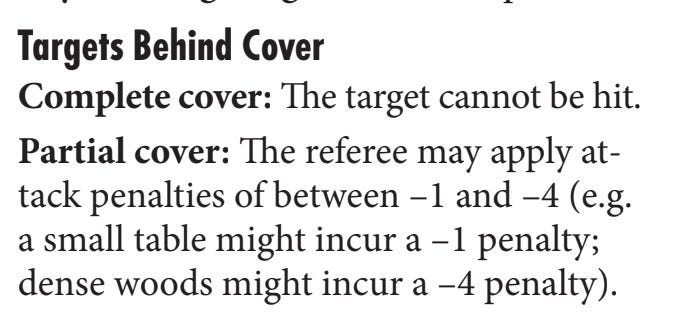

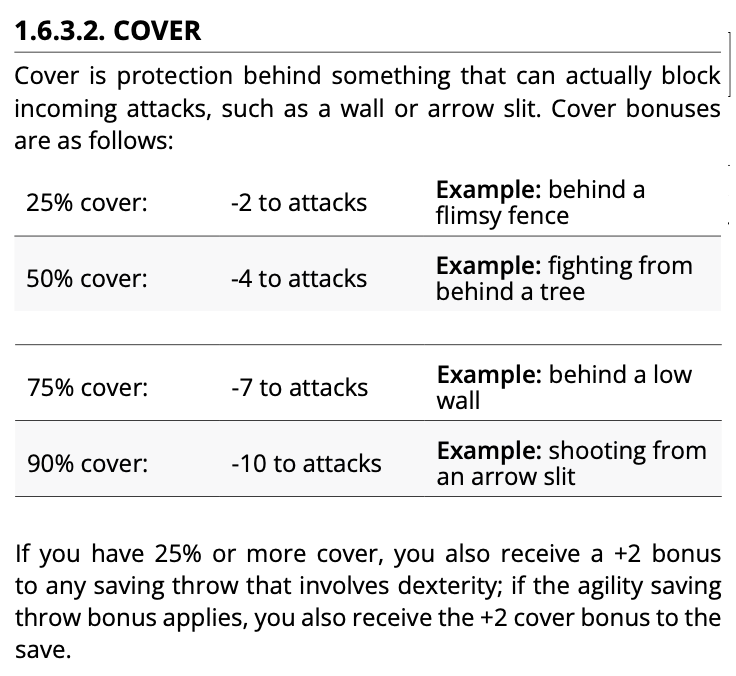
I think most of these descriptions are overly gm-fiat, and tend to be concerned with horizontal cover (like a flipped over table). In my experience, the main form of cover is corners.
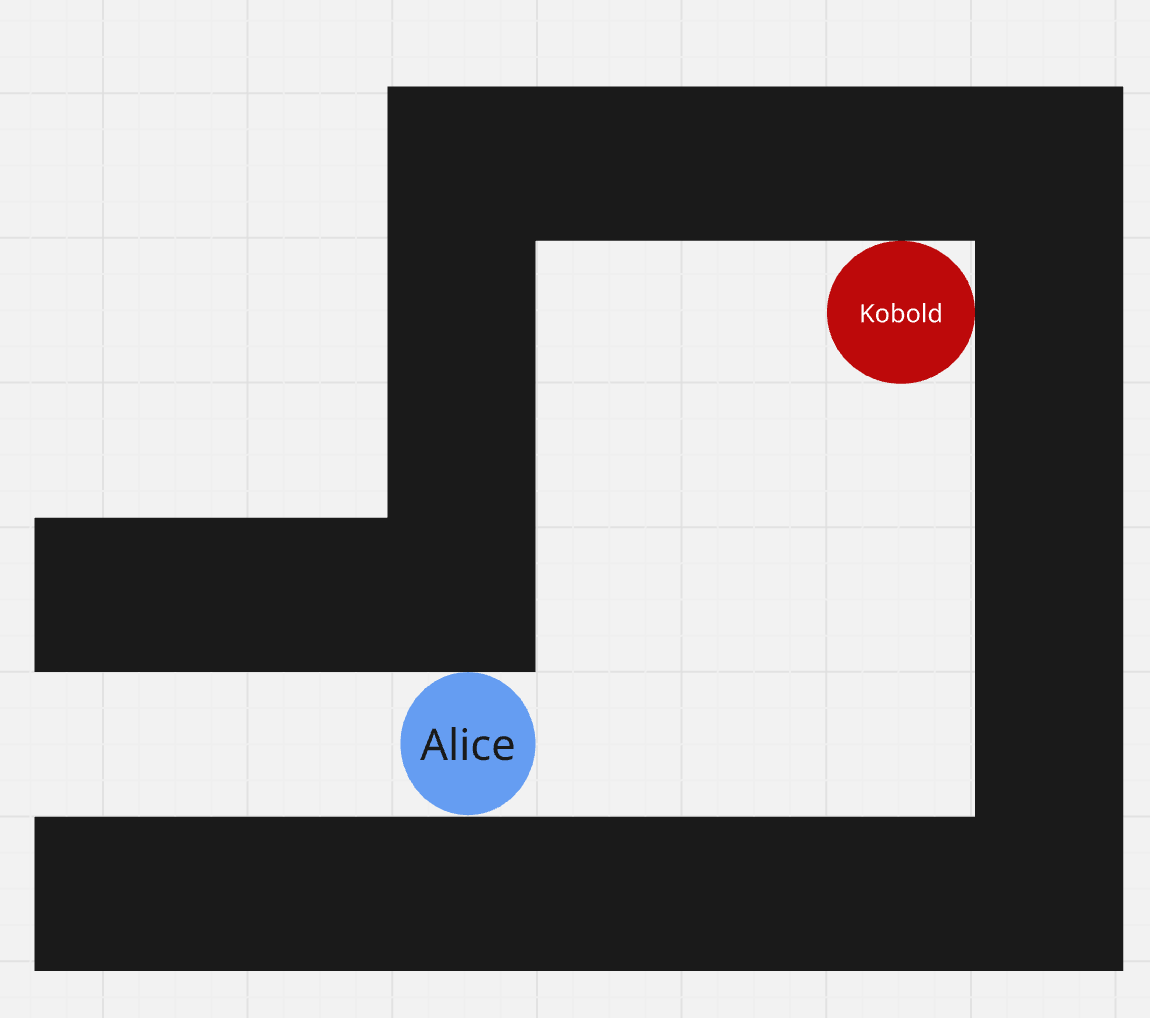
Dungeons have corners everywhere, so it’s always bizarre to me when the rulesets handle them ambiguously. Meanwhile, here’s 3.5e
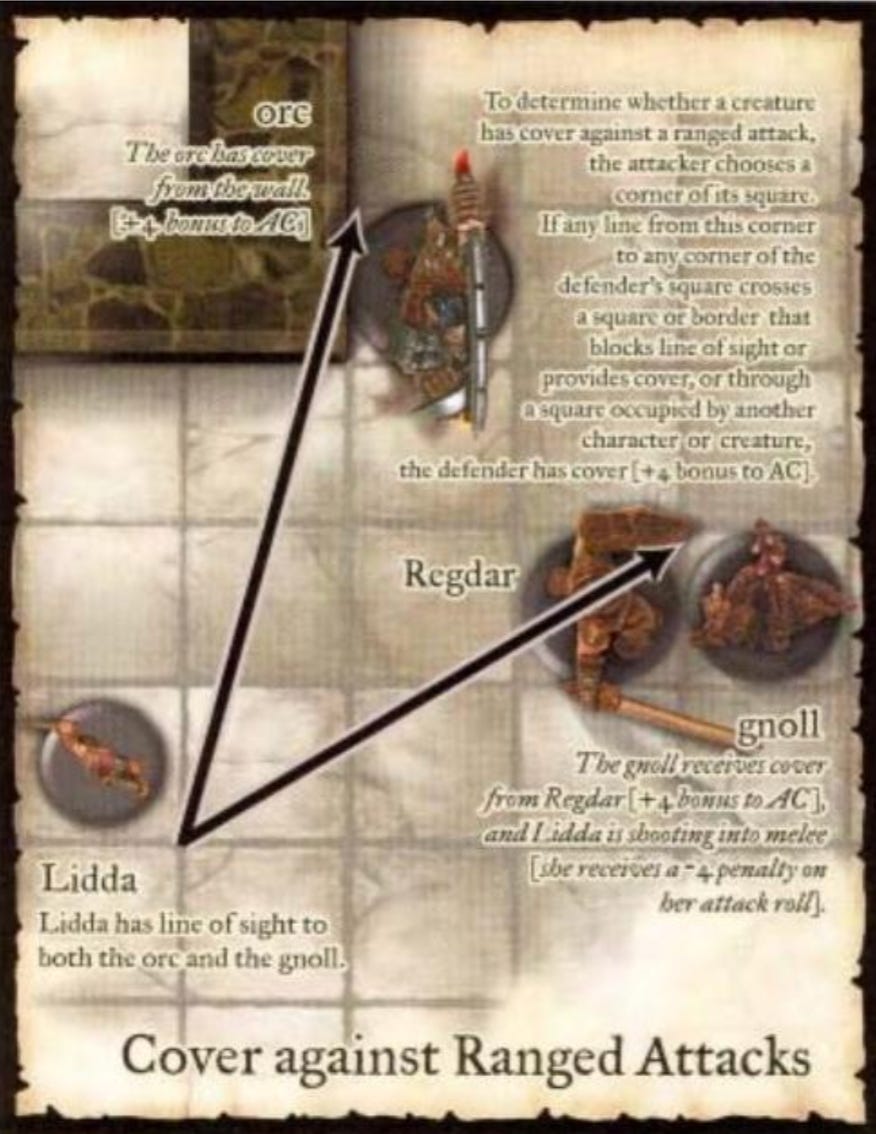
I think this definition works wonderfully, my only gripe is that it operates in two dimensions instead of three dimensions.
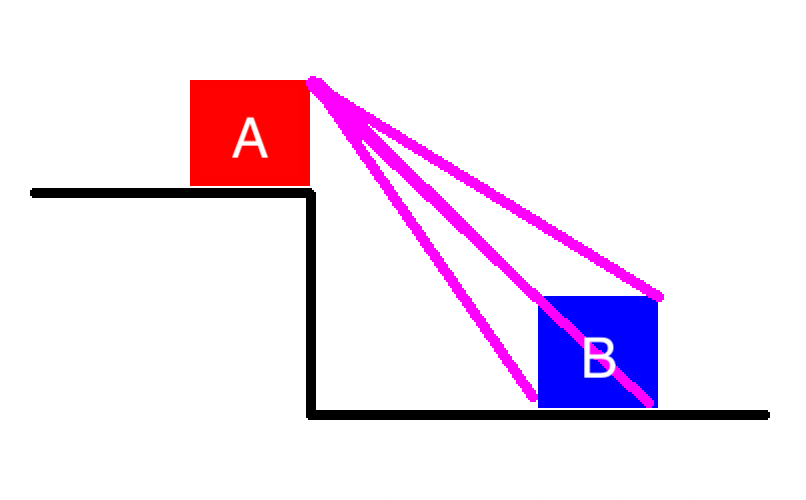
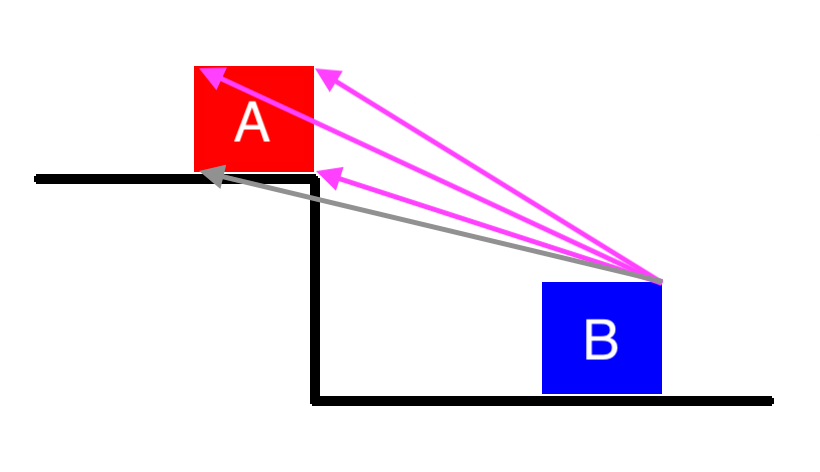
Here, B is fully exposed to A while A has cover from B. High ground is advantageous!
My suggestion is to simplify cover into a binary - you either have it or you don’t (like 3.5e does). If you really want to maintain the 1e-style of 25%/50%/75%/90% cover, then you can count corners of the cube.
If no lines are blocked, they don’t have cover.
If 1-3 lines are blocked, they have 25% cover.
If 4-5 lines are blocked, they have 50% cover.
If 6-7 lines are blocked, they have 75% cover.
If all lines are blocked, but you can still see them (like through an arrow slit), that’s 90% cover.
+Hit and Armor Class
Imagine an Orc with 1d8 HP and 6 AC and a PC Fighter that attacks with a THAC0 of 19 for 1d6 damage.
We can model how many attacks it will take for the Fighter to defeat this Orc via a recurrence relation.
At 6 AC, the Fighter hits on a 13+, which is 40%. Define E[h] to be the expected number of attacks to defeat an Orc with h HP.
E[0] = 0 since the orc is already dead.
E[1] = 2.5 + 1/6 * (E[0] + E[0] + E[0] + E[0] + E[0] + E[0]) = 2.5
E[2] = 2.5 + 1/6 * (E[1] + E[0] + E[0] + E[0] + E[0] + E[0]) = 2.92
E[3] = 2.5 + 1/6 * (E[2] + E[1] + E[0] + E[0] + E[0] + E[0]) = 3.4
E[4] = 2.5 + 1/6 * (E[3] + E[2] + E[1] + E[0] + E[0] + E[0]) = 3.97
E[5] = 2.5 + 1/6 * (E[4] + E[3] + E[2] + E[1] + E[0] + E[0]) = 4.63
E[6] = 2.5 + 1/6 * (E[5] + E[4] + E[3] + E[2] + E[1] + E[0]) = 5.4
E[7] = 2.5 + 1/6 * (E[6] + E[5] + E[4] + E[3] + E[2] + E[1]) = 6.3
E[8] = 2.5 + 1/6 * (E[7] + E[6] + E[5] + E[4] + E[3] + E[2]) = 6.94
Then, we take the average of E[1] to E[8] and get 4.5, so that’s how many attacks it takes to defeat the Orc on average.
Then, we can code this up and start creating some charts to demonstrate how weird the AC curve is:
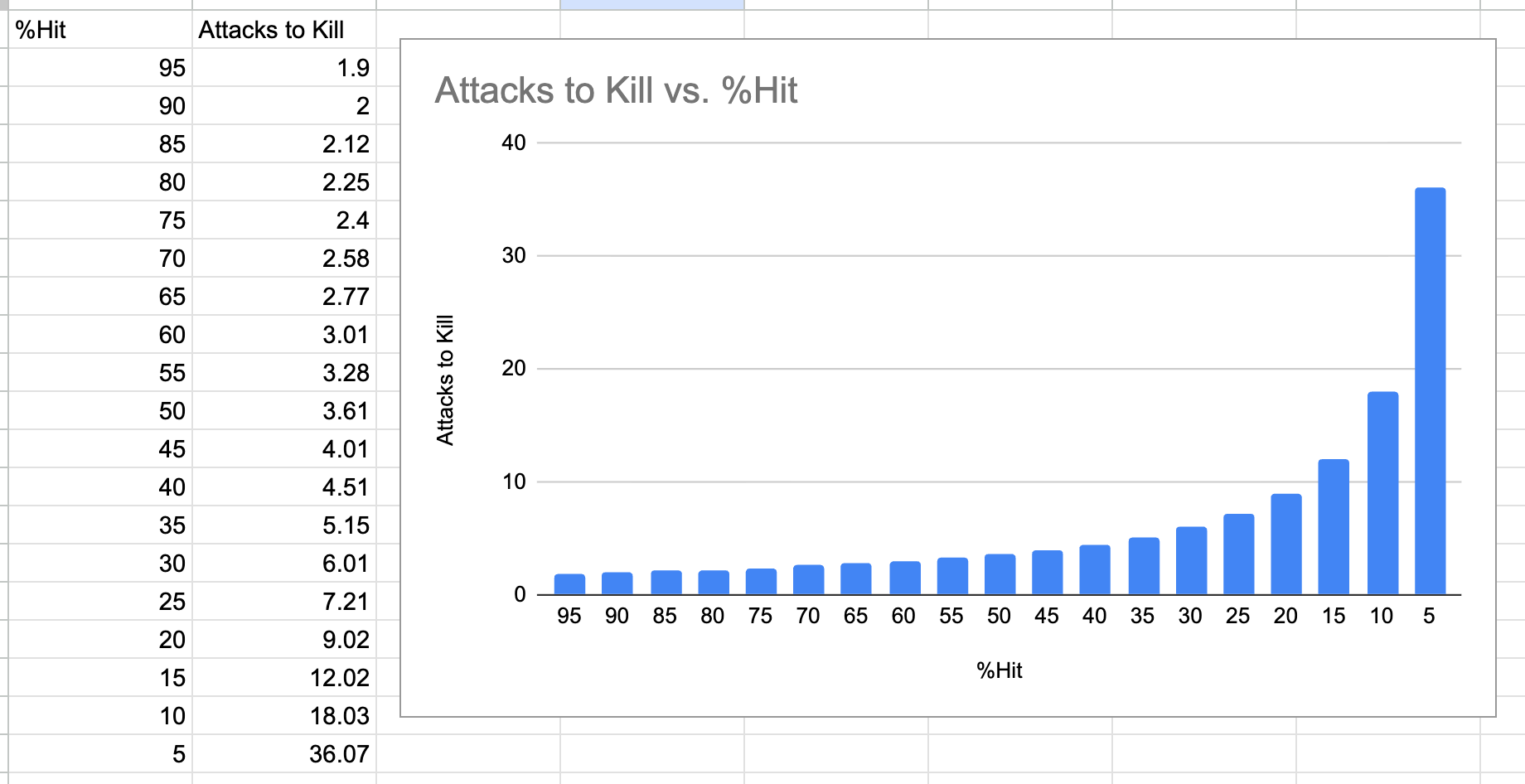
The difference between a 95% chance to hit and a 80% chance to hit is hard to notice. The difference between a 20% chance to hit and a 5% chance to hit is gargantuan.
PCs tend to have a lot more control over their own AC than their +hit. The main sources are:
Wearing Plate and Shield
Magic Items
Dexterity Modifiers
Games that include a “defend” action.
Take BX as an example. If you have +2 DEX, and are wearing +1 plate and have a +1 shield, you have an AC of -2. This means you’ll tend to only get hit on nat 20’s by 2 HD creatures and below, so if you have 2d8+2 HP (fighter with a +1 con), you’re living for… ~72 attacks.
If you can take a defend action for another, say, +2 AC, this gives an Ogre a 10% chance to hit you for for 1d10, and you’ll live for… ~25 rounds.
This highly encourages spear-walls. You stick 2-3 heavily armored characters in the front (ideally clerics that can heal themselves) with high DEX and CON but do pitiful damage. Then, in the second rank you have high-STR characters with polearms or spears that can reach over the front line. It’s absurdly effective.
Does this sound like it’s working as intended?
Yet
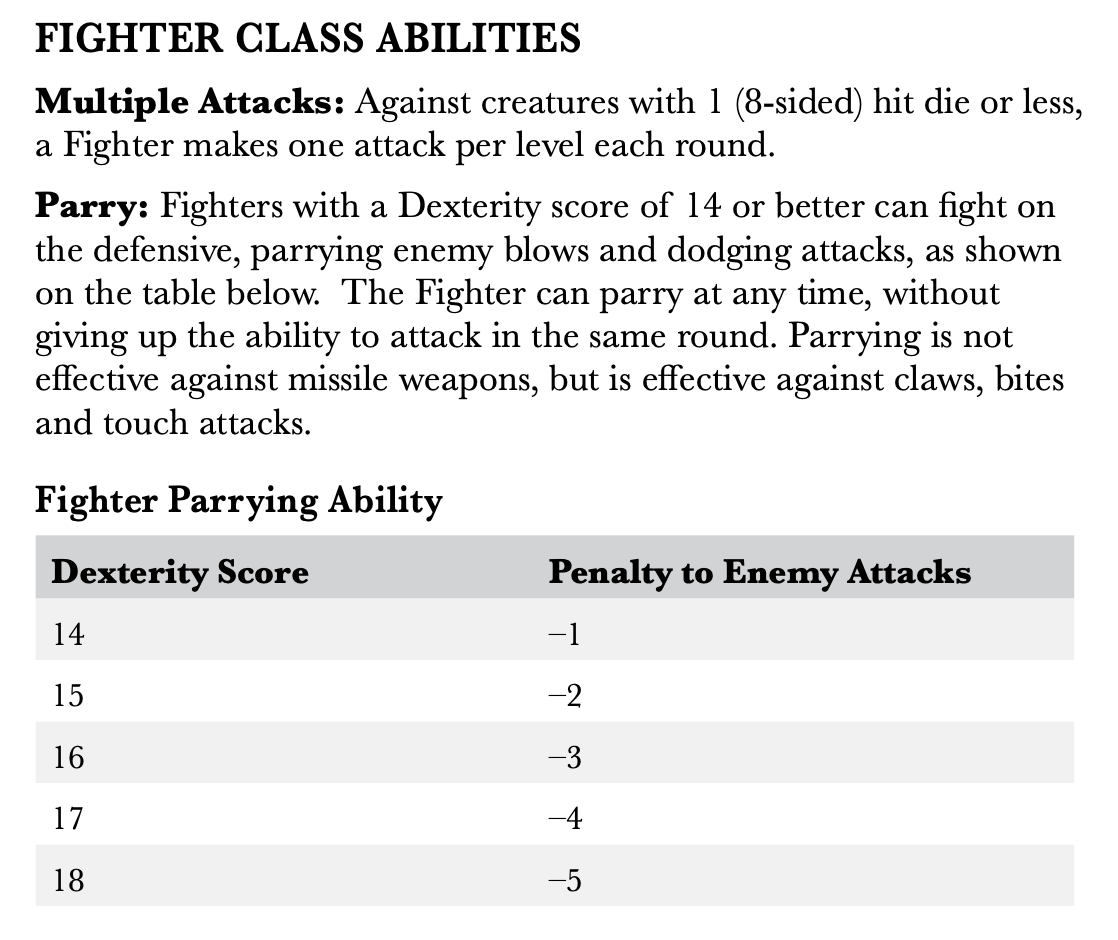
So an 18 DEX nets a S&W fighter +1 AC on top of letting them Parry (for free) for an additional 5, which in +1 plate and +1 shield puts them at -5 AC. 🙃🙃🙃
My experience has been that these games’ math tend to work (be exciting, create HP attrition, resolve in a reasonable number of rounds) with the default values, but fall apart when modifiers get involved (DEX bonuses, magic bonuses, etc), so we want to stay in the default values.
I highly recommend doing away with DEX bonuses to AC and making magic armor do something else besides give more and more AC. If you want to make magic armor give the wearer more tankiness, give them a multiplier on HP (good for fighters) or a flat amount of temp HP (good for thieves/magic-users).
This also helps us evaluate “what to hold”. Frequently these games ask if we want to wear:
Sword + Shield
Two-handed Sword
Dual Wield
The rough idea is that the higher your AC is, the more attractive the shield is. If you can go from getting hit on a 18 without a shield to a 19 with a shield, that’s massive.
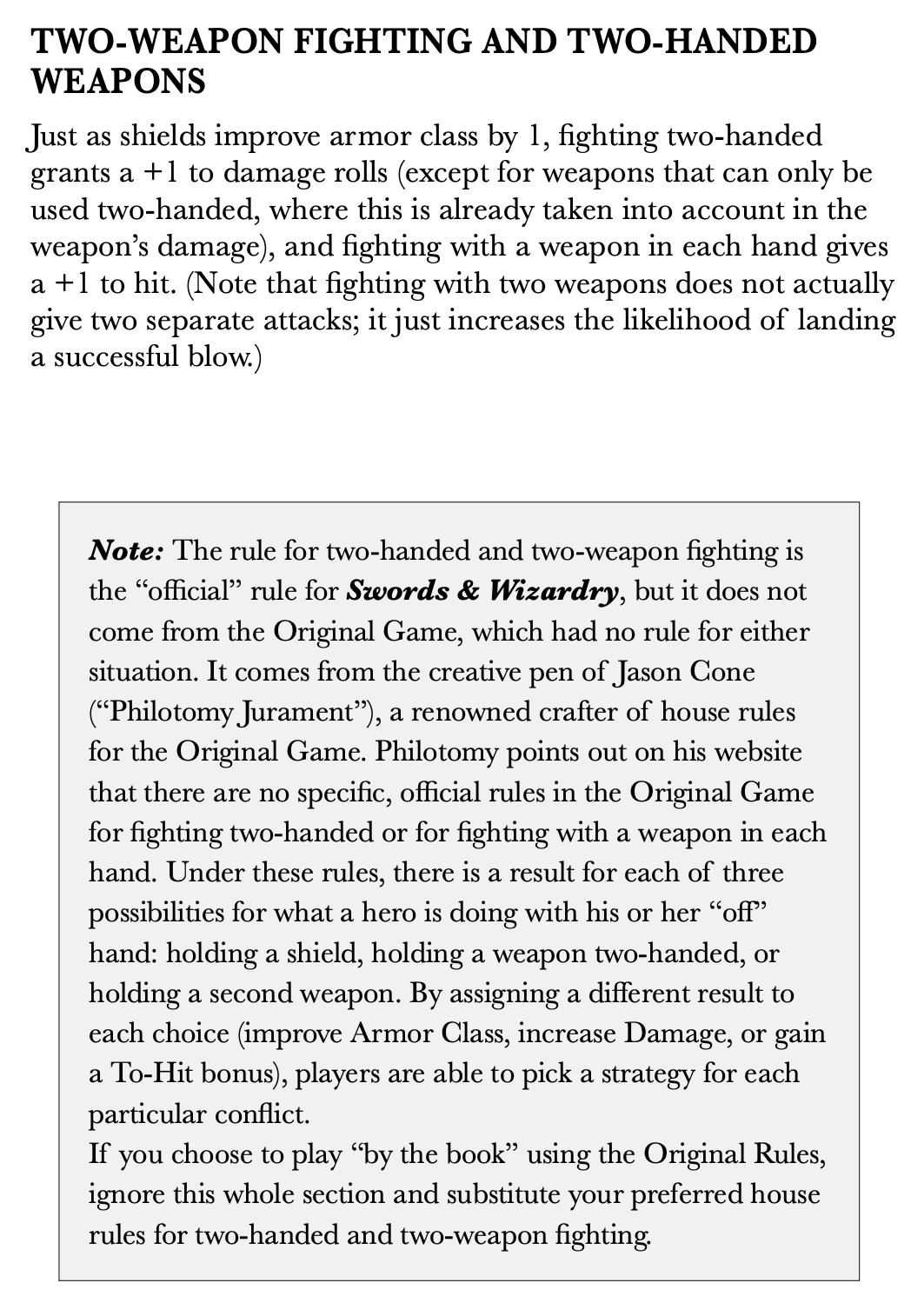
So under what contexts ought you to two-hand a weapon vs wielding two weapons?
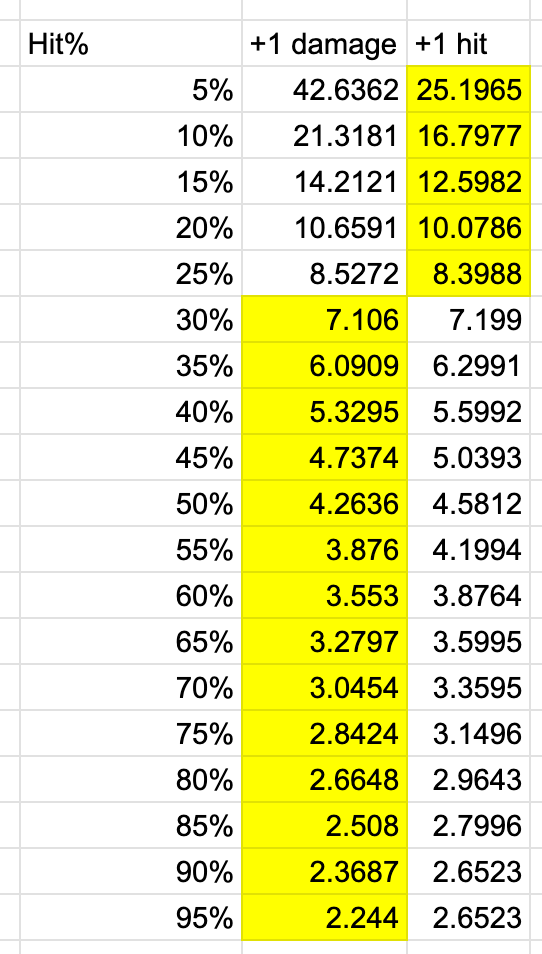
Unless your original accuracy was lower than 30%, it’s better to have +1 damage vs +1 to hit. This is also why the Fighter’s predominant offensive growth being in terms of accuracy instead of damage is so punishing. They need to scale their damage somehow: more attacks, a damage modifier, etc.
Great stuff, I've delved deep into this kind of thing for my own game and just love discussing these.
I had thought about parallel to one of the themes of this article, that theme being, if a game doesn't provide a definition, the GM has to bring one instead. If a game doesn't have a definition for what "In Melee" is, the GM has to bring one.
My thought wasn't related to "In Melee" it was the way that a lot of older and even a lot of fairly recent games fail to provide systems for character roleplay outside of combat. They don't define conversations, or scenes, or interludes, or moments where a couple of player characters can talk about how they feel or what they want. So, the players and GM's have to bring that with them.
Some tables do this really well, others do it incredibly poorly. Even games like Dolmenwood just kind of gesture to these moments, with things like herb, beer, and food descriptions. The parts are there if a group wants to pick them up, but there's never any attempt to bring that into the game loop.
This may be intentional. My group for instance only has 2 hours to play every week or two. We don't have time to smell the roses and perform the narrative equivalent of masturbation every session. But I kind of wish more games had definitions for these things, and ways to bring them about as part of the gameplay loop without going full story game.